Incident Management
Stop fighting fires.
Start controlling them.
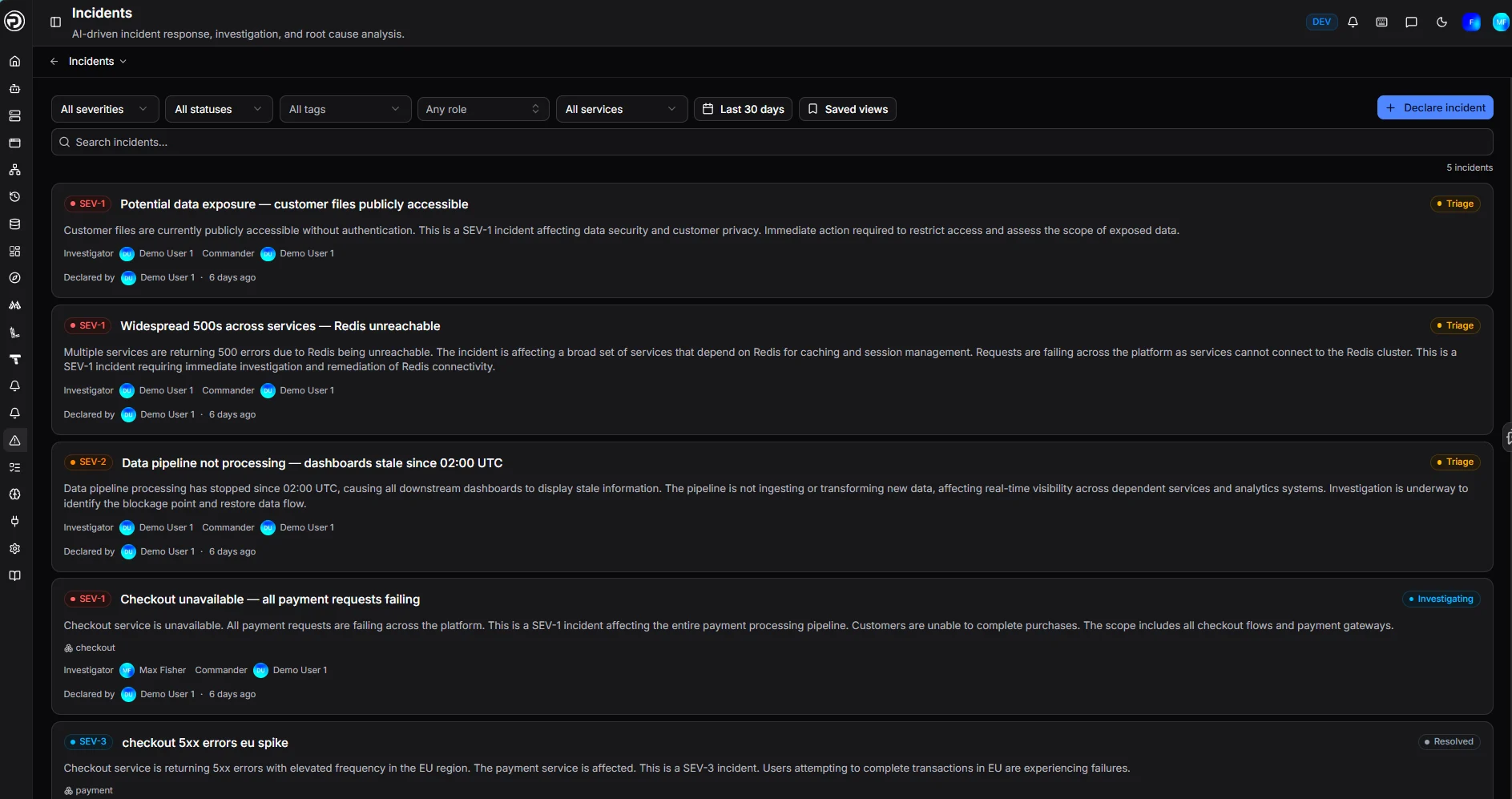
Re-engineered incident response — with a standardized lifecycle, precision alerting, and built-in accountability from triage to post-mortem.
4
Severity levels — SEV-1 to SEV-4
1
Unified workspace per incident
0
Action items lost after resolution
Live
Real-time timeline tracking
Severity System
One shared language
for every incident.
Ambiguous severity wastes minutes you don't have. OpsPilot standardizes on a clean four-tier model so every engineer on your team responds with the same urgency — automatically.
SEV-1
Critical outage. Full business impact. All hands on deck.
SEV-2
Major degradation. Key functionality impaired. Immediate response required.
SEV-3
Partial impact. Non-critical systems affected. Monitored response.
SEV-4
Minor issue. Low user impact. Scheduled investigation.
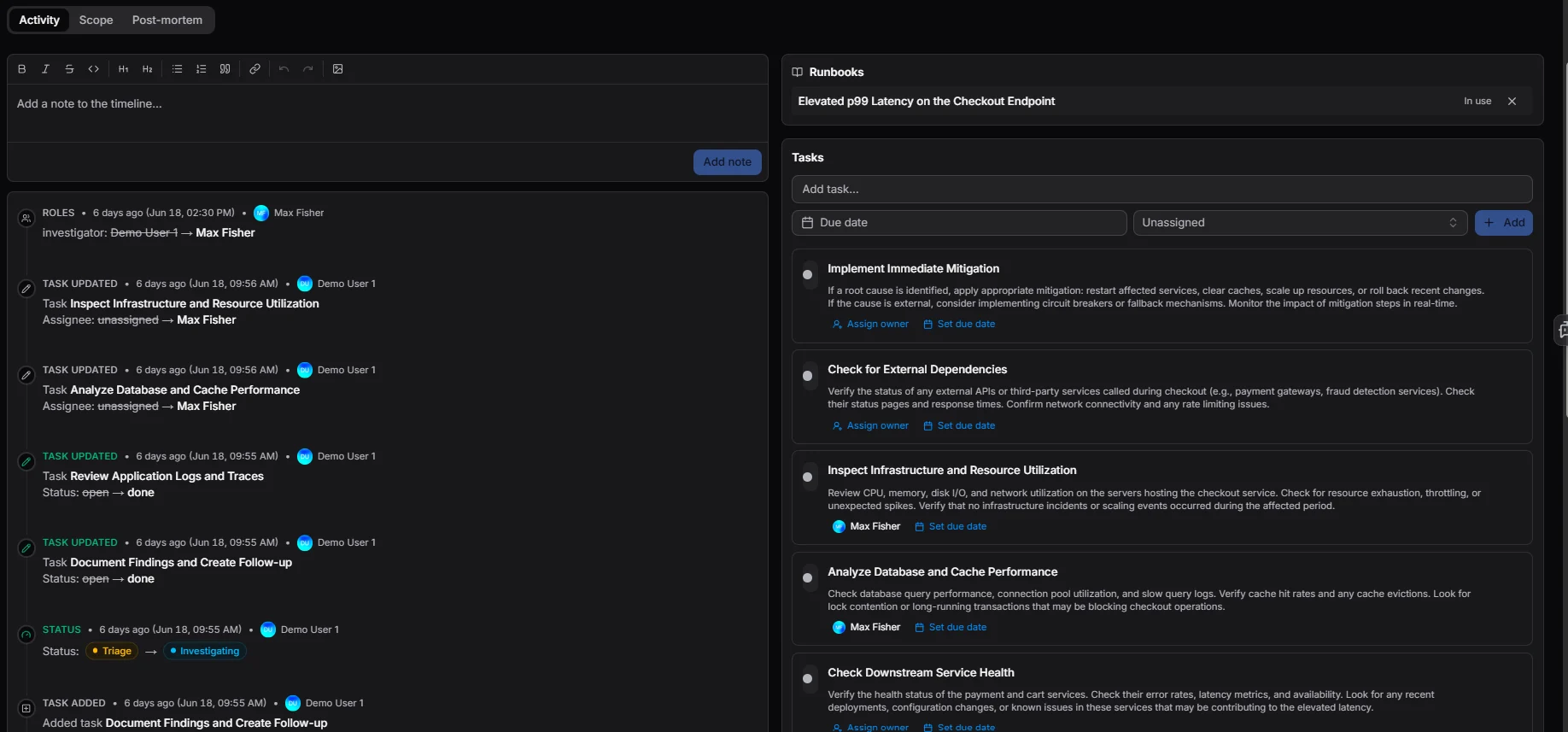
Live Activity Timeline
Everything that happened.
In order. In real time.
State changes, internal communications, and automated alerts flow into a single timeline — so anyone joining mid-incident gets up to speed in seconds, not minutes.
No more piecing together Slack threads and runbook comments. The incident record is the truth.
- Real-time state change tracking
- Internal comms logged alongside automated alerts
- Immutable audit trail for post-incident review
- Instantly visible to all incident participants
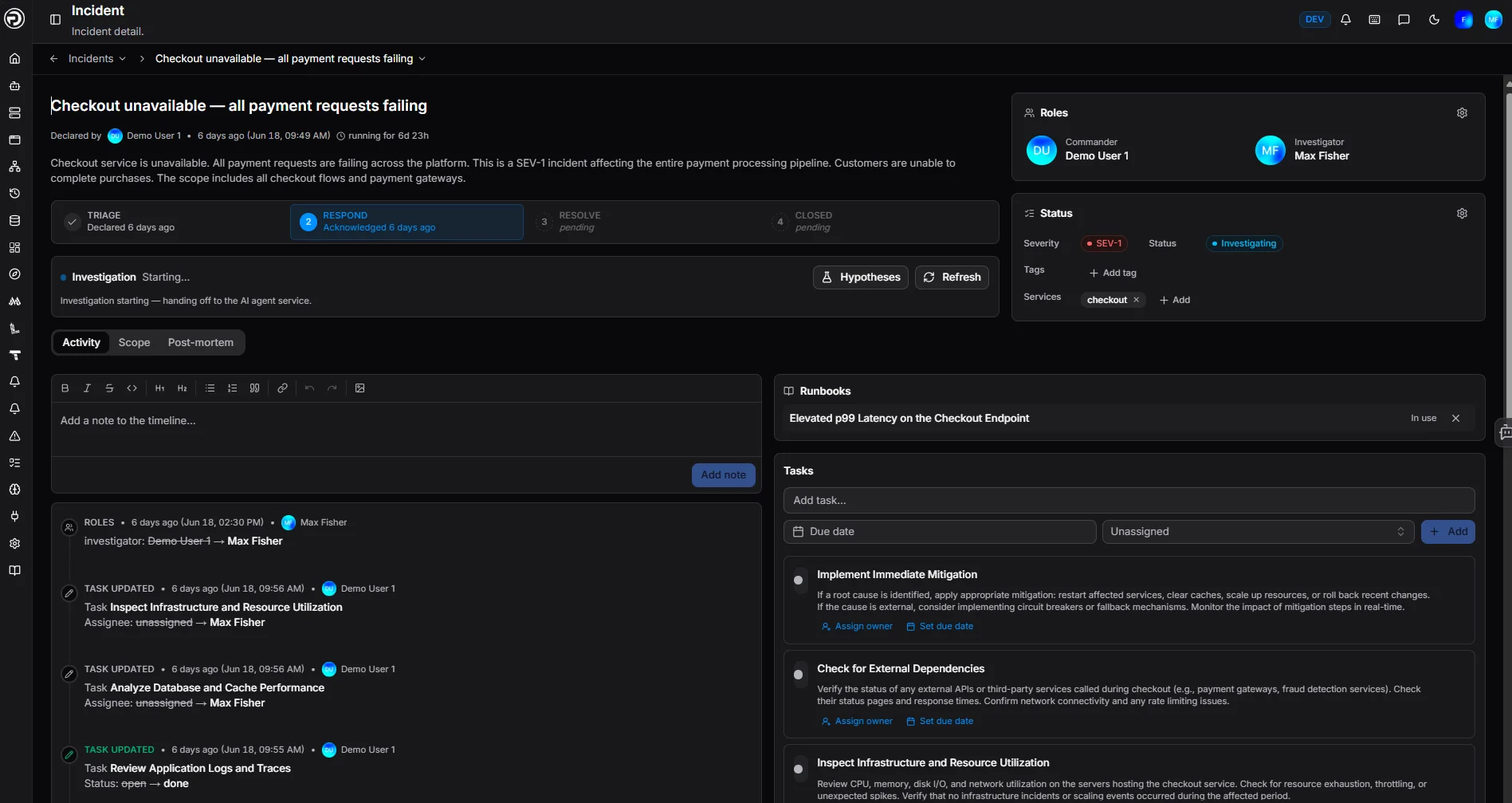
Contextual Sidebar
Everything you need.
Right where you are.
Active runbooks, linked services, SLA budgets, and ownership — consolidated in a persistent sidebar so your team never loses context during a high-pressure event.
No tab switching. No lost context. Everything visible, right now.
- Active runbooks with live step progress
- Linked services pulled from your Service Catalog
- Real-time SLA budget with breach warnings
- Incident ownership always in view
What's Included
Built for the full
incident lifecycle.
Post-Mortem Gatekeeper
Built-in post-mortem editors ensure remediation work is tracked and completed long after the incident closes — not abandoned in a doc nobody opens.

Tasks & Action Items
Every follow-up item, runbook action, and maintenance task lives on a unified board — connected to the incident that created it, so nothing falls through the cracks.

Precision Notifications
Get alerted the moment SLA budget approaches breach, an upstream dependency impacts your service, or a critical task drops onto your plate — never sooner, never later.
Service Catalog Integration
Every incident is automatically contextualized with ownership, service tiers, and dependencies from your catalog — giving Coworker AI the baseline it needs to triage faster.
Unified Workspace
Timeline, sidebar, runbooks, and communications — one screen, zero context switching. Designed for the speed and pressure of a live production incident.
Coming soon
Coworker AI — Autonomous Response
Coworker won't just provide context — it will step in. Proactively spin up incidents, assign tasks, page the right owners, and execute remediation steps autonomously.
Get Started
Faster response starts
today.
All Incidents features are live and rolled out to every OpsPilot workspace. No migration, no agents to swap out.
No form. No sales call required to start.
FAQ
Frequently asked questions
Everything you need to know about OpsPilot incident management — from severity levels to AI-powered autonomous response.
-
OpsPilot incident management is a centralized, high-velocity response environment built into the OpsPilot AI observability platform. It provides a standardized lifecycle (Triage → Respond → Resolve → Closed), a four-tier severity system (SEV-1 through SEV-4), a live activity timeline, a contextual sidebar with active runbooks and SLA budgets, and a post-mortem gatekeeper — all in a single unified workspace.
-
OpsPilot uses four severity levels. SEV-1 is a critical outage with full business impact requiring an all-hands response. SEV-2 is major degradation with key functionality impaired, requiring immediate action. SEV-3 is partial impact affecting non-critical systems, handled with a monitored response. SEV-4 is a minor issue with low user impact, scheduled for investigation. This standardized model ensures every engineer responds with the same urgency — automatically.
-
The live activity timeline tracks every state change, internal communication, and automated alert in real time within a single incident workspace. It creates an immutable audit trail so any engineer joining mid-incident can get up to speed immediately. Entries are logged automatically by the OpsPilot alerting engine and Coworker AI, alongside manual updates from the incident team.
-
The contextual sidebar displays active runbooks with live step progress, linked services from the Service Catalog, real-time SLA budget with breach warnings, and incident ownership — all without leaving the incident workspace. It is designed to eliminate tab switching and context loss during high-pressure events.
-
The post-mortem gatekeeper prevents incidents from being closed without completing remediation accountability. When an incident moves to resolved, OpsPilot opens a post-mortem editor tied to the incident record — ensuring root cause documentation, follow-up actions, and SLA budget notes are tracked and completed, not abandoned after the immediate fire is out.
-
OpsPilot sends precision notifications at three key moments: when an SLA budget is approaching a breach threshold, when an upstream dependency impacts a service you own, and when a critical task is assigned to your plate. Notifications are delivered via Slack, Microsoft Teams, or wherever your team works — alerting you only when your attention is genuinely required.
-
Coworker is OpsPilot's AI SRE teammate. During incidents it investigates alerts, correlates metrics, logs, and traces, and surfaces root cause analysis directly in the incident workspace. Autonomous incident response is in development: Coworker will proactively spin up incidents, dynamically assign tasks, page the correct service owners, and autonomously execute remediation steps to stop outages before they escalate.
-
OpsPilot is an AI-powered observability and site reliability platform with full incident management built in — covering alerting, incident lifecycle, tasks, post-mortems, and SLA tracking. Teams using Datadog, Dynatrace, or New Relic who want to consolidate incident tooling with AI-driven investigation can replace standalone tools like PagerDuty as part of an OpsPilot adoption.
-
OpsPilot ingests telemetry via OpenTelemetry (OTLP), Prometheus remote_write, and the FusionReactor APM agent. It works alongside Grafana, Prometheus, Datadog, Dynatrace, and New Relic — no rip-and-replace required. Incident context is automatically enriched with the metrics, logs, and traces already flowing into OpsPilot.
-
Yes. All Incidents features — including the live activity timeline, contextual sidebar, post-mortem gatekeeper, tasks board, and precision notifications — are live and rolled out to every OpsPilot workspace. No additional configuration or agent migration is required.
OpsPilot is the AI SRE teammate for teams using OpenTelemetry, Prometheus, Grafana, and existing observability stacks — helping engineers investigate incidents, find root cause, and move toward autonomous operations without replacing their tools. OpsPilot, formerly FusionReactor Cloud, is Intergral’s AI-powered observability and AI SRE platform.