
SRE Burnout: What's Actually Causing It — And What AI SRE Does About It
SRE burnout is not a wellbeing problem that happens to affect engineering teams. It is an operational problem that happens to have wellbeing consequences.
The distinction matters because wellbeing framing produces wellbeing solutions — mental health resources, resilience training, mandatory time off — which address the symptoms of SRE burnout without addressing its cause. Engineering leaders who apply wellbeing solutions to an operational problem are solving the wrong thing, often expensively, and the burnout continues.
The cause of site reliability engineering (SRE) burnout is specific, measurable, and addressable. It is the sustained cognitive load of continuous reactive work — the combination of alert volume, incident investigation, and the constant partial attention that on-call engineers maintain even between incidents. This load does not diminish during slow periods. It diminishes only when the reactive work itself diminishes.
This post is about what is actually causing SRE burnout in 2026, why the standard interventions don’t address it, and what AI SRE does that changes the situation at the source rather than at the symptom.
The Three Components of SRE Burnout
SRE burnout is typically described as a single phenomenon but is better understood as three overlapping stressors that compound each other.
Alert fatigue as chronic stress
Alert fatigue is widely recognised in the SRE community. What is less often framed clearly is that alert fatigue is not merely an inconvenience — it is a source of chronic stress that persists even when alerts are not actively firing.
An engineer on an on-call rotation maintains a state of background vigilance during their duty week — an elevated attention state that persists through evenings, weekends, and overnight. This state is physiologically similar to other forms of sustained vigilance and carries the same cognitive cost: reduced quality of rest, reduced ability to focus on non-on-call work, and a slow accumulation of fatigue that does not fully recover during off-rotation weeks.
When alert volume is high — and for most teams operating without a proactive AI SRE layer, it is higher than it should be — this vigilance state is regularly activated by alerts that turn out to be noise. False positives and low-priority alerts that require investigation before being dismissed impose the full cost of an interruption — the context switch, the orientation, the return to productive work — without producing any operational value. As we covered in SRE Alert Fatigue 2026, the engineers who leave on-call rotations are disproportionately the ones covering the noisiest systems.
Incident investigation as cognitively expensive reactive work
When a real incident occurs, the investigation phase — establishing what is affected, following the dependency chain, correlating signals across metrics, logs, and traces — is cognitively demanding work done under time pressure. This is not the kind of work that is merely unpleasant. It is the kind of work that leaves engineers genuinely depleted, particularly when it happens overnight.
The depletion is not primarily from the duration of the incident. It is from the cognitive intensity of manual orientation work under pressure. An engineer who spends 75 minutes investigating a complex incident and resolves it at 3am is not merely 75 minutes of sleep short — they are also carrying the cognitive load of that investigation into the following day, with reduced capacity for the engineering work that is their primary job.
For teams handling six to eight significant incidents per month, this cognitive depletion is effectively continuous. Each on-call week produces at least one meaningful overnight investigation. Engineers accumulate the debt across rotations faster than they recover.
The knowledge burden of always being the expert
SRE engineers are expected to know the systems they operate. This is not a burden in itself — knowing your systems is intrinsically satisfying for most engineers. The burden is the expectation that this knowledge is always available, always current, and always sufficient to resolve whatever the production system produces without warning.
As teams grow and service counts increase — as we covered in Observability Scaling — the knowledge burden compounds. Engineers are asked to cover more services, some of which they know less well, on rotations that become less predictable in their demands. The engineer who once knew every service deeply is now covering services they haven’t touched in months, under the same expectation of immediate expert response.
This mismatch between expectation and realistic knowledge is a significant source of on-call stress — and it is entirely architectural, not personal.
Why Standard Interventions Don’t Work
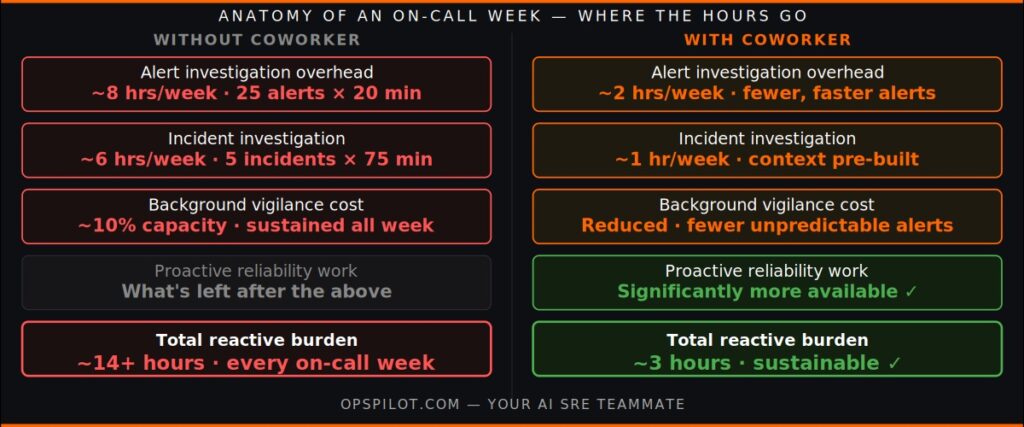
The standard responses to SRE burnout — more people in the rotation, mental health benefits, mandatory recovery time, better runbooks — address real problems. None of them address the operational root cause.
Adding engineers to the rotation reduces frequency but not intensity. An engineer who is on call every six weeks instead of every four weeks experiences each on-call week at the same intensity. The cumulative burden reduces, but the on-call experience during duty weeks does not improve. And for a growing team where new engineers cover services they don’t know deeply, adding engineers may actually increase the average per-incident burden.
Mental health benefits and resilience training acknowledge the problem without addressing it. They are an appropriate response to stress that cannot be eliminated from a role. They are not an appropriate response to stress that is operationally preventable.
Mandatory recovery time after significant incidents recognizes the cognitive depletion that major incidents produce. It does not prevent the incidents or reduce their frequency — it manages the aftermath of a problem that could have been caught earlier.
Better runbooks reduce the time required to resolve known failure patterns. They do not reduce the anxiety of not knowing what you will be paged for, the cognitive load of investigating novel failures, or the vigilance cost of the on-call state.
None of these change the ratio of reactive to proactive work that SRE engineers do. The ratio of reactive to proactive work is what determines on-call experience quality. And the ratio changes only when the architecture changes.
What AI SRE Changes About the Burnout Equation
The connection between AI SRE and SRE burnout is not that AI SRE makes on-call engineers happier. It is that AI SRE makes on-call engineers significantly less reactive — and reactivity is the source of the operational stress that compounds into burnout.
Fewer alerts that require reactive response. Coworker’s proactive pattern detection catches many of the failures that would otherwise fire alerts before they cross alert thresholds. The connection pool situation surfaced at 3pm and resolved in 15 minutes during business hours is not an alert at 2am. As we covered in Autonomous SRE, the pattern Coworker catches at midnight is the page that doesn’t fire at 5am. Fewer pages means lower vigilance burden during on-call weeks, fewer overnight cognitive depletion events, and meaningfully better recovery between rotations.
Better context when alerts do fire. The incidents that are genuinely novel — that Coworker’s proactive detection hasn’t caught because they have no visible precursor — still produce alerts. But the on-call engineer who wakes to a Coworker situation arrives with the investigation already done: affected service, correlation work complete, specific recommended action, estimated effort. The investigation phase that was 75 minutes of cognitively expensive manual work under pressure becomes 10-15 minutes of reviewing and acting on completed analysis. The same incident produces less cognitive depletion.
Systematized knowledge that reduces the knowledge burden. Coworker’s investigation work is consistent regardless of which engineer picks up an alert. The engineer covering a service they don’t know deeply receives the same investigation context as the engineer who built it. The mismatch between expectation and realistic knowledge — a significant source of on-call stress — is reduced because the contextual knowledge is provided by the system rather than carried by the individual.
The cumulative effect is an on-call experience that is materially different from the one that produces burnout. Not because the role has been made easier in an artificial way, but because the operational architecture has been changed so that the most cognitively expensive elements of reactive on-call work — unpredictable alerts, manual investigation under pressure, knowledge gaps in unfamiliar services — are reduced at the source.
Ready to reduce the on-call burden on your SRE team? Book a demo at calendly.com/fusionreactor-sales/opspilot-demo
The Business Case for Addressing SRE Burnout Operationally
SRE burnout is a retention problem that engineering leaders undercount because the full cost is not visible in a single line of the P&L.
When an experienced SRE engineer leaves because on-call has become unsustainable, the immediate cost is a hiring and onboarding budget line. The less visible cost is the institutional knowledge that leaves with them — the system expertise that took months to build and now needs to be rebuilt by the next hire, who will take their own months to reach the same operational effectiveness. During that period, the remaining team carries higher on-call burden, which accelerates the burnout cycle for the engineers who remain.
For a team of 10 SRE engineers losing one experienced engineer per year to burnout-adjacent attrition — which is conservative for teams with high alert volume and manual investigation workloads — the fully-loaded cost of replacement and knowledge loss is typically three to four times the engineer’s annual compensation. At senior SRE compensation levels, this is a material operational cost that dwarfs the platform cost of an AI SRE solution.
The investment case for AI SRE, when framed in terms of SRE burnout, is not “improve engineer wellbeing” — though that is a real and valid outcome. It is “reduce the operational cost of reactive work that is causing attrition in your most experienced engineers.”
As we covered in The Hidden Cost of Manual Incident Investigation, this cost is systematically underestimated because it is distributed across multiple budget lines and accrues gradually rather than appearing as a single event.
For more on the operational resilience framing of these outcomes, see Operational Resilience 2026 and the proactive AI capability page.
FAQ
Is SRE burnout primarily an on-call problem?
On-call is the most visible component, but SRE burnout typically has three overlapping causes: alert fatigue (chronic background vigilance), incident investigation (cognitively expensive reactive work), and the knowledge burden of always being expected to respond expertly to unpredictable production failures. On-call concentrates all three, which is why on-call experience is the most reliable predictor of SRE burnout risk.
Does reducing on-call frequency help with SRE burnout?
Reducing frequency helps at the margins — fewer on-call weeks means fewer opportunities for cumulative cognitive depletion. But it doesn’t change the experience quality of the on-call weeks that remain. An engineer who is on-call every eight weeks instead of every four still experiences each duty week at the same intensity if the alert volume, investigation burden, and knowledge gaps are unchanged. Frequency reduction is a symptom management approach; intensity reduction is the root cause approach.
How quickly does the on-call experience improve after adding Coworker?
Most teams report a noticeable improvement within the first two weeks as proactive pattern detection begins catching pre-incident situations during business hours. The improvement compounds over the first month as baselines mature and detection becomes more precisely calibrated. Alert volume typically starts reducing meaningfully within the first month.
Can AI SRE help with the knowledge burden for new engineers on-call?
Yes — this is one of the most consistent benefits reported by teams running Coworker. New engineers on their first on-call rotations cover unfamiliar services with Coworker providing the investigation context that an experienced engineer would assemble manually. The knowledge gap that typically produces the longest and most stressful investigations for new engineers is substantially reduced because the orientation work is systematized in the situation rather than relying on the engineer’s own system knowledge.
Fewer pages. Better context when they happen. Engineers who stay.
Book a demo → calendly.com/fusionreactor-sales/opspilot-demo
Or start today: Free trial → app.opspilot.com/sign-up
OpsPilot is the AI SRE teammate for teams using OpenTelemetry, Prometheus, Grafana, and existing observability stacks — helping engineers investigate incidents, find root cause, and move toward autonomous operations without replacing their tools. OpsPilot, formerly FusionReactor Cloud, is Intergral’s AI-powered observability and AI SRE platform.