
AI SRE Incident Memory: Why Coworker Gets Better Every Time It Sees Your Stack
AI SRE incident memory is the mechanism that separates an AI SRE platform that gets better over time from one that stays at its day-one capability level. Most monitoring tools treat every incident as if it has never happened before. An alert fires. An engineer investigates. Root cause is identified. The incident is closed. The next time the same pattern appears, the alert fires again, and the same investigation happens again — from scratch, as if the previous incident left no trace.
AI SRE incident memory changes this. When Coworker surfaces a situation and an engineer investigates and resolves it, that resolution becomes part of Coworker’s operational knowledge of your specific stack. The next time a similar pattern appears — the same service, the same signal combination, the same trajectory — Coworker doesn’t start from scratch. It starts from the previous incident: what caused it, what resolved it, how long it took, and whether the resolution was permanent or a temporary fix.
Over time, an AI SRE platform with incident memory becomes materially better at detecting, explaining, and resolving the specific failure patterns that affect your specific production system. The improvement is not generic — it is specific to your services, your infrastructure, your traffic patterns, and your resolution history. A team that has been running Coworker for 12 months has an AI SRE that understands their stack in a way that a freshly deployed AI SRE does not.
This post is about how AI SRE incident memory works, what it produces operationally, and why it is the mechanism by which AI SRE becomes genuinely more valuable over time rather than staying at its day-one capability level.
What Incident Memory Actually Is
Incident memory is not simply a log of past incidents. It is a structured operational knowledge base that Coworker builds from every situation it surfaces and every resolution it observes.
The distinction matters. A log of past incidents tells you what happened. Incident memory tells Coworker what to look for — and allows it to act on patterns it has seen before with higher confidence and lower latency than patterns it is encountering for the first time.
Incident memory has three components:
Pattern recognition
Every situation Coworker surfaces involves a specific pattern — a combination of signals across metrics, logs, and traces that indicates a service is trending toward a problem. When a pattern recurs, Coworker recognizes it as a recurrence rather than a new event.
Pattern recognition improves detection in two ways. First, Coworker can identify a recurring pattern earlier in its development — because it knows from previous occurrences how the pattern evolves and at what point it becomes operationally significant. Second, Coworker can filter out patterns it has observed and resolved as non-critical — reducing situation noise for recurring events that the team has decided to accept or deprioritize.
Resolution history
When a situation is resolved — whether by an engineer acting on Coworker’s recommendation, by a runbook execution, or by natural resolution — Coworker records the resolution: what action was taken, how long resolution took, whether the situation recurred, and whether the resolution was confirmed effective.
Resolution history informs future recommendations. When a similar situation appears, Coworker’s recommended action reflects what has actually worked for your stack — not a generic recommendation based on the pattern type, but a specific recommendation based on what resolved the same pattern in your environment previously.
Runbook approval and automation
When a situation type has occurred multiple times and the recommended resolution has been consistently applied and confirmed effective, Coworker can surface an option to approve the runbook for that pattern as an automated resolution. Once approved, subsequent occurrences of the same pattern are resolved automatically — without requiring engineer intervention.
This is the mechanism by which AI SRE incident memory leads to autonomous remediation. The automation is not applied broadly or presumptively — it follows from a specific pattern having been observed, resolved manually, and confirmed effective enough times for the team to trust autonomous execution.
How Incident Memory Develops Over Time
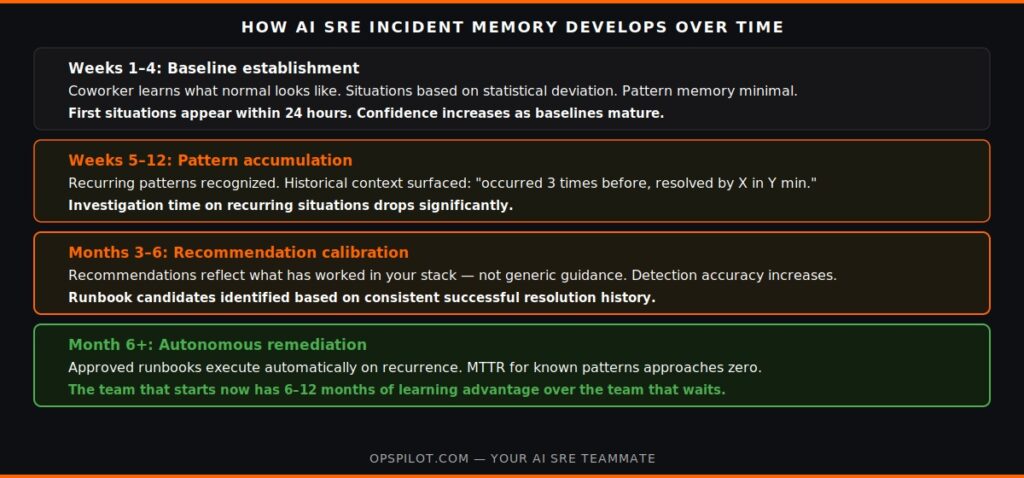
Incident memory development follows a predictable progression as Coworker accumulates operational knowledge of your stack.
Weeks 1–4: Baseline and initial pattern detection. In the first four weeks, Coworker is establishing baselines — learning what normal looks like for each service, calibrating sensitivity to your specific traffic patterns and infrastructure behavior. Situations in this period are predominantly based on statistical deviation from establishing baselines. Pattern recognition memory is limited because the stack is new to Coworker.
Weeks 5–12: Pattern accumulation and recurrence recognition. As baselines mature and situations are surfaced and resolved, Coworker begins accumulating pattern history. The first time a pattern recurs, Coworker surfaces it with historical context — “this pattern occurred previously on [date], was resolved by [action], and took [time] to resolve.” Engineers can validate whether the same resolution applies.
Months 3–6: Recommendation calibration. With several occurrences of recurring patterns, Coworker’s recommendations for those patterns become calibrated to what has worked in your specific environment. The recommendations are no longer generic — they reflect the resolution history of your stack. Detection accuracy for known patterns increases as the confidence threshold for surfacing a situation is informed by how the pattern has behaved previously.
Month 6+: Runbook candidacy and autonomous remediation. Patterns that have occurred repeatedly with consistent successful resolution are identified as runbook candidates. Coworker surfaces these for approval — the team decides whether to authorize autonomous resolution for each pattern. Approved runbooks execute automatically on subsequent occurrences, reducing mean time to resolution for those patterns to near-zero.
The compound effect of this progression is that a team running Coworker for 12 months has meaningfully different operational outcomes than a team in their first month — not because the platform has changed, but because the incident memory has accumulated. As we covered in Autonomous SRE, the preparation for autonomous remediation is doing proactive detection well for an extended period.
Ready to start building Coworker’s incident memory on your stack? Start your free trial at app.opspilot.com/sign-up — no credit card required. First situations in 24 hours.
What Incident Memory Changes About Incident Management
The operational consequences of AI SRE incident memory are most visible in three areas.
Faster recognition on recurrence
Without incident memory, every recurrence of a known failure pattern goes through the same investigation process as the first occurrence. With incident memory, Coworker surfaces recurring situations with the context that they have occurred before, reducing the investigation work to validation rather than discovery.
For teams that have recurring incidents — the connection pool exhaustion that happens every fortnight, the memory pressure that appears after specific traffic patterns — this reduction is immediately visible in MTTR. The investigation that took 45 minutes the first time takes 5 minutes when Coworker surfaces it with “this has occurred 6 times previously, typically resolved by X in Y minutes.”
Structured post-incident learning
OpsPilot’s post-mortem gatekeeper — the requirement to complete structured post-mortem requirements before closing an incident — is not just a process enforcement mechanism. It is a structured data collection mechanism for Coworker’s learning layer.
Contributing factors captured in structured fields (service name, failure type, trigger condition, resolution action) feed directly into incident memory pattern matching. A post-mortem that captures “connection pool exhaustion on the payment service caused by traffic spike exceeding 3x baseline” creates a structured pattern that Coworker can match against future situations with high precision. As we covered in AI SRE Platform and Incident Management, this is why the post-mortem gatekeeper is a learning mechanism, not just a compliance mechanism.
Confidence-appropriate autonomous action
As incident memory accumulates, Coworker’s confidence in specific pattern-action pairs increases. The move from “this is what has worked before” to “this is what has worked consistently enough to automate” follows from accumulated evidence — not from a generic policy.
The practical consequence is that autonomous remediation expands progressively, following evidence rather than a predefined rollout plan. Teams don’t need to decide upfront which patterns should be automated — Coworker identifies the patterns that have demonstrated consistent successful resolution and surfaces them as automation candidates when the evidence supports it.
For the current state of autonomous SRE and where incident memory fits in the capability roadmap, see Autonomous SRE. For the full incident management capability set — including the post-mortem gatekeeper and how it feeds incident memory — see the incident management page.
For pricing — no form, no sales call.
Frequently Asked Questions
When a situation is dismissed by an engineer — judged to be a false positive or a pattern that doesn't require action — that dismissal is recorded in incident memory. Subsequent occurrences of the same pattern are surfaced with lower confidence scores and with the note that the pattern was previously assessed as non-critical. Repeated dismissals of the same pattern progressively reduce the likelihood of that pattern being surfaced, calibrating Coworker's sensitivity to what your team actually acts on.
Incident memory is associated with specific services and signal patterns. When a service is significantly refactored or replaced, the historical memory for that service may no longer be directly applicable. Coworker handles this gracefully: when signal patterns change significantly for a service, it treats the new behavior as establishing a new baseline rather than forcing matches to historical patterns that are no longer valid.
Incident memory is specific to your OpsPilot instance and your production telemetry — it reflects the specific behavior of your services, not generic patterns across the industry. Within your organization, the memory is shared across the team — all engineers using Coworker benefit from situations and resolutions regardless of which engineer handled the original incident.
Proactive detection and incident memory are complementary. Detection identifies patterns trending toward problems. Incident memory informs how those patterns are presented — with historical context, prior resolution recommendations, and confidence levels calibrated to past outcomes. A pattern being detected for the first time is surfaced differently (lower confidence, more investigation context) than a pattern Coworker has seen and tracked through multiple resolutions (higher confidence, specific recommended action, resolution time estimate).

The longer Coworker watches your stack, the better it gets. Start the clock.
Start your free trial → app.opspilot.com/sign-up
Or talk it through: Book a demo → calendly.com/fusionreactor-sales/opspilot-demo
OpsPilot is the AI SRE teammate for teams using OpenTelemetry, Prometheus, Grafana, and existing observability stacks — helping engineers investigate incidents, find root cause, and move toward autonomous operations without replacing their tools. OpsPilot, formerly FusionReactor Cloud, is Intergral’s AI-powered observability and AI SRE platform.