
AI Site Reliability Engineering
Reduce observability cost.
Add AI-driven SRE action.
What is AI SRE? It's the shift from reactive dashboards to continuous investigation — your stack's data automatically monitored, correlated, and explained, with root cause and recommended fixes delivered to Slack, Microsoft Teams, or wherever your team works. At 60–70% lower cost than Datadog or Dynatrace.
The category defined
What is AI SRE? AI Site Reliability Engineering explained
What is AI SRE? AI Site Reliability Engineering uses artificial intelligence to automate the investigation, triage, and remediation of production incidents — freeing your engineering team from reactive firefighting so they can focus on reliability work that actually matters.
The traditional SRE model
Site Reliability Engineering was created to keep production systems running reliably. In practice, most SRE teams spend the majority of their time on reactive work — alert triage, dashboard checking, war rooms, and manual root cause investigation. It's skilled work, but it doesn't scale and it burns out great engineers.
What changes with AI
AI SRE applies machine learning and large language models to the same reliability problems — but continuously and at machine speed. Instead of an engineer checking dashboards at 2am, an AI SRE monitors your entire stack 24/7, correlates signals across services, identifies the true root cause, and delivers a prioritized recommendation before your pager fires.
The practical definition
AI SRE is not a tool category — it's an operational model. It's the shift from "my team investigates incidents" to "my AI SRE investigates continuously, and my team acts on recommendations." The outcome is faster resolution, lower incident frequency, and engineers focused on reliability instead of noise.
Why the category is growing now
Modern stacks generate more telemetry than any team can process. OpenTelemetry has standardized how that data is collected. Large language models can now reason over it meaningfully. These three forces converging are why Gartner is tracking AI SRE as one of the fastest-growing enterprise technology categories — with search volume up 376% year-over-year.
Clearing up the confusion
AI SRE vs. AIOps — what's the difference?
These terms are used interchangeably, but they represent different things. Gartner now treats them as distinct categories. The distinction matters when you're evaluating vendors.
AIOps
- Designed primarily for event correlation and noise reduction
- Filters and de-duplicates alert storms — does not investigate
- Does not explain what happened or what to do next
- Requires significant configuration and ongoing tuning
- Increasingly associated with legacy tooling built on older ML approaches
- Relevant for large-scale event management, but insufficient for modern SRE teams
AI SRE
- Combines observability, investigation, and remediation in one continuous loop
- Correlates metrics, logs, and traces simultaneously to find actual root cause
- Explains what happened, why it happened, and what to do about it — in plain English
- Delivers findings to Slack, Microsoft Teams, or wherever your team works
- Learns your baseline and detects patterns before they become incidents
- Designed to augment SRE teams — not replace dashboards with different dashboards
Understanding what is AI SRE — and how it differs from AIOps — is fundamental to choosing the right platform. OpsPilot is built as a true AI SRE platform, not an AIOps tool.
How it works
From your existing stack to AI-powered action
No migration. No rip-and-replace. Three steps and your AI SRE teammate is live.
Connect your existing stack
Point your OpenTelemetry pipeline at OpsPilot. If you're running Grafana, Prometheus, or any OTel-compatible source, you're connected in under five minutes. No new agents. No data migration. No disruption to what's already working.
AI analyzes continuously
Your AI Coworker starts watching immediately — correlating metrics, logs, and traces across all your services to learn your baseline and detect deviations before they surface as incidents.
Answers delivered where you work
Root cause, recommended fix, and a complete runbook appear in Slack, Microsoft Teams, or wherever your team works — before anyone opens a dashboard. Plain English. Actionable immediately.
Investigate proactively
OpsPilot doesn't wait for alerts to fire. It surfaces patterns that precede incidents — memory pressure, connection pool trends, degrading response times — giving your team time to act before users are affected.
Build operational memory
Every investigated incident adds to OpsPilot's understanding of your stack. Recurring issues are recognized faster. Recommendations improve over time. The AI gets better at knowing your systems as it learns them.
Move toward autonomous operations
As confidence in recommendations grows, teams move from AI-assisted investigation toward autonomous remediation — self-healing runbooks, approved automated fixes, and continuous reliability improvement without manual intervention.
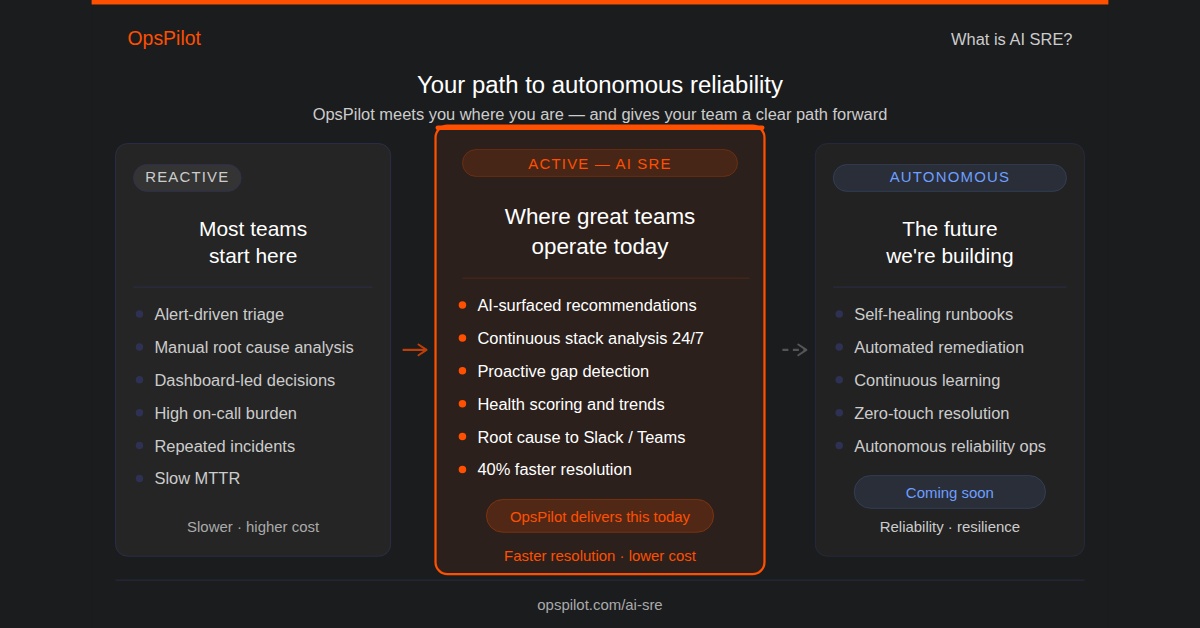
Operational maturity
Where does your team operate today?
AI SRE is a direction, not a single destination. OpsPilot meets you where you are — and gives you a clear path forward.
OpsPilot grows with you — no forced migration, no rip-and-replace at each stage.
Platform capabilities
What OpsPilot delivers as your AI SRE
AI Coworker
An always-on AI SRE that monitors your entire stack 24/7, investigates anomalies automatically, and tells you exactly what needs attention — before your pager fires. Built by engineers with two decades of APM experience across thousands of production incidents.
AI investigation
Context-aware analysis across all your metrics, logs, and traces simultaneously. OpsPilot correlates signals across services to find the true source of every incident — not just the symptom that triggered the alert.
Root cause analysis
Stop chasing red herrings. OpsPilot pinpoints the actual origin of every incident in plain English — with a confidence score, timeline, and recommended fix ready to send directly to your team.
Slack, Teams, and PagerDuty delivery
Root cause, recommended actions, and runbooks delivered to Slack, Microsoft Teams, or wherever your team works — the moment something needs attention. No dashboard hopping. No context switching.
Proactive insights
OpsPilot continuously analyzes your stack for patterns that precede incidents — memory leaks, connection pool pressure, latency trends — surfacing recommendations before your users notice anything.
Intelligent alerting
Context-aware alerting that understands your baseline, suppresses noise, and escalates only what actually matters — with the investigation already completed when the alert arrives.
Built for your team
Who AI SRE is for
OpsPilot is designed for engineering organizations where reliability, speed, and cost control all matter — and where the current stack is generating more data than the team can act on.
Stop firefighting. Start preventing.
If your on-call rotation is exhausting your best engineers, AI SRE changes the equation. OpsPilot handles the investigation — your team handles the decisions.
More signal. Less noise.
Platform teams responsible for observability strategy get a force multiplier — AI SRE that surfaces exactly what needs attention across every service you support, without adding headcount.
Measurable reliability at lower cost.
Directors and VPs of IT Ops get AI SRE capabilities at 60–70% lower cost than mainstream platforms — with the setup simplicity and support quality that makes the business case straightforward to defend.
No rip-and-replace
Keep your existing stack. Add AI SRE capabilities.
OpsPilot is OpenTelemetry-native. It adds the AI intelligence layer your current tools don't provide — without requiring you to replace them.
Works with what you already have
If you're running Grafana, Prometheus, or any OpenTelemetry-compatible source, OpsPilot connects in minutes. Your existing instrumentation, your existing dashboards — plus AI SRE capabilities on top of all of it.
Already using Datadog or New Relic? OpsPilot works alongside those tools too — or replaces them at 60–70% lower cost. The choice is yours and there is no disruption either way.
OpsPilot adds AI intelligence to your existing telemetry — no data migration required.
G2 reviews — 169 verified
What engineering teams say about OpsPilot
9.7/10 for support. 9.0/10 for ease of setup. Higher scores than Datadog, New Relic, Splunk, Grafana, and Sentry across every G2 satisfaction category.
"OpsPilot surfaces exactly what needs attention — the AI suggestions are genuinely useful, not just noise. We've cut the time our team spends on investigation by nearly half."
Vinay J
Head of Platform Engineering
"The AI support is genuinely useful — it helps narrow down errors fast and tells you what to fix, not just what broke. It's the difference between a dashboard and an actual teammate."
Rene H
SRE Lead
"The AI capabilities are straightforward to use, and the support team ensures an excellent experience from day one. Setup took less than an afternoon and we were getting value immediately."
Brandon B
Director of IT Operations
Common questions
What is AI SRE — frequently asked questions
AI Site Reliability Engineering (AI SRE) uses artificial intelligence to automate the investigation, triage, and remediation of production incidents. Instead of engineers manually checking dashboards and correlating signals, an AI SRE like OpsPilot's Coworker continuously monitors your stack, identifies issues, and delivers prioritized findings and recommended actions — 24/7.
AIOps was designed primarily for event correlation and noise reduction — filtering alert storms and routing incidents. AI SRE goes significantly further: it investigates the cause of incidents, correlates signals across your entire stack, explains what happened in plain English, and recommends specific actions. Gartner now treats these as distinct categories. AIOps is increasingly associated with legacy tooling. AI SRE is the emerging standard for engineering teams who need investigation and action, not just filtering.
No — OpsPilot adds an AI intelligence layer on top of your existing observability stack. It ingests telemetry via OpenTelemetry's OTLP standard and works alongside Grafana, Prometheus, and any OTel-compatible source. No data migration, no rip-and-replace, no new agents. Teams already running Datadog or New Relic can add OpsPilot alongside them — or replace those platforms entirely at 60–70% lower cost.
OpsPilot integrates natively with OpenTelemetry (OTLP), Grafana, and Prometheus. It works alongside existing tools including Datadog, Dynatrace, and New Relic. For delivery, it connects to Slack, Microsoft Teams, and PagerDuty. No new agents are required — if you're already sending telemetry data, OpsPilot connects in minutes.
OpsPilot reduces observability spend in two ways: by identifying gaps and redundancy in your current instrumentation, and by replacing expensive legacy platforms like Datadog or Dynatrace with a modern AI-powered alternative at 60–70% lower cost. The pricing page includes a live cost comparison calculator — no form, no sales call required.
Autonomous reliability means your observability stack doesn't just collect data — it acts on it. OpsPilot moves beyond reactive alerting to proactively investigate incidents, detect patterns before they become outages, and continuously improve operational outcomes. Fully autonomous operations — self-healing runbooks, automated remediation — are in active development and represent the next stage of OpsPilot's maturity model.
Yes. OpsPilot is SOC 2 Type II certified and GDPR aligned. Full security and compliance documentation is available at our trust center.
Most teams are connected and receiving AI SRE insights within minutes. If you're already using OpenTelemetry, Grafana, or Prometheus, you're 90% of the way there. OpsPilot requires no new agents, no data migration, and no professional services engagement. Start a free trial or book a demo to see it working with your own stack.
Ready to add an AI SRE teammate?
Connect your OpenTelemetry pipeline in minutes and your AI SRE Coworker is part of the team. Built on two decades of APM experience across thousands of production incidents.
No credit card required · Live within minutes · See pricing — no form, no sales call
OpsPilot is the AI SRE teammate for teams using OpenTelemetry, Prometheus, Grafana, and existing observability stacks — helping engineers investigate incidents, find root cause, and move toward autonomous operations without replacing their tools. OpsPilot, formerly FusionReactor Cloud, is Intergral's AI-powered observability and AI SRE platform.