
AI SRE Pricing: What It Should Look Like and How OpsPilot Makes It Predictable
Looking for transparent AI SRE pricing? OpsPilot plans are flat, published, and don’t scale with headcount. See exactly what you’d pay — no form, no sales call. See AI SRE pricing →
AI SRE pricing is one of the first questions engineering teams ask when they start evaluating AI-powered operations tools. How does it scale? What drives costs up? And how do you know what you’ll pay before committing? These are the right questions. This post explains exactly how OpsPilot approaches AI SRE pricing — and why predictability is built into the model from the start.
That is why OpsPilot plans include OpsPilot AI Tokens — a fixed monthly allowance for the AI-powered operational work that Coworker performs on your behalf.
This post explains what OpsPilot AI Tokens are, what consumes them, how to forecast usage, and why predictability is a feature — not a limitation.
The Problem With Unpredictable AI SRE Pricing
Most AI SRE pricing models are opaque by design. Usage scales with incident volume, alert frequency, and investigation depth — and teams are often left guessing what the bill will look like until it arrives.
If an AI SRE is investigating alerts, running scheduled checks, and analyzing OpenTelemetry data around the clock — teams need to know what that costs before it happens, not after.
Surprise consumption is the fastest way to lose trust in an AIOps platform — regardless of how much value it delivers.
OpsPilot is designed to fix this. Plans are flat and published. OpsPilot AI Tokens give teams a clear, fixed allowance for Coworker’s AI-powered work. Full visibility into usage, forecasting, and controls are built directly into the product.
What Are OpsPilot AI Tokens?
OpsPilot AI Tokens are the usage allowance for Coworker’s AI SRE work.
They are consumed when Coworker performs tasks such as — all powered by your existing OpenTelemetry data:
- Investigating alerts — Coworker analyzes OpenTelemetry telemetry, correlates signals, and surfaces root cause candidates.
- Running scheduled checks — recurring tasks like daily error rate reviews, performance audits, and resource usage analysis.
- Generating recommendations — suggested fixes, runbook steps, and next-best actions based on current system state.
- Updating situations — Coworker tracks evolving incidents, adds context, and produces debriefs.
- Answering questions in chat — direct conversations about system behavior, trends, and anomalies.
Every plan includes a fixed monthly allowance. Starter plans include 500 OpsPilot AI Tokens per month. Pro AI plans include 5,000 OpsPilot AI Tokens per month — enough for continuous Coworker AI SRE activity across alerts, scheduled checks, and agentic operations workflows.
Teams replacing Datadog, New Relic, or Grafana often ask whether AI usage costs are comparable. With OpsPilot, they are fixed, published, and visible in your dashboard before they are charged. See the full breakdown on the OpsPilot pricing page.
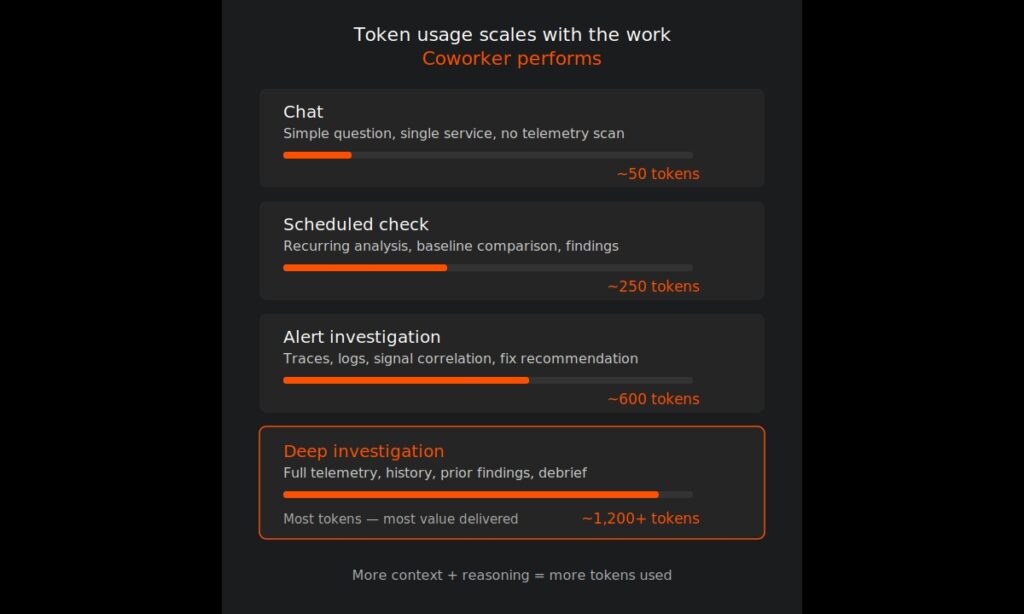
Not All AI Observability Work Uses the Same Number of Tokens
One question teams ask is whether every Coworker action costs the same. The answer is no — and that is by design.
A simple chat question — “What is the current error rate on the payments service?” — requires a small amount of context and reasoning. It uses fewer AI Tokens.
A deep AI incident investigation — where Coworker reviews recent OpenTelemetry traces, correlates log data, checks prior findings, compares against historical baselines, and produces a recommended fix — requires significantly more. It uses more AI Tokens.
This is the same principle that governs all AI SRE work: the more context and reasoning required, the more compute is involved. OpsPilot reflects this honestly rather than hiding it behind a flat rate.
Teams using Coworker in Active or Autonomous mode — with continuous monitoring, scheduled checks, and agentic operations — will use more AI Tokens than teams running occasional checks. That is a fair reflection of the work being done.
Always Pair AI Token Usage With Value
OpsPilot AI SRE pricing is fixed, published, and visible before you commit. See exactly what Coworker delivered for every AI Token spent — and exactly what you’ll pay next month. See full AI SRE pricing — no form, no sales call →
A token count on its own tells you nothing. That is why OpsPilot always pairs AI Token usage with the operational work Coworker delivered.
Instead of showing:
1,222 tokens used
OpsPilot shows:
1,222 AI Tokens powered 1,966 Coworker runs, 339 findings, 12 situation updates, and 18 debriefs.
This framing matters. AI Tokens are not being burned — they are funding real AI SRE work. Every token represents an investigation completed, a recommendation surfaced, a finding recorded, or a debrief produced.
Teams can see AI Token usage broken down by source:
- Chat — AI Tokens used by direct conversations with Coworker.
- Coworker Investigations — AI Tokens used when Coworker performs AI incident investigation and analyzes telemetry.
- Scheduled Checks — AI Tokens used by recurring automated tasks.
- Recommendations — AI Tokens used to generate fixes, explanations, and next steps.
Forecasting and Controls — No Surprises in Your AIOps Platform
OpsPilot shows admins their current usage, projected usage for the rest of the period, and whether the workspace is on track to stay within its allowance. This is part of OpsPilot’s proactive AI capability — visibility that acts, not just reports.
A projection like:
Projected usage: 3,698 AI Tokens by period end — within your plan allowance.
gives admins the information they need to act early. Not after the fact.
If usage is trending high, admins have several options:
- Review and adjust scheduled Coworker AI SRE activity
- Reduce check frequency during lower-priority periods
- Upgrade to a higher-tier plan with more AI Tokens
- Add additional token allowance as needed
The key principle is control. Admins should never be surprised by AI Token usage. OpsPilot is built to make that promise real.
What Happens When You Approach Your Limit?
OpsPilot notifies admins as AI Token usage approaches plan limits. This gives teams time to review usage, adjust scheduled activity, or upgrade before reaching their allowance.
If a workspace reaches its AI Token allowance, non-critical Coworker activity moves into reduced mode until the allowance resets or additional tokens are added. Critical alerting and defined SLA behaviors remain active.
The important point: customers should never be surprised. Notifications, projections, and controls exist precisely to prevent that.
OpsPilot AI Tokens Are a Trust Feature
The point of OpsPilot AI Tokens is not to meter AI observability usage. It is to make AI-powered operations transparent and trustworthy.
Teams adopting an AI SRE or AIOps platform for production operations need to know three things (we cover what AIOps actually means in 2026 in this post):
- What is the AI doing? — Coworker’s activity is visible: investigations, checks, findings, recommendations.
- What is it costing? — AI Token usage is shown by source, with projections and trends.
- Can I control it? — Yes. Admins can adjust schedules, set thresholds, and receive alerts before hitting limits.
When those three things are true, AI becomes something a team can rely on — not something they have to monitor nervously.
Your plan includes predictable AI observability capacity. OpsPilot shows what Coworker did, how many AI Tokens it used, and whether you are projected to stay within your allowance.
That is agentic operations without surprise consumption.
Frequently Asked Questions
What are OpsPilot AI Tokens? OpsPilot AI Tokens are the monthly allowance for Coworker’s AI SRE work. They are consumed when Coworker investigates alerts, runs scheduled checks, analyzes OpenTelemetry telemetry, generates recommendations, or answers questions. Every plan includes a fixed allowance with usage visible in real time.
How many AI Tokens does an AI SRE typically use per month? It depends on your Coworker mode. Reactive mode uses around 400 AI Tokens per month. Active mode uses around 4,000. Autonomous mode — where Coworker runs continuously as a full AI SRE — uses 5,000 to 25,000+ AI Tokens depending on alert volume and investigation depth.
Does OpsPilot work with my existing OpenTelemetry stack? Yes. OpsPilot connects via OTLP — no new agents, no data migration. Teams running Grafana, Prometheus, Datadog, or New Relic can add OpsPilot’s AI observability layer in minutes. Read more: OpenTelemetry without intelligence is just expensive data collection.
What happens if I go over my AI Token allowance? OpsPilot notifies admins before limits are reached. Overages are billed at a clear published rate — $20 per 250 AI Tokens — and are visible in your dashboard before they are charged. There are no surprise bills.
Is the AI Token allowance the same across all plans? No. Starter plans include 500 OpsPilot AI Tokens per month. Pro AI plans include 5,000. Advanced plans include 20,000. Enterprise plans include custom volumes.
AI SRE Pricing That Works the Way Your Team Needs
OpsPilot AI SRE pricing is flat, published, and doesn’t grow with headcount. Starter includes 500 OpsPilot AI Tokens per month. Pro AI includes 5,000. Every plan includes usage visibility, forecasting, and controls — connect your OpenTelemetry data and get your first AI analysis within 24 hours.

OpsPilot is the AI SRE teammate for teams using OpenTelemetry, Prometheus, Grafana, and existing observability stacks — helping engineers investigate incidents, find root cause, and move toward autonomous operations without replacing their tools. OpsPilot, formerly FusionReactor Cloud, is Intergral’s AI-powered observability and AI SRE platform.