
There is a question every engineering leader should be asking their observability stack in 2026. Not “what broke?” — your tools have been able to answer that for years. The question is: what should we fix next?
If your observability stack can’t answer that question clearly, automatically, and continuously, it’s only doing half its job. And in 2026, half the job isn’t good enough.
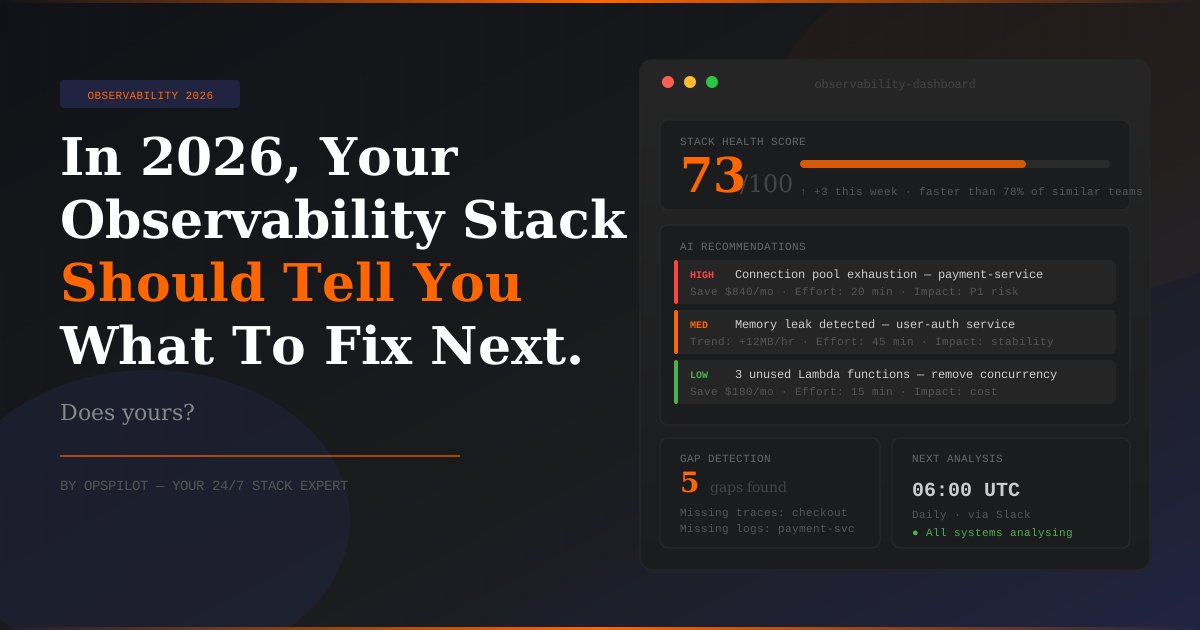
What Your Observability Stack Should Be Doing in 2026
The observability market has matured significantly in the last five years. Collection is largely a solved problem — OpenTelemetry is now the standard and it works. Visualization is excellent — Grafana, Datadog, and their peers have built genuinely impressive dashboard and alerting tooling.
But there is a third thing that a modern observability stack 2026 should be doing that most teams still don’t have: intelligence. The ability to look at all the data being collected and visualized, and tell you what it actually means for your system right now.
Not a dashboard. Not an alert. A recommendation. A priority. A business impact. An action.
Most observability stacks stop at layer two. They collect, and they visualize. The intelligence layer — the part that connects data to decision — is still missing for the majority of engineering teams.
The Gap Is Costing You More Than You Think
Here is what the absence of an intelligence layer in your observability stack actually costs:
Engineer time. The average mid-sized engineering team spends more than 10 hours per week manually analysing observability data. At a fully loaded cost of $160K per senior engineer, that’s roughly $800 of engineering salary per week spent looking at dashboards. Per team. Every week.
Missed optimisations. Manual analysis is inherently incomplete. Nobody has time to check every service, every metric, every trend, every week. Things that would have been caught automatically go undetected. Cloud costs accumulate. Performance degrades slowly. The observability stack 2026 that doesn’t analyse automatically is leaving savings on the table continuously.
Slow root cause analysis. When incidents do happen, the intelligence gap turns a 15-minute fix into a 3-hour investigation. The data was there. The connection between the data and the root cause wasn’t made automatically. It had to be made manually, under pressure, at 3 am.
No measurable progress. Without an intelligence layer tracking improvement over time, observability becomes a cost center rather than a value driver. You can’t show leadership that your stack health improved from 68 to 81 this quarter if nothing is being measured and tracked.
Already questioning what your observability spend is actually delivering? Compare OpsPilot against your current stack — no form, no sales call. See the comparison at opspilot.com/pricing
What An Intelligent Observability Stack 2026 Looks Like
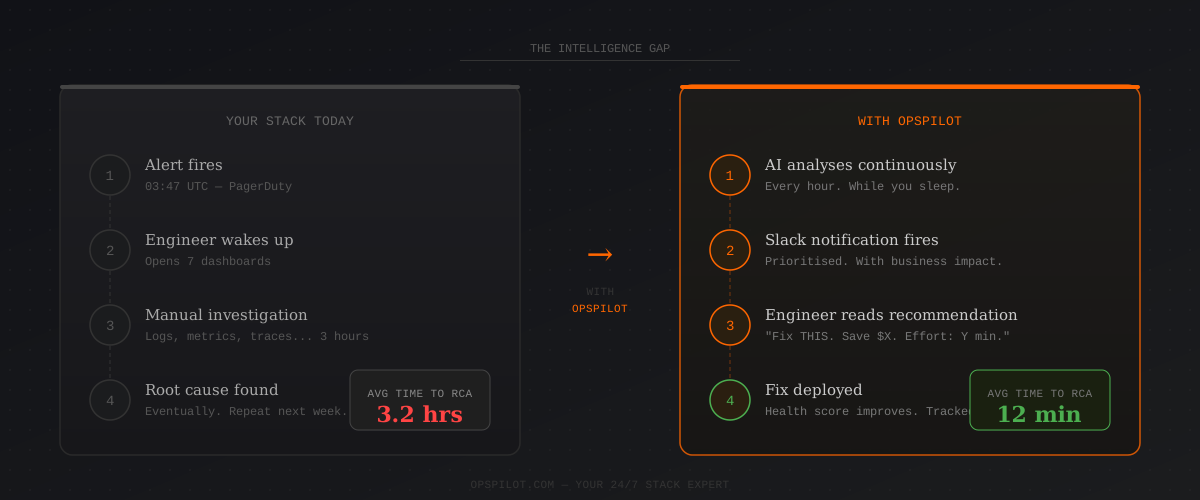
The difference between a standard observability stack and an intelligent one comes down to what happens between data collection and engineer action.
In a standard stack, the path looks like this: data is collected, a threshold is breached, an alert fires, an engineer investigates manually, root cause is eventually found, a fix is deployed. The intelligence is human. The human has to be awake, available, and experienced enough to make the right connections quickly.
In an intelligent observability stack 2026, the path looks different: data is collected and continuously analysed by an AI layer, prioritised recommendations are delivered automatically to Slack with business impact quantified, the engineer reads a specific recommendation with a suggested action and estimated effort, the fix is deployed, and the health score improves visibly.
The intelligence is automated. The engineer’s time is spent on the fix, not the investigation.
This is not a hypothetical future state. Engineering teams are running this way today. The question is whether yours is.
The Three Questions Your Observability Stack Should Answer Every Day
A mature observability stack 2026 should be able to answer three questions automatically, every single day, without an engineer having to manually check anything:
- What is the current health of our stack? Not just “are services up?” but a genuine health score — a single number that reflects performance, error rates, logging coverage, alerting effectiveness, cost efficiency, and observability maturity. Something that can be tracked over time and shown to leadership as evidence of continuous improvement.
- What should we fix first? A prioritized list of recommendations, ordered by business impact. Not fifty alerts of equal severity. Three clear actions, ranked HIGH, MEDIUM, or LOW, each with an estimated effort and a quantified impact. “Fix this connection pool issue. Save $840 per month. Effort: 20 minutes.”
- What are we missing? Gap detection — automated identification of the services and signals that aren’t being instrumented correctly. Most teams have blind spots in their observability coverage that they don’t know about. An intelligent observability stack finds them automatically.
If your current stack answers all three of these questions automatically every day, you’re in good shape. If it doesn’t, you have an intelligence gap.
Why Most Teams Are Still Operating Without This
The intelligence layer is new. It didn’t exist in a practical, accessible form until recently. The observability market spent a decade solving the collection and visualization problems — which were genuinely hard to solve — and the intelligence layer has only recently become achievable at scale.
The second reason is that the teams who most need it are often the teams least likely to have the time and resources to build it themselves. Mid-sized engineering teams of 20-100 engineers are running production systems of significant complexity, but they don’t have a dedicated observability engineering team to build custom AI analysis on top of their data. They’re using the tools they can afford and can use, and manual analysis is just an accepted cost of doing business.
It shouldn’t be.
What The Shift Looks Like In Practice
Teams that have added an intelligence layer to their observability stack in 2026 consistently report the same outcomes:
The first thing that changes is incident response time. When recommendations are pre-computed and delivered automatically, the time from alert to action collapses. Engineers stop investigating and start fixing.
The second change is proactive improvement. When the AI is running continuously — not just during incidents — it surfaces optimization opportunities that would never have been found manually. Cloud waste gets identified and eliminated. Performance bottlenecks are addressed before they lead to outages. Observability gaps get filled before they create blind spots.
The third change is the ability to show progress. A health score that moves from 68 to 81 over a quarter is a story you can tell leadership. It turns observability from a cost center into a demonstrable business investment.
The Right Question To Ask Your Observability Vendor
Next time you’re reviewing your observability stack — especially if you’re approaching renewal — ask this question: does this tool tell us what to fix, or does it just show us what’s happening?
If the answer is the latter, you have a visualization tool. Visualization tools are valuable. But in 2026, a visualization tool alone is not a complete observability solution.
The intelligence layer is what completes it. And it’s available now — without ripping out your existing stack, without a two-year transformation project, and without an enterprise budget.
OpsPilot sits above your existing OpenTelemetry data via OTLP and adds the intelligence layer your stack is missing. No proprietary agents. No rework. Just the prioritized recommendations, health scoring, and gap detection your team should have been getting all along.
Your 24/7 stack expert. Delivered to Slack on your schedule.
See how OpsPilot compares to your current observability stack — no form, no sales call. View the pricing comparison at opspilot.com/pricing
Or if you’re ready to see it in your stack: Start your free trial at app.opspilot.com/sign-up
OpsPilot is an AI-powered observability intelligence platform that continuously analyses your OpenTelemetry data and delivers prioritised recommendations, health scoring, and gap detection — directly to Slack. Built by APM engineers with 20 years experience analysing 10M+ production incidents.
What should an observability stack do in 2026? In 2026 a mature observability stack should do three things automatically: score the health of your stack continuously, deliver prioritised recommendations with business impact quantified, and identify observability gaps you don’t know you have. Most stacks currently only handle collection and visualisation — the intelligence layer is missing.
What is the difference between observability and AIOps? Observability tools collect and visualise telemetry data. AIOps platforms analyse that data automatically and tell you what to do with it. In 2026 the two are converging — an observability stack without an intelligence layer is only doing half the job.
How does OpsPilot work with my existing observability stack? OpsPilot ingests your existing OpenTelemetry data via OTLP — no new agents, no rework of your existing instrumentation. It adds the intelligence layer on top of whatever you already have, delivering prioritised recommendations directly to Slack on your schedule.