
Proactive SRE: What the Shift From Reactive Actually Looks Like
Every SRE team wants proactive SRE. Almost every SRE team is still largely reactive.
The aspiration is universal — spend less time firefighting, more time preventing fires. Catch failures before they become incidents. Surface patterns before they cross alert thresholds. Give on-call engineers context before they need to ask for it. The language of proactive site reliability engineering (SRE) appears in every engineering roadmap, every observability vendor pitch, and every post-incident review that ends with “we should have caught this earlier.”
The gap between aspiration and reality is not a motivation problem. Most SRE engineers genuinely want to work on prevention rather than firefighting. The gap is architectural. A reactive SRE architecture — threshold-based alerts, manual investigation, reactive runbook execution — produces reactive outcomes regardless of the intentions of the engineers operating it. Moving to proactive SRE is not a cultural shift or a process improvement. It is an architectural change.
This post is a practical account of what that architectural change looks like: what reactive SRE teams do with their time, what proactive SRE teams do differently, and what has to change in the stack to make the shift possible.
What a Reactive SRE Week Looks Like
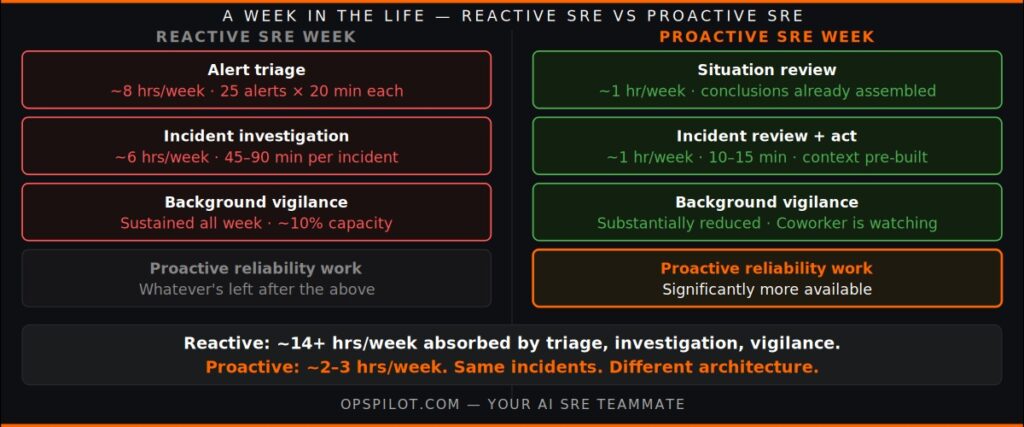
Understanding the reactive SRE pattern is important because it is often invisible to the engineers inside it. The work feels productive — incidents get resolved, alerts get triaged, runbooks get executed. The pattern only becomes visible when you account for where the hours actually go.
The alert triage loop
In a reactive SRE architecture, alerts arrive continuously. The on-call engineer evaluates each alert: is this genuine? Is it urgent? Does it require immediate action or can it wait? For teams with high alert volume, this evaluation loop consumes significant engineering time even when most alerts turn out to be noise.
The cognitive cost is higher than the clock time suggests. Each alert evaluation requires context-switching from whatever the engineer was doing, orienting to the affected service, assessing severity, and making a triage decision. Even a two-minute alert evaluation consumes closer to ten minutes of productive engineering time when context-switching and recovery are included.
The investigation phase
When a genuine incident occurs, the investigation phase begins. An engineer who doesn’t immediately know what is causing the failure has to assemble the picture manually: check the affected service’s metrics, follow dependency chains, correlate signals across metrics and logs, form a hypothesis, test it, revise it if wrong. For a complex incident in a system the engineer knows well, this takes 30-45 minutes. For a novel failure pattern in a service the engineer knows less well, it can take two to three hours.
As we covered in AI Incident Investigation, this investigation phase is where the majority of MTTR is consumed — not in the remediation itself, which is usually straightforward once root cause is identified, but in the analytical work that precedes it.
The reactive attention posture
Beyond the active work of alert triage and incident investigation, reactive SRE produces a sustained background cognitive load that is harder to measure but equally significant. Engineers on on-call rotation maintain a state of background vigilance — phones nearby, Slack open, attention partly on the production system even during nominally off-duty hours. This posture is the inevitable consequence of a system that fires alerts unpredictably and requires human attention at any hour.
For most teams operating reactively, on-call weeks consume meaningful engineering capacity not because of the hours spent actively working but because of the hours spent in a state of readiness that prevents sustained deep work.
What a Proactive SRE Week Looks Like
A proactive SRE team using OpsPilot’s Coworker operates differently at each of these points — not because the engineers are different, but because the architecture is different.
Situations instead of alerts
In a proactive SRE architecture, Coworker watches the production system continuously and surfaces situations — patterns detected before thresholds are crossed, investigation context assembled automatically, recommended action specific and effort-estimated. The on-call engineer’s relationship with the monitoring system changes fundamentally.
Instead of an unpredictable stream of alerts requiring evaluation, the engineer receives a managed queue of situations with severity ratings, status (active, watching, resolved), and investigation context already assembled. The cognitive work of triage — is this genuine? what is causing it? what should I do? — has been done before the situation arrives.
The morning review of active situations is qualitatively different from the reactive alert triage loop. The engineer is reviewing conclusions rather than forming them. Most situations during business hours can be handled between other work, without the full context switch that alert triage requires.
Investigation that starts finished
When a situation escalates to an incident — when a pattern Coworker has been watching crosses into genuine reliability impact — the on-call engineer arrives with the investigation already done. The affected service is identified. The dependency chain has been followed. The correlation across metrics, logs, and traces has been assembled. The specific recommended action is in the situation.
The engineer’s job shifts from “figure out what is happening” to “review what Coworker found and act on it.” For most incidents, this reduces the investigation phase from 45-90 minutes of manual analytical work to 10-15 minutes of reviewing and validating Coworker’s analysis.
This is the on-call experience change that teams report most consistently after adopting proactive SRE: not fewer pages (though that also improves), but better pages. Pages where you arrive knowing what to do rather than needing to figure it out first.
A lower vigilance baseline
When the production system is being watched continuously by Coworker, the background vigilance that reactive on-call requires is substantially reduced. Engineers still need to be available during on-call weeks. But the anxiety of not knowing what might appear next — which is what drives the sustained background cognitive load of reactive on-call — is reduced when Coworker is watching and will surface patterns before they become emergencies.
As we covered in SRE Burnout, this vigilance reduction is one of the most significant on-call experience improvements that proactive SRE produces — and one of the hardest to quantify, because it shows up in retention and wellbeing rather than MTTR metrics.
What Has to Change to Make the Shift
The shift from reactive to proactive SRE requires one architectural change and two operational adjustments.
The architectural change: add the intelligence layer
The structural difference between reactive and proactive SRE is the presence of a continuous intelligence layer above the telemetry. A reactive architecture has collection (metrics, logs, traces) and visualization (dashboards, alert rules). A proactive SRE architecture adds an intelligence layer that watches the telemetry continuously and surfaces situations without being queried.
Adding Coworker to your existing OpenTelemetry stack is this architectural change. One OTLP exporter pointed at OpsPilot alongside your existing backends. Your Grafana dashboards, Prometheus alert rules, and existing on-call routing are unchanged. Coworker operates as an additional intelligence layer above them, not a replacement for them.
The first situations arrive within 24 hours. The baseline maturity that produces precisely calibrated detection — where Coworker’s understanding of what is normal for your specific system is well-established — develops over the first four to six weeks.
The operational adjustment: trust the situations
The transition from reactive to proactive SRE requires an adjustment in how engineers relate to what the monitoring system surfaces. Reactive engineers are accustomed to treating alert output with skepticism — too many false positives, too much noise — and doing their own investigation before acting.
Coworker’s situations require a different approach: engaging with the investigation context before assuming it is wrong. This is an adjustment, not a permanent cognitive leap. As baselines mature and false positive rates decline, the situations become more reliably accurate. The correction mechanism — dismiss a situation with a reason, and Coworker learns from the correction — is the mechanism by which trust is built systematically rather than assumed.
The operational adjustment: use the time that opens up
The hours that proactive SRE frees from reactive investigation and alert triage do not automatically get redirected to reliability improvement work. Teams that make the most of the proactive SRE shift are those that deliberately use the reclaimed time — for reliability reviews, for instrumentation quality improvement, for architecture work that reduces the underlying failure rate rather than just responding to its symptoms.
For more on how to frame this shift for leadership, see SRE Automation: Where the Market Is Heading and Operational Resilience 2026. The proactive AI capability page covers what Coworker’s continuous analysis covers in detail.
Ready to see what proactive SRE looks like on your stack? Book a demo at calendly.com/fusionreactor-sales/opspilot-demo
Frequently Asked Questions
The architectural change — connecting Coworker to your OTLP pipeline — takes minutes. The first situations arrive within 24 hours. Meaningful improvement in the on-call experience is typically visible within the first two weeks as proactive pattern detection begins catching situations during business hours. Full baseline maturity, where detection is precisely calibrated to your system's specific behavior, takes approximately four to six weeks.
No. Alert rules remain an important part of the reliability architecture — they catch threshold breaches that Coworker's proactive detection may not have surfaced, and they integrate with existing on-call routing workflows. Proactive SRE adds a layer above alert rules rather than replacing them. Over time, as Coworker's proactive detection matures, the proportion of incidents caught before alert thresholds are crossed increases — but alert rules remain the safety net.
It substantially improves it. New engineers on their first on-call rotations are most disadvantaged by the reactive SRE architecture — they have the least system knowledge to apply to manual investigation, so investigation takes the longest and is most stressful. Coworker's investigation context arrives regardless of the engineer's experience level, meaning new engineers on call receive the same analytical support as experienced engineers. The knowledge gap that makes reactive on-call stressful for new engineers is substantially reduced.
Proactive SRE benefits are proportional to instrumentation completeness — the more complete the OTLP telemetry, the more complete the pattern detection. Teams with partial coverage still get meaningful proactive detection for the services that are instrumented, along with coverage gap situations that identify which uninstrumented services are most worth prioritizing. Starting with partial coverage and completing instrumentation while Coworker runs is a common and effective adoption path.
OpsPilot is the AI SRE teammate for teams using OpenTelemetry, Prometheus, Grafana, and existing observability stacks — helping engineers investigate incidents, find root cause, and move toward autonomous operations without replacing their tools. OpsPilot, formerly FusionReactor Cloud, is Intergral’s AI-powered observability and AI SRE platform.