
SOC 2 Type II and AI SRE: What Your Compliance Team Needs to Know About OpsPilot
The SOC 2 Type 2 AI SRE Platform Compliance Guide
When engineering teams evaluate a new AI SRE platform, the conversation usually starts with capability: what does it detect, how fast does it respond, how does it integrate with the existing stack. But for teams in regulated industries, or teams whose vendors require security documentation, a second conversation starts quickly: what is the security posture of this platform, and what does it do with our production telemetry?
OpsPilot is SOC 2 Type II accredited. This post is for the compliance teams, security reviewers, and engineering leaders who need to understand what that means in practice — and what specific questions to ask when evaluating any soc 2 type 2 ai sre platform for your environment.
What SOC 2 Type II Means (and Why It Matters More Than Type I)
SOC 2 Type I is a point-in-time assessment — an auditor evaluates whether the right controls exist at a specific moment. SOC 2 Type II is an operational assessment — an auditor evaluates whether those controls functioned effectively over a sustained period, typically six to twelve months.
The distinction matters for vendor selection. A Type I report tells you a vendor had the right policies in place on the day of the audit. A Type II report tells you those policies were operating consistently over time — that access controls were enforced, that incident response procedures were followed, that data handling matched the stated policy across the entire audit period.
For a platform like OpsPilot that ingests production telemetry — metrics, logs, and traces from your live systems — the operational consistency of security controls matters more than their existence. SOC 2 Type II is the evidence that they work, not just that they were documented.
OpsPilot’s full SOC 2 Type II accreditation details are available on the SOC 2 Type II accreditation page.
The Compliance Checklist: 10 Questions to Ask Any AI SRE Platform
This checklist covers the questions that compliance teams, security reviewers, and procurement functions consistently ask when evaluating a SOC 2 Type II AI SRE platform. Each answer reflects OpsPilot’s current position.
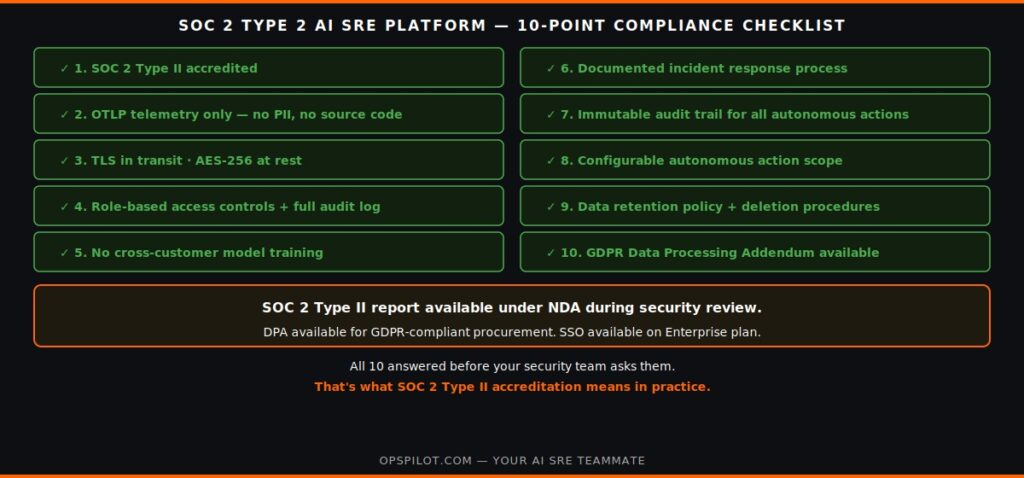
1. Is the platform SOC 2 Type II accredited?
Yes. OpsPilot holds SOC 2 Type II accreditation covering the Security, Availability, and Confidentiality trust service criteria. The report covers a sustained audit period — not a point-in-time assessment.
2. What data does the platform ingest, and where is it stored?
OpsPilot ingests OpenTelemetry Protocol (OTLP) telemetry — metrics, logs, and traces from your production systems. No source code, no database contents, no customer PII is ingested — only the operational telemetry signals your stack produces.
3. Is production telemetry encrypted in transit and at rest?
Yes. All telemetry transmitted to OpsPilot is encrypted in transit using TLS. Data at rest is encrypted using AES-256. Encryption applies to all telemetry types — metrics, logs, and traces.
4. What access controls exist for production data within the platform?
OpsPilot uses role-based access controls at the account level. All access is logged and auditable. The token transparency dashboard provides a full audit trail of every AI operation Coworker performs — every Chat query, every investigation, every scheduled check — with timestamps and attribution.
5. Does the platform use customer telemetry to train shared AI models?
No. Your production data is not used to train models shared with other customers. The incident memory and pattern recognition that builds over time is specific to your account — it does not cross account boundaries.
6. What is the incident response process for a security event?
OpsPilot’s incident response process is documented within the SOC 2 Type II report. Ask for the report during your security review — it is available to prospective customers under NDA.
7. How are autonomous actions logged and auditable?
Every action Coworker takes is logged in an immutable activity timeline. Autonomous runbook executions include the pre-execution check record, the action taken, the services affected, the timestamp, and the post-execution monitoring outcome. As we covered in Self-Healing Runbooks, the audit trail for autonomous actions meets the same post-mortem requirements as manually resolved incidents.
8. Can the platform be configured to limit autonomous action scope?
Yes. Coworker’s Autonomous mode is applied pattern-by-pattern with explicit team approval — it is not a global setting. The action library is defined at onboarding. As we covered in Coworker Modes, teams can operate entirely in Active mode — proactive detection and recommendation only, with all execution requiring human approval.
9. What is the data retention policy for ingested telemetry?
Data retention is governed by the plan tier and any applicable data processing agreements. Enterprise customers can negotiate specific retention periods and deletion procedures.
10. Is a Data Processing Addendum (DPA) available for GDPR compliance?
Yes. OpsPilot provides a Data Processing Addendum for customers who require GDPR-compliant data processing documentation. Contact the sales team to request the DPA during your procurement process.
What This Means for Your Deployment Decision
For engineering teams in regulated industries — financial services, healthcare, government technology — SOC 2 Type II accreditation removes the primary compliance blocker for AI SRE platform deployment.
The checklist above covers the questions that typically extend vendor evaluation cycles by weeks. Having documented answers to all ten reduces the security review to a documentation exercise rather than an investigation.
For the full accreditation details, see the SOC 2 Type II accreditation page. For the token dashboard and audit trail that supports internal compliance requirements, see AI SRE Token Transparency. The Coworker page covers the full capability set and configuration options. For pricing — no form, no sales call.
Frequently Asked Questions
Yes, under NDA. Prospective customers can request the full SOC 2 Type II report during their security review process. Contact the sales team to arrange access. The report covers the Security, Availability, and Confidentiality trust service criteria across the full audit period.
SSO support is available for Enterprise plan customers. Contact the sales team for the current SSO integrations supported. For teams with strict access control requirements, SSO combined with OpsPilot's role-based access controls provides the access governance needed for enterprise deployment.
Data deletion procedures are documented in the Data Processing Addendum and the platform's terms of service. Enterprise customers can negotiate specific deletion timelines and receive deletion confirmation. Contact the sales team to discuss data handling procedures during your evaluation.
OpsPilot is a cloud-hosted platform. For teams with specific deployment requirements — air-gapped environments, private cloud mandates, or data residency requirements — contact the sales team to discuss whether the current architecture meets your requirements or whether alternative arrangements are available for Enterprise customers.

SOC 2 Type II accredited. Ready for your security review.
Book a demo → calendly.com/fusionreactor-sales/opspilot-demo
Or start today: Free trial → app.opspilot.com/sign-up
OpsPilot is the AI SRE teammate for teams using OpenTelemetry, Prometheus, Grafana, and existing observability stacks — helping engineers investigate incidents, find root cause, and move toward autonomous operations without replacing their tools. OpsPilot, formerly FusionReactor Cloud, is Intergral’s AI-powered observability and AI SRE platform.