
How to Evaluate an AI SRE Platform: The Questions That Actually Matter
Every AI SRE platform vendor will tell you the same things.
Proactive detection. Intelligent alerting. Root cause analysis. Autonomous operations. AI that works alongside your engineers. These phrases appear in every product page, every demo, every analyst briefing in the AI SRE platform category. They are not wrong, exactly — most platforms do something in each of these areas. But they are not useful as evaluation criteria, because they describe directions of travel rather than levels of delivery.
Engineering leaders evaluating an AI site reliability engineering (AI SRE) platform in 2026 need a different set of questions. Not “does this platform have AI?” — the answer is always yes. Not “does it do proactive detection?” — every vendor claims this. The useful questions are the ones that expose the gap between what a platform markets and what it actually delivers in a production environment with your specific telemetry data.
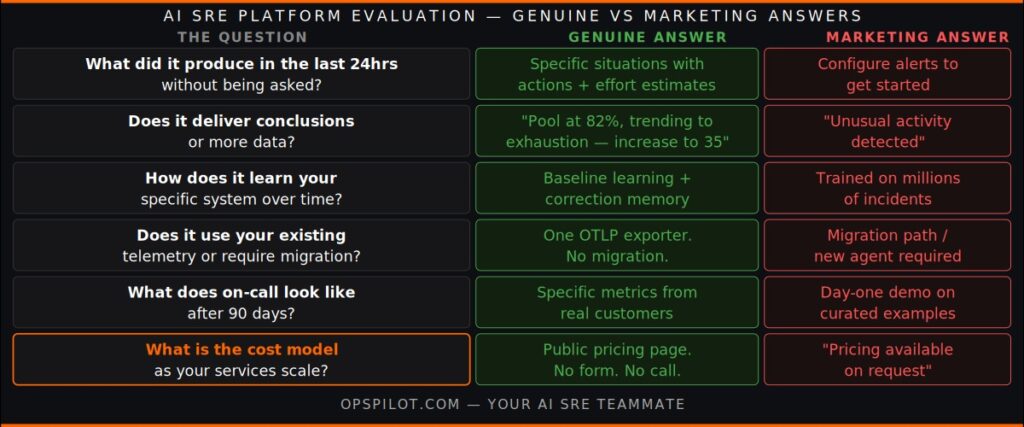
This post is a practical evaluation guide. Six questions that separate genuine AI SRE platform capability from AI-branded monitoring with a new interface. For each question, a description of what a genuine answer looks like — and what a marketing answer looks like in its place.
The Six Evaluation Questions
Question 1: What did it produce in the last 24 hours without being asked?
This is the single most diagnostic question you can ask an AI SRE platform. Log in. Do nothing. Come back 24 hours later. What has the platform surfaced?
A genuine answer is a list of situations — specific findings about your production system, with affected services, pattern descriptions, recommended actions, and effort estimates. Some will be things you knew about. Some will be things you didn’t. The ratio of novel findings to known issues is a measure of the platform’s analytical depth.
A marketing answer is a prompt to set up alert rules, configure dashboards, or ask the AI a question. A platform that requires your input to produce output is not an AI SRE platform — it is a search interface with AI features. An AI SRE platform produces output autonomously.
This question also exposes the difference between platforms that run analysis continuously and platforms that run analysis only when triggered. If the platform has been connected to your OTLP endpoint for 24 hours and has nothing to show you without being asked, it is not watching your system. It is waiting to be queried.
Question 2: Does it deliver conclusions or more data?
The core value proposition of an AI SRE platform is reducing the analytical work that engineers do manually. If the platform delivers more data — better visualizations, faster queries, AI-generated summaries of metrics — the analytical work is still manual. The format has changed. The work has not.
A genuine answer is a situation with a specific conclusion: “The connection pool on the auth-gateway is at 82% and trending toward exhaustion. Recommended action: increase pool size from 20 to 35. Estimated effort: 15 minutes.” The engineer’s job is to act on a conclusion, not to derive one.
A marketing answer is an anomaly flag: “Unusual activity detected in auth-gateway connection metrics.” The engineer still has to investigate what “unusual” means, whether it is significant, what is causing it, and what to do about it. The AI has added a notification to a manual investigation process.
Ask to see an actual situation output during the demo. Not a screenshot. Not a pre-packaged example. A real situation from a real production system, with the full investigation context. If the vendor cannot or will not show you this, it is a signal about what the platform actually produces.
Question 3: How does it learn your specific system over time?
Generic AI SRE platform models apply the same pattern detection logic to every customer’s telemetry. This produces acceptable results for common failure patterns — connection pool exhaustion, memory growth, latency degradation — but limited results for the failure patterns that are specific to your system’s architecture, your traffic patterns, and your service behavior.
A genuine answer involves two mechanisms: baseline learning and correction memory. Baseline learning means the platform’s detection becomes more precisely calibrated to your system’s specific behavior over the first four to six weeks as it establishes what normal looks like for your traffic patterns. Correction memory means that when you dismiss a false positive with a reason, the platform remembers — and does not surface the same false positive again.
A marketing answer is a description of the model architecture — transformer-based, LLM-powered, trained on millions of incidents. This describes what was used to build the platform, not what the platform learns about your specific system. A model trained on millions of generic incidents does not automatically know that your nightly batch job always produces a 40% latency spike that is expected and should not surface as a situation.
Ask specifically: “How does the platform’s detection accuracy change between week one and week six of operation on our telemetry?” A genuine answer involves specific mechanisms. A marketing answer circles back to the training data.
Question 4: Does the AI work from your existing telemetry or require you to send data to a new place?
The data migration question is often undersold as an evaluation criterion. Platforms that require you to move your telemetry to a proprietary backend introduce migration cost, data duplication, and a dependency on the vendor’s data infrastructure that limits future flexibility.
A genuine answer is that the platform connects to your existing OpenTelemetry OTLP endpoint and analyzes the same telemetry stream that your current backends receive. Your Grafana instance, Prometheus setup, Loki, and Tempo continue to operate exactly as before. The AI SRE platform is an additional consumer of your OTLP stream, not a replacement for your existing backends.
A marketing answer involves a migration path, a new agent to install, or a requirement to re-instrument your services for a proprietary format. These are not necessarily dealbreakers, but they are meaningful costs that should be evaluated honestly rather than treated as implementation details.
OpsPilot’s Coworker receives your telemetry via OTLP. One exporter pointed at OpsPilot alongside your existing exporters. No migration, no new agents, no re-instrumentation. As we covered in OpenTelemetry Maturity, this is the architecture that makes the intelligence layer practically deployable for teams at Stage 2 and above.
Question 5: What does the on-call experience look like after 90 days?
The first 30 days on any AI SRE platform are an onboarding period. Baselines are not yet established. False positive rates are typically higher than they will be. The platform is learning what normal looks like for your system. Evaluating a platform on its day-one output is like evaluating a new engineer on their first week.
A genuine answer involves specific claims about what changes between day 30 and day 90, backed by a mechanism. Alert volume should be meaningfully lower as proactive detection catches more patterns before they escalate to alerts. Investigation time should be shorter as Coworker’s correlation work matures. False positive rates should decline as baseline precision improves. Ask for these numbers from existing customers at comparable team sizes and service counts — not marketing testimonials, but actual metrics.
A marketing answer focuses on day-one capability. The demo shows the platform working perfectly on pre-selected telemetry data. The claim is that the AI immediately provides value. This may be true for a narrow set of common failure patterns. It does not tell you what the platform produces for your specific system after the baselines have matured.
Ask specifically: “What are the p50 and p90 investigation times for teams at 90 days of operation compared to their first two weeks?” If the vendor does not track this, the question is worth asking anyway — the willingness to engage with it is informative.
Question 6: What is the cost model as your services scale?
AI SRE platform pricing varies substantially — and the difference between per-host pricing, per-metric pricing, per-service pricing, and per-team pricing has material implications for total cost at scale.
A genuine answer is a clear per-service or per-tier pricing model with explicit overage rates and a calculator that lets you project costs at your current scale and your expected scale in 12 months. No form, no sales call required to see the numbers.
A marketing answer is “pricing available on request” or a model that requires a sales conversation to understand. This is not inherently problematic — some pricing complexity is legitimate — but it makes cost comparison difficult and should prompt closer scrutiny of how costs scale with your specific growth trajectory.
OpsPilot’s pricing is public at /pricing/ — Starter at $49/month, Pro at $249/month, Advanced at $899/month, with explicit overage rates. No form, no sales call. As we covered in The Hidden Cost of Manual Incident Investigation, the total cost comparison includes what manual investigation is currently costing your team — not just the platform subscription.
Running the Evaluation
The practical evaluation process for an AI SRE platform should include three stages.
The demo stage
During the demo, ask to see real situation output — not a pre-packaged example, but an actual situation from a production system with full investigation context. Ask how the platform performed in its first 24 hours on a new customer’s telemetry. Ask what changed between day 30 and day 90. Ask to see the false positive rate trend over time.
Pay attention to how the vendor handles questions about mechanisms rather than outcomes. “Our AI is trained on millions of incidents” is not a mechanism. “Corrections create lasting memory that prevents the same false positive from recurring” is a mechanism. The presence or absence of mechanistic answers is a reliable signal about whether the vendor understands their own product’s limitations.
The trial stage
Every serious AI SRE platform evaluation should include a trial period on your actual production telemetry. Not a sandbox, not a demo environment — your real telemetry data. The evaluation questions above can only be answered by a platform running on your specific data.
OpsPilot offers a free trial — no credit card required — with first situations typically arriving within 24 hours. The evaluation is straightforward: does what Coworker surfaces match your team’s genuine priorities? Is the investigation context accurate and actionable? Does the false positive rate decline over the first two weeks?
The reference stage
Before committing, speak to engineering leaders at teams of comparable size and service count who have been running the platform for at least 90 days. Ask specifically about on-call experience change, investigation time reduction, and alert volume change. The delta between vendor claims and customer outcomes is informative.
For more context on how to frame the business case once you’ve completed evaluation, see How To Defend Your Observability Budget in 2026 and Operational Resilience 2026. The AI SRE capability page covers OpsPilot’s specific approach to each of the six evaluation questions above.
FAQ
How long should an AI SRE platform evaluation take?
A meaningful evaluation requires at least 30 days of operation on your production telemetry — long enough for baselines to establish and for proactive detection to demonstrate its capability on your specific system. A 14-day trial is useful for initial assessment; 30 days gives you meaningful signal on whether alert volume is declining and whether investigation context is accurate for novel failures.
Should we evaluate multiple AI SRE platforms simultaneously?
Running multiple platforms simultaneously gives you a direct comparison but creates evaluation overhead. A sequential evaluation — one platform for 30 days, then a second if the first doesn’t meet the bar — is more manageable and typically sufficient.
What is the minimum instrumentation needed to meaningfully evaluate an AI SRE platform?
A meaningful evaluation requires at least OpenTelemetry metrics from your production services exported via OTLP. Logs and distributed traces improve analysis quality but are not required for an initial evaluation. If your services currently export to Prometheus, the OpenTelemetry Collector’s Prometheus receiver can bridge your existing metrics to OTLP without re-instrumentation.
How do we evaluate the accuracy of AI SRE investigation context?
Compare Coworker’s investigation output to what your team would have assembled manually for the same incidents. For the first month, when a Coworker situation leads to an incident resolution, have the on-call engineer note whether the investigation context was accurate, whether the recommended action was correct, and whether the correlation identified the right root cause. This direct comparison produces a team-specific accuracy measure more meaningful than vendor-provided statistics.
Run the evaluation on your actual telemetry. First situations in 24 hours.
Book a demo → calendly.com/fusionreactor-sales/opspilot-demo
Or start now: Free trial → app.opspilot.com/sign-up
OpsPilot is the AI SRE teammate for teams using OpenTelemetry, Prometheus, Grafana, and existing observability stacks — helping engineers investigate incidents, find root cause, and move toward autonomous operations without replacing their tools. OpsPilot, formerly FusionReactor Cloud, is Intergral’s AI-powered observability and AI SRE platform.