
AIOps explained
What is AIOps? And why are engineering teams moving beyond it?
What is AIOps? Artificial Intelligence for IT Operations uses AI and machine learning to correlate events, reduce alert noise, and automate IT workflows. But in 2026, leading engineering teams are asking whether AIOps alone is enough — or whether AI SRE goes further. At 60–70% lower cost than Datadog or Dynatrace.
The definition
What is AIOps? The honest answer.
What is AIOps? AIOps — Artificial Intelligence for IT Operations — is the application of machine learning and AI to IT operations data to automate event correlation, reduce noise, and surface actionable insights. Gartner coined the term in 2017. Since then it has become one of the most marketed and least consistently defined terms in enterprise technology.
Where AIOps came from
AIOps emerged as a response to the explosion of IT event data. Operations teams were drowning in alerts from monitoring tools, and existing approaches to correlation and triage didn't scale. The promise of AIOps was AI-assisted filtering — separating signal from noise, correlating related events, and reducing the volume of alerts that needed human attention.
What AIOps tools actually do
In practice, what is AIOps in production? Most AIOps platforms perform event correlation (grouping related alerts), noise suppression (filtering duplicates and low-priority events), basic anomaly detection, and workflow automation (routing incidents to the right team). They make the alert stream manageable. They do not investigate the cause.
The gap AIOps leaves open
What is AIOps missing? The most honest answer: investigation and explanation. AIOps tools tell you there is a problem. They do not tell you why it happened, what the root cause is, or what your team should do to fix it. That gap — between "something is wrong" and "here is what to do" — is where AI SRE operates.
Why the category is evolving
Gartner now considers AIOps and AI SRE as distinct categories. AIOps is increasingly associated with legacy event-correlation tooling built on older ML approaches. AI SRE — the emerging standard — correlates signals across your entire stack, explains root cause in plain English, and delivers recommended actions directly to your team. The search volume for "AIOps platform" has grown 324% in three months, reflecting how buyers are actively reassessing what they need.
AIOps vs AI SRE
What is AIOps vs AI SRE — and why it matters
Understanding what is AIOps versus what is AI SRE is increasingly important when evaluating observability platforms. They are not the same thing. Gartner explicitly treats them as distinct categories — and the difference has direct implications for your team's operational outcomes.
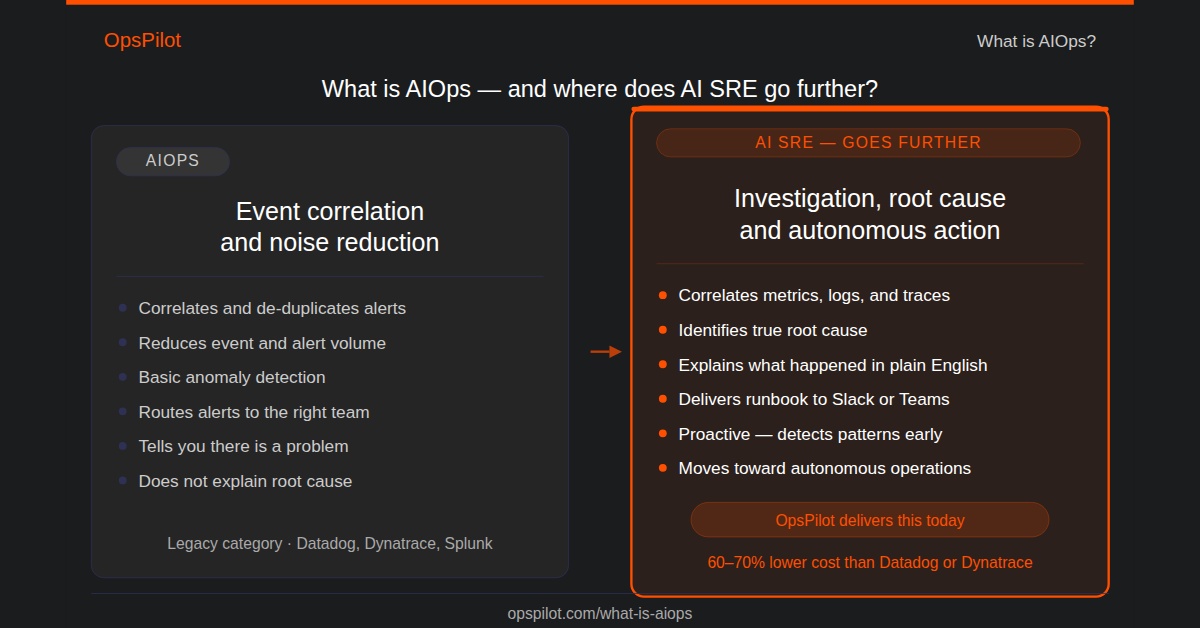
What AIOps tools do
Common AIOps use cases — and their limits
AIOps tools deliver real value in specific areas. Understanding what is AIOps in practice means understanding both what it does well and where it stops short.
Alert noise reduction
What AIOps does well: grouping related alerts, suppressing duplicates, and reducing the raw volume of events that reach your on-call team. Useful — but it doesn't tell your team what caused the alerts or what to do about them.
Event correlation
AIOps platforms correlate events across monitoring tools to identify which alerts are related. This helps reduce noise but the correlation is typically rule-based or pattern-matched — not a true causal investigation across your telemetry data.
Workflow automation
Many AIOps tools automate incident routing — getting the right alert to the right team faster. This reduces manual coordination overhead but still requires a human to investigate and resolve the underlying issue.
Anomaly detection
AIOps platforms detect statistical anomalies in metric streams. This can surface problems earlier than threshold-based alerting. However, detecting an anomaly is not the same as explaining it — your team still needs to investigate.
What AIOps doesn't do
What is AIOps missing? Root cause analysis. Plain-English explanation. Runbook generation. Proactive pattern detection before incidents occur. Delivery of findings to Slack or Microsoft Teams before your team opens a dashboard. These are AI SRE capabilities — not AIOps.
Where AI SRE goes further
AI SRE combines observability, investigation, and remediation in one continuous loop. OpsPilot doesn't just correlate events — it analyzes your metrics, logs, and traces simultaneously, identifies the true root cause, and delivers a prioritized recommendation before your team needs to open a single dashboard.
Beyond AIOps
From AIOps to AI SRE — how OpsPilot works
OpsPilot is not an AIOps platform. It's an AI SRE platform — which means it goes from event correlation all the way through to root cause, recommended fix, and delivery to your team. Here's how that works in practice.
Connect your existing stack
Point your OpenTelemetry pipeline at OpsPilot. Works with Grafana, Prometheus, and any OTel-compatible source. No new agents. No data migration. Connected in under five minutes.
AI monitors continuously
Unlike AIOps tools that wait for events to correlate, OpsPilot's AI Coworker watches your entire stack 24/7 — learning your baseline across metrics, logs, and traces and detecting deviations before alerts fire.
Root cause analysis — not just correlation
When something needs attention, OpsPilot doesn't just group related alerts. It identifies the actual origin of the issue — correlating signals across all your services to find the true root cause, not the symptom that triggered first.
Answers delivered where you work
Root cause, recommended fix, and a complete runbook appear in Slack, Microsoft Teams, or wherever your team works — before anyone opens a dashboard. Plain English. Actionable immediately. No context switching required.
Proactive — not just reactive
OpsPilot surfaces patterns that precede incidents — memory pressure, connection pool trends, degrading response times — giving your team time to act before users are affected. This is where AIOps stops and AI SRE begins.
Lower cost than traditional AIOps platforms
Legacy AIOps platforms from Datadog, Dynatrace, and Splunk carry significant licensing costs. OpsPilot delivers AI SRE capabilities — which go further than AIOps — at 60–70% lower cost than mainstream alternatives.
G2 reviews — 169 verified
What engineering teams say about OpsPilot
9.7/10 for support. 9.0/10 for ease of setup. Higher scores than Datadog, New Relic, Splunk, Grafana, and Sentry across every G2 satisfaction category.
"OpsPilot surfaces exactly what needs attention — the AI suggestions are genuinely useful, not just noise. We've cut the time our team spends on investigation by nearly half."
Vinay J
Head of Platform Engineering
"The AI support is genuinely useful — it helps narrow down errors fast and tells you what to fix, not just what broke. It's the difference between a dashboard and an actual teammate."
Rene H
SRE Lead
"The AI capabilities are straightforward to use, and the support team ensures an excellent experience from day one. Setup took less than an afternoon and we were getting value immediately."
Brandon B
Director of IT Operations
Common questions
What is AIOps — frequently asked questions
AIOps — Artificial Intelligence for IT Operations — is the use of AI and machine learning to analyze IT operations data, correlate events, reduce alert noise, and automate incident workflows. The term was coined by Gartner in 2017. AIOps tools help operations teams manage the volume of alerts and events generated by modern infrastructure. They improve signal-to-noise ratio but typically stop short of explaining root cause or recommending specific remediation actions.
AIOps is primarily used for event correlation (grouping related alerts), noise reduction (filtering duplicates and low-priority events), anomaly detection, and incident workflow automation (routing alerts to the right team). It is most commonly deployed by large enterprise IT Ops teams managing high volumes of events across complex infrastructure. In 2026, many teams are also evaluating AI SRE platforms — which go further by providing root cause analysis and recommended actions, not just event management.
AIOps focuses on event correlation and noise reduction — it makes the alert stream manageable but does not investigate or explain incidents. AI SRE goes significantly further: it correlates signals across your entire observability stack, identifies the true root cause of incidents, explains what happened in plain English, and delivers recommended actions directly to your team. Gartner now treats these as distinct categories. AIOps is increasingly associated with legacy tooling. AI SRE is the emerging standard for modern SRE and platform engineering teams. Learn more about what is AI SRE.
The major AIOps platforms include Datadog, Dynatrace, Splunk IT Service Intelligence, ServiceNow AIOps, and BMC Helix. Most enterprise observability tools have added AIOps capabilities to their core monitoring products. OpsPilot takes a different approach — rather than adding AIOps features to a monitoring tool, it provides full AI SRE capabilities including root cause analysis, proactive investigation, and runbook delivery, at 60–70% lower cost than mainstream platforms.
OpsPilot adds an AI intelligence layer on top of your existing observability stack via OpenTelemetry OTLP — it works alongside tools like Grafana, Prometheus, Datadog, and Dynatrace. For many teams, OpsPilot replaces the AIOps capabilities of platforms like Datadog or Dynatrace while delivering significantly more value through root cause analysis and AI SRE investigation — at 60–70% lower cost. No new agents required, no data migration, connected in minutes.
OpsPilot integrates natively with OpenTelemetry (OTLP), Grafana, and Prometheus, and works alongside existing platforms including Datadog, Dynatrace, and New Relic. It delivers findings to Slack, Microsoft Teams, and PagerDuty. No new agents are required — if you're already sending telemetry data, OpsPilot connects in minutes.
OpsPilot is an AI SRE platform, not an AIOps platform. The distinction matters: AIOps tools correlate and filter events. OpsPilot investigates incidents, identifies root cause, generates runbooks, and delivers answers to your team before they open a dashboard. It goes further than what AIOps delivers — combining observability, AI investigation, and autonomous reliability in one platform. Learn more about AI SRE.
Most teams are connected and receiving AI SRE insights within minutes. If you're already using OpenTelemetry, Grafana, or Prometheus, you're 90% of the way there. No new agents, no data migration, no professional services engagement required. Start a free trial or book a demo to see it working with your own stack.
Ready to go beyond AIOps?
OpsPilot delivers what AIOps platforms don't — root cause, recommended fix, and runbook delivered to your team before they open a dashboard. Connect your OpenTelemetry pipeline in minutes.
No credit card required · Live within minutes · See pricing — no form, no sales call
OpsPilot is the AI SRE teammate for teams using OpenTelemetry, Prometheus, Grafana, and existing observability stacks — helping engineers investigate incidents, find root cause, and move toward autonomous operations without replacing their tools. OpsPilot, formerly FusionReactor Cloud, is Intergral's AI-powered observability and AI SRE platform.