
AI SRE vs AIOps: What's the Difference and Why It Matters for Engineering Teams
AIOps and AI SRE are used interchangeably in vendor marketing, analyst briefings, and engineering blog posts. They are not the same thing. Gartner now treats them as distinct categories, and the distinction matters when you are evaluating platforms.
Understanding what separates AI site reliability engineering (AI SRE) from AIOps is not a matter of splitting definitional hairs. It determines whether the platform you evaluate will reduce the manual investigation work your engineers are doing, or simply present that work in a different interface. It determines whether you are buying a tool that filters alert noise, or a tool that finds root cause. And it determines whether the AI in the product name refers to machine learning that correlates events — which AIOps has done for fifteen years — or to reasoning models that investigate, explain, and recommend — which AI SRE does.
This post explains the distinction clearly, covers what Gartner’s category separation means practically, and describes what to look for when a vendor claims to be in either category.
Where AIOps Came From and What It Was Built For
AIOps — Artificial Intelligence for IT Operations — emerged in the mid-2010s as a response to a specific problem: enterprises running large-scale IT infrastructure were drowning in alert volume. Alert storms during incidents generated thousands of events, all firing simultaneously, overwhelming operations centers that were staffed to handle dozens of discrete notifications rather than thousands of correlated ones.
The AIOps solution was event correlation and noise reduction. Machine learning models analyzed historical alert patterns, identified which events co-occurred during incidents, and grouped related alerts into a single correlated event. Instead of 3,000 alerts, the operations team saw 12 correlated groups. The noise was reduced. The human still did the investigation — but at least they were looking at a manageable queue.
This was genuinely valuable for the large-scale enterprise IT operations context it was designed for. For teams running on-premises infrastructure at significant scale, AIOps event correlation platforms provided real operational value.
What AIOps was not designed to do: investigate the cause of incidents, explain what happened in plain English, correlate signals across metrics, logs, and traces simultaneously, identify patterns before thresholds are crossed, or recommend specific remediation actions. It filtered and grouped. It did not investigate.
What AI SRE Is — And How It Differs
AI SRE applies a fundamentally different approach to the reliability problem. Rather than filtering alert volume after the fact, AI SRE watches the telemetry continuously and investigates autonomously — correlating signals, identifying root cause, and delivering a conclusion before the alert fires.
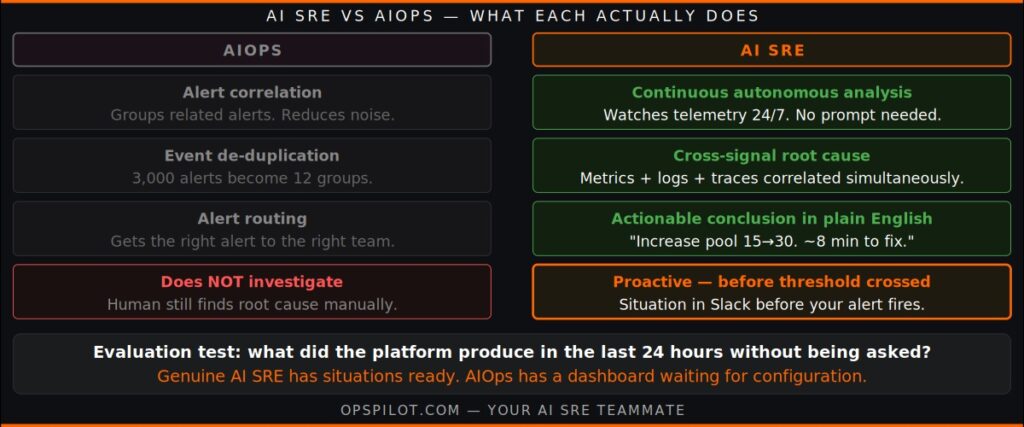
The practical differences between AIOps and AI SRE, as Gartner now distinguishes them:
What AIOps does:
Alert correlation and noise reduction. De-duplication of related events. Routing alerts to the right team. Suppressing known false positives. Presenting a managed alert queue rather than a flood.
What AI SRE does:
Continuous autonomous analysis of your telemetry — metrics, logs, and traces simultaneously. Identification of patterns before alert thresholds are crossed. Root cause investigation delivered as a specific, actionable conclusion in plain English. Recommended remediation with effort estimate. Learning from your system over time so baselines become more precise and recurring patterns are recognized faster.
The difference is not incremental. AIOps reduces the amount of work the human has to do before they can start investigating. AI SRE does the investigation itself.
OpsPilot’s Coworker is an AI SRE platform. When Coworker detects a pattern — a connection pool trending toward exhaustion, a database query degrading over four days, a third-party dependency approaching its rate limit — it does not surface a grouped alert. It surfaces a situation: the affected service, the correlated signals across all telemetry types, a specific recommended action, and an estimated effort to resolve. Delivered to Slack or Microsoft Teams before a threshold is crossed.
That is not event correlation. It is investigation.
Why the Gartner Distinction Matters
Gartner began formally distinguishing AI SRE from AIOps in 2025 as the category matured sufficiently to warrant separate tracking. The search volume data is revealing: Gartner reports AI SRE search volume up 376% year-over-year, while AIOps search volume has plateaued or declined in the same period.
This reflects a genuine market shift. Engineering teams — particularly those that have adopted OpenTelemetry and built mature observability stacks — are finding that event correlation is not sufficient for their operational model. They have unified telemetry. They have Grafana dashboards. What they don’t have is continuous analytical intelligence that tells them what matters in that telemetry without being asked.
The practical consequence of Gartner’s category separation is that vendors are now making explicit claims about which category they occupy. Some legacy AIOps vendors have begun calling their platforms AI SRE without meaningfully changing the underlying architecture — event correlation with an LLM wrapper for explanation text. The category label has changed. The fundamental approach has not.
The evaluation question that distinguishes genuine AI SRE from re-labelled AIOps is simple: What did the platform produce in the last 24 hours without being asked?
A genuine AI SRE platform — Coworker — has situations ready. Specific findings. Affected services. Correlated signals. Recommended Actions. Produced autonomously, without a query or an alert trigger.
An AIOps platform dressed as AI SRE will have a dashboard waiting for you to configure alert sources, tune correlation rules, and set thresholds. The AI surfaces when you ask it something or when an alert fires. Between those events, it is passive.
As we covered in How to Evaluate an AI SRE Platform, this is the most diagnostic question in any AI SRE evaluation. The answer tells you immediately which category the platform actually belongs to.
The Engineering Team Context: Why This Matters Right Now
For engineering teams evaluating reliability tooling in 2026, the AIOps vs AI SRE distinction has a specific practical consequence: the problems each category solves are different, and they address different stages of observability maturity.
AIOps was designed for large-scale enterprise IT operations — organizations running thousands of servers, dozens of monitoring tools, and operations centers staffed for high-volume alert management. The core problem was alert storm management at scale.
AI SRE is designed for engineering teams running cloud-native stacks on OpenTelemetry — teams where telemetry is unified, engineers are skilled, and the problem is not alert volume management but analytical depth. The problem is not too many alerts to process. The problem is that between alerts, nobody is watching — and when incidents do occur, investigation is manual, time-consuming, and cognitively costly.
For teams that fit this profile — and most SRE and platform engineering teams in 2026 do — AIOps event correlation addresses a problem they don’t primarily have. AI SRE addresses the problem they do.
This is why the Gartner category distinction matters practically: it clarifies which product category addresses your actual operational problem, rather than the operational problem that was common in enterprise IT operations fifteen years ago.
For more on what the shift to AI SRE means for day-to-day operations, see From Reactive to Proactive SRE.
For pricing and to see Coworker working on your own stack, see the pricing page — no form, no sales call — and book a demo.
Ready to see what AI SRE — not AIOps — looks like on your stack? Book a demo at calendly.com/fusionreactor-sales/opspilot-demo
Frequently Asked Questions
Not dead, but repositioned. AIOps retains genuine value in large-scale enterprise IT operations contexts — organizations running thousands of managed devices, legacy monitoring tool sprawl, and centralized operations centers where alert correlation at scale is a real problem. For cloud-native engineering teams running OpenTelemetry stacks, AIOps event correlation addresses a problem that isn't their primary one. AI SRE addresses what is.
Ask to see live output from a production system without a demo environment. A genuine AI SRE platform produces situations autonomously — specific findings with affected services, correlated signals, recommended actions, and effort estimates — without being queried or triggered by an alert. If the vendor shows you a query interface, a correlation rules configuration screen, or a dashboard waiting for alert source setup, the underlying architecture is AIOps regardless of the label.
As of mid-2026, Gartner tracks AI SRE as a distinct category with growing analyst coverage but has not yet published a standalone Magic Quadrant for the category. The AI SRE space is covered in related reports including the Market Guide for AIOps Platforms, where Gartner is beginning to distinguish platforms with genuine investigation capability from those with event correlation plus LLM wrapping.
Yes, and in some large enterprise environments they do. AIOps handles high-volume event correlation and routing across a broad infrastructure footprint; AI SRE runs upstream, investigating specific service-level patterns with full telemetry context. For most engineering teams evaluating new tooling, choosing one is the practical path — and AI SRE addresses the larger operational problem for cloud-native teams.
See what AI SRE — not event correlation — looks like on your stack.
Book a demo → calendly.com/fusionreactor-sales/opspilot-demo
Or start today: Free trial → app.opspilot.com/sign-up
OpsPilot is the AI SRE teammate for teams using OpenTelemetry, Prometheus, Grafana, and existing observability stacks — helping engineers investigate incidents, find root cause, and move toward autonomous operations without replacing their tools. OpsPilot, formerly FusionReactor Cloud, is Intergral’s AI-powered observability and AI SRE platform.