
From Firefighting to Prevention: What Proactive Operations Actually Looks Like in 2026
There is a version of site reliability engineering (SRE) that most engineering teams know well.
Something breaks. An alert fires. An engineer is paged. They investigate. They fix it. They write a post-mortem. They add a new alert to catch the same thing next time. Repeat.
This is firefighting. It is not a failure of engineering practice — it is what reactive tooling produces. When your observability stack is designed to tell you what happened after it happened, reactive incident response is the natural result. The tools shape the work.
In 2026, the best engineering teams have moved somewhere different. Not a world without incidents — but a world where the majority of potential incidents are identified and resolved before they fire, by an AI site reliability engineering (AI SRE) layer that watches continuously and acts before the pager goes off.
This post is about what that shift actually looks like — not the vendor vision of fully autonomous operations, but the practical, measurable reality of proactive operations for a mid-sized engineering team.
Why Firefighting Persists
Before describing what proactive operations looks like, it is worth being honest about why firefighting persists even in teams that know it is suboptimal.
The first reason is tooling. Most observability tooling is architecturally reactive. Metrics databases, log aggregators, and trace backends are systems for storing and retrieving telemetry — they surface information when queried. Alert rules fire when thresholds are crossed. Dashboards show current state when viewed. The architecture of these tools is fundamentally pull-based and threshold-based. They are not designed to proactively surface what matters before it crosses a threshold.
The second reason is time. Moving from reactive to proactive requires identifying patterns before they become incidents. That requires someone — or something — to be continuously watching for those patterns. In a team of 20-50 engineers, nobody has that as their job. On-call engineers watch for alerts. Senior engineers review dashboards occasionally. But continuous, systematic pattern analysis across all services, all telemetry streams, all the time? That is not how human attention scales.
The third reason is the absence of baselines. Proactive pattern detection requires knowing what normal looks like so that deviations are meaningful. Building and maintaining accurate baselines manually — across a system that is constantly changing through deployments, traffic shifts, and infrastructure updates — is more work than most teams can sustain.
These three reasons combine to make reactive operations the path of least resistance even for teams that understand its costs. The shift to proactive operations is not primarily a cultural change. It is a tooling change.
What Proactive Operations Actually Looks Like
The description of proactive operations that most resonates with practitioners is simple: problems get fixed before users notice them.
Not all problems — some failures are sudden and unpredictable, and no observability system will eliminate them entirely. But a significant proportion of production incidents follow patterns that are visible in telemetry data hours or days before they cause impact. Connection pools trending toward saturation. Memory growth trending toward OOM restart. Slow queries trending toward timeout. Upstream dependency latency trending toward cascading failure.
These patterns are in the data right now, in every production system with reasonable OpenTelemetry instrumentation. The question is whether anything is looking for them.
In a reactive model, nothing is. The pattern plays out. The threshold is crossed. The alert fires. The engineer is paged at 2am.
In a proactive model, OpsPilot’s Coworker — your AI SRE teammate — is watching continuously. When it identifies the connection pool trending toward saturation, it doesn’t wait for the threshold. It surfaces a prioritized recommendation to Slack or Microsoft Teams: “Connection pool on payment-service at 87% — trending toward exhaustion. Recommended action: increase pool size from 20 to 35. Estimated effort: 15 minutes. If unaddressed, expect service degradation within 48 hours.”
The engineer acts during business hours. The 2am incident never fires.
That is proactive operations. It is not complicated in principle. It requires continuous analysis and a system capable of doing it.
Ready to move from firefighting to prevention? Book a demo at calendly.com/fusionreactor-sales/opspilot-demo — or start your free trial if you’d rather explore first.
The Four Stages of Operational Maturity
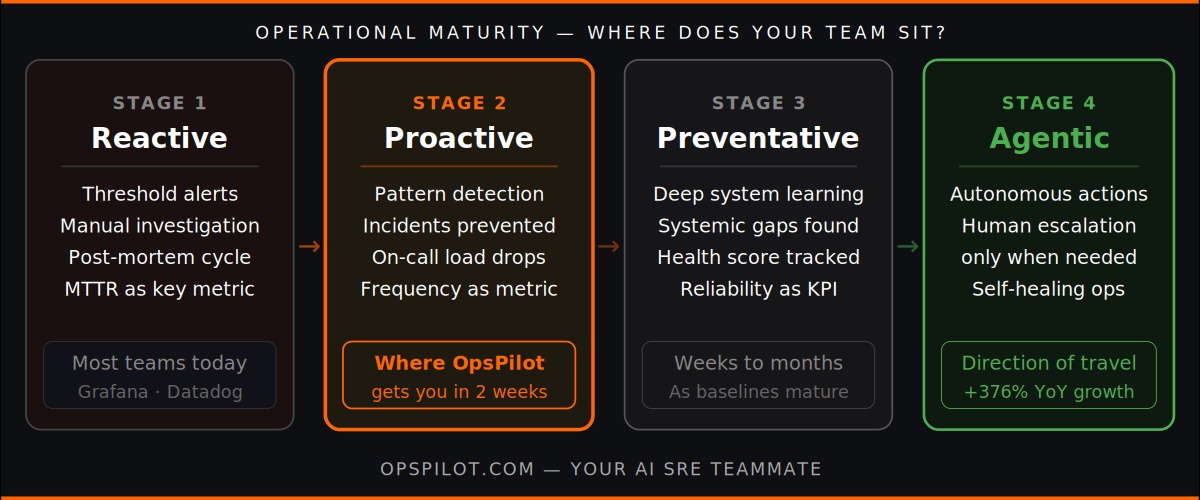
Understanding where your team sits helps clarify what the shift to proactive operations requires. Most engineering teams move through four recognizable stages:
Stage 1: Reactive
Everything is threshold-based. Alerts fire when metrics cross configured values. Engineers investigate after the fact. Root cause analysis is manual. Post-mortems identify what happened but the next similar incident often follows within weeks or months. MTTR is the primary operational metric. The team measures how quickly it recovers, not how often it prevents.
Most teams running standard observability tooling — Grafana, Datadog, New Relic — without an intelligence layer are operating at Stage 1, regardless of how sophisticated their dashboards are.
Stage 2: Proactive
An AI SRE intelligence layer is in place. Pattern detection runs continuously. Known failure signatures are identified before they cross alert thresholds. The majority of incidents that follow recognizable patterns are prevented. MTTR improves not because engineers investigate faster but because fewer incidents fire at all. On-call burden decreases measurably.
This is where the most immediate and commercially significant value of AI SRE sits. As we covered in AIOps in 2026: What It Actually Means and Why Your Monitoring Tool Isn’t It, Stage 2 is the practical, accessible reality of AI SRE in 2026 — not a multi-year transformation project.
Stage 3: Preventative
The intelligence layer has been operating long enough to have learned the system deeply. It not only detects known failure patterns but identifies systemic weaknesses before they manifest as incidents — instrumentation gaps that create analytical blind spots, architectural patterns that recur as failure modes, cost inefficiencies that compound over time. Health scoring provides a continuous measure of operational quality improvement. The team is managing reliability proactively, not just responding to it.
Stage 4: Agentic Operations
The direction of the market as described by Gartner and evidenced by the AI SRE category growth of +376% year over year. The AI SRE layer does not just surface recommendations — it executes routine operational actions autonomously, escalating to human judgment only when the situation requires it. Engineers define the boundaries of autonomous action; Coworker operates within them continuously.
This is real as a direction of travel. OpsPilot’s Coworker is designed with agentic operations as its architectural north star. For most teams in 2026, the practical focus is the Stage 2 → Stage 3 transition — establishing continuous proactive pattern detection and building toward deeper preventative capability as baselines mature and the intelligence layer learns the system.
The Practical Shift: What Changes For Your Team
Moving from Stage 1 to Stage 2 changes three specific things about how an engineering team operates.
The character of on-call changes. On-call engineers stop being the people who discover problems and start being the people who confirm and resolve pre-identified recommendations. The cognitive load of an on-call shift drops significantly. As we explored in Everyone’s Talking About AIOps. Here’s What It Looks Like For a 50-Person Engineering Team, this is particularly significant for smaller teams where on-call rotation is concentrated.
The morning standup changes. Instead of “we had three incidents last night,” the conversation becomes “Coworker flagged two patterns yesterday — we resolved one, the second is being reviewed.” Operational work moves from reactive firefighting into the normal cadence of the working day.
The post-mortem becomes less frequent. Not eliminated — genuine novel failures still occur and deserve proper analysis. But the volume of post-mortems drops as the proportion of incidents that were preventable decreases. The post-mortems that do happen become more valuable because they address genuinely novel failure modes rather than repeating the same pattern analysis for the fourth time.
What Proactive Operations Requires
The transition from reactive to proactive has three practical requirements.
OpenTelemetry instrumentation. Proactive pattern detection requires telemetry data — metrics, logs, and traces flowing from your services. As we covered in You’ve Instrumented Everything With OpenTelemetry. Now What?, most modern engineering teams have this in place. The instrumentation question is answered. The intelligence question is what remains.
An AI SRE intelligence layer. The intelligence layer is what transforms telemetry into proactive insights. Coworker connects to your existing OTLP endpoint — no new agents, no re-instrumentation — and begins continuous analysis within 24 hours. As we explored in What Is An Observability Platform?, this is Layer 3 — the layer that turns a two-thirds observability platform into a complete one.
A delivery channel. Proactive recommendations need to reach the team in the flow of their work, not in a new tool requiring a new habit. Coworker delivers to Slack, Microsoft Teams, or wherever your team works — prioritized HIGH, MEDIUM, or LOW, with specific actions and effort estimates, on the schedule your team configures.
None of these requirements involves a migration project. None requires replacing existing tooling. The shift from reactive to proactive is a matter of adding the intelligence layer that connects your existing telemetry to your team — and letting Coworker do the watching so your engineers don’t have to.
The Cost of Staying Reactive
One practical note for teams considering the shift: the cost of reactive operations is real and ongoing, but it is largely invisible because it is expressed in engineer time rather than tool cost.
Three hours of investigation time per incident, six incidents per month: 18 engineer-hours of your most experienced engineers’ time, consumed monthly by work that an AI SRE layer handles automatically. At a fully-loaded engineering cost, that is a significant recurring investment in reactive firefighting.
The teams that have made the shift to proactive operations report that the time savings alone — from reduced incident frequency and faster resolution when incidents do occur — justify the investment within the first month. The proactive AI capability is not an additional cost on top of your observability spend. For most teams, it replaces some of that spend while delivering substantially more value.
FAQ
Is proactive operations realistic for a team without dedicated SRE engineers? Yes — it is often more impactful for teams without dedicated SRE roles. When reliability work falls on generalist engineers, the cognitive overhead of reactive incident response is most disruptive. An AI SRE layer that watches continuously and surfaces prioritized recommendations reduces that overhead regardless of team structure.
How quickly can a team move from Stage 1 to Stage 2? With OpsPilot, the first proactive recommendations typically arrive within the first 24-hour analysis cycle. Accurate baseline establishment — which improves pattern detection precision — takes approximately one week. Most teams report measurable incident frequency reduction within the first month of operation.
Does proactive operations mean we never have incidents? No. Novel, unpredictable failures will always occur. Proactive operations means that the significant proportion of incidents that follow recognizable patterns — connection pool exhaustion, memory growth, dependency degradation — are identified and resolved before they cause impact. The incidents that do occur are the genuinely novel ones that require human investigation and judgment.
What are agentic operations, and how far away is it? Agentic operations is Stage 4 of the maturity model — where the AI SRE layer executes routine operational actions autonomously, not just recommending them. OpsPilot’s Coworker is architecturally designed for agentic operations as a direction of travel. For most teams in 2026, the practical focus is on establishing proactive pattern detection (Stage 2) and building toward deeper preventative capability (Stage 3).
Stop firefighting. Start preventing. See what OpsPilot finds in your stack.
Book a demo → calendly.com/fusionreactor-sales/opspilot-demo
Or explore at your own pace: Start your free trial → app.opspilot.com/sign-up
OpsPilot is the AI SRE teammate for teams using OpenTelemetry, Prometheus, Grafana, and existing observability stacks — helping engineers investigate incidents, find root cause, and move toward autonomous operations without replacing their tools. OpsPilot, formerly FusionReactor Cloud, is Intergral’s AI-powered observability and AI SRE platform.