
Your Stack Expert, Not Your Stack Replacement: What an AI SRE Teammate Actually Does
When a new category emerges in enterprise software, it carries two risks: the hype that oversells it and the fear that misrepresents it.
For site reliability engineering (SRE) teams in 2026, artificial intelligence for SRE carries both. The hype says AI will run your operations autonomously. The fear says AI will run your operations — and your engineers out of a job.
Neither is accurate. But the fear, in particular, is doing real damage. Engineering leaders who might otherwise benefit from AI SRE capability are holding back because the conversation has been framed as replacement rather than augmentation. That framing is wrong, it is commercially inconvenient for the teams affected, and it deserves a clear and direct response.
An AI site reliability engineering (AI SRE) teammate does not replace SRE engineers. It replaces the parts of SRE work that don’t require SRE engineers — and in doing so, makes the SRE engineers your team has significantly more effective.
Here is what that actually looks like.
What SRE Work Actually Consists Of
To understand what an AI SRE teammate does, it helps to look clearly at what SRE work actually consists of — because not all of it is equally dependent on human expertise.
SRE work broadly divides into two categories.
Work that requires human judgment: Architectural decisions about reliability trade-offs. Incident command under pressure with incomplete information. Communication with leadership and other teams during high-severity events. Long-term reliability strategy. Decisions about acceptable risk. Mentoring junior engineers. Postmortem facilitation. These tasks require experience, context, empathy, and judgment that AI cannot replicate.
Work that is analytical but formulaic: Alert triage — reviewing incoming alerts and determining which are genuine signals versus noise. Dashboard review — checking the current state of services against expected behavior. Initial incident orientation — establishing which services are affected, which dependency relationships are relevant, which recent changes might be implicated. Routine pattern analysis — identifying whether telemetry trends match known failure signatures.
This second category is where engineering time disappears. It is necessary work. It requires knowledge of the system. But it is fundamentally pattern-matching work — the kind that machine learning handles well at scale, continuously, without fatigue.
For a typical SRE team, this formulaic pattern-matching work accounts for 40-50% of engineering time. That is the work an AI SRE teammate does. Not the other 50-60% — the judgment-intensive work that makes SREs valuable.
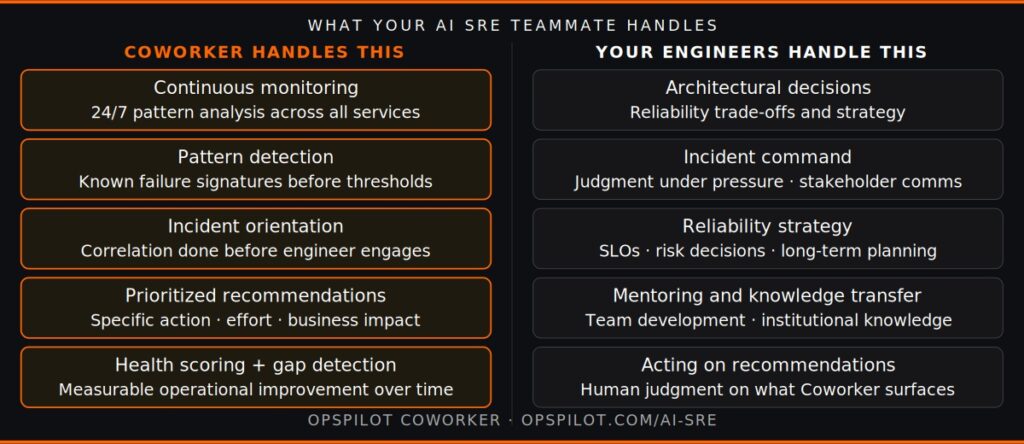
What Coworker Actually Does
OpsPilot’s AI SRE agent is called Coworker. The name is deliberate. A coworker is not a manager and not a subordinate — it is a peer that handles its share of the work so you can focus on yours.
Here is what Coworker does in practice.
Continuous monitoring. Coworker analyzes your OpenTelemetry telemetry continuously — metrics, logs, and traces — on the schedule your team configures. It does not need to be prompted. It does not need someone to remember to check. It watches your production system the way a diligent colleague would if that colleague could maintain perfect attention across all services simultaneously, indefinitely.
Pattern detection. Coworker matches incoming telemetry against known failure patterns — the signatures that precede connection pool exhaustion, memory leak progression, slow query degradation, upstream dependency deterioration. When it identifies a match, it does not wait for the threshold to be crossed. It surfaces the finding proactively. As we explored in From Firefighting to Prevention, this is the shift from reactive to proactive operations.
Prioritized recommendations. Coworker does not deliver raw data or another dashboard. It delivers a conclusion — a specific recommended action, with an effort estimate, a business impact assessment, and a priority rating (HIGH, MEDIUM, or LOW). This is the output of the analytical work that would otherwise require an engineer to complete manually.
Incident orientation. When an alert does fire, Coworker has already done the correlation work. It has matched the pattern, followed the dependency chain, and identified the probable root cause. The engineer who picks up the alert arrives with the investigation already oriented — not starting from scratch. As we covered in Why Does Root Cause Still Take 3 Hours?, this is where most incident time is lost. Coworker eliminates the majority of it.
Gap detection. Coworker continuously evaluates the coverage of your observability instrumentation — identifying which services lack complete trace propagation, which database calls are not instrumented, which external dependencies create analytical blind spots. It surfaces these gaps before an incident exposes them, as described in What Is An Observability Platform?
Health scoring. Coworker tracks operational quality across multiple dimensions — performance, error rate management, cost efficiency, alerting quality, coverage completeness — and produces a health score that changes over time. This gives the team a measurable KPI for operational improvement that was previously invisible.
All of this is delivered to Slack, Microsoft Teams, or wherever your team works — without requiring a new interface, a new dashboard to check, or a new habit to form.
See what Coworker finds in your stack. Book a demo — or start your free trial if you’d rather explore first.
What Coworker Does Not Do
Being clear about what Coworker does not do is as important as describing what it does.
It does not make architectural decisions. When a pattern suggests a fundamental architectural weakness — a service boundary that creates repeated cascade failure risk, a data model that generates query patterns destined to degrade — Coworker surfaces the signal. A senior engineer makes the call on what to do about it.
It does not run incident command. When a high-severity incident requires coordinating multiple teams, communicating with leadership, making judgment calls about user-facing communication, and managing the pressure of a live production failure — that is SRE work. Coworker provides the technical orientation. The engineer runs the incident.
It does not replace reliability strategy. Deciding what reliability targets to commit to, how to balance reliability investment against feature velocity, what risks are acceptable and what are not — these are strategic engineering decisions that require organizational context, business understanding, and accountable human judgment.
It does not self-heal without authorization. Coworker delivers recommendations and, within explicitly configured boundaries, can take defined autonomous actions. It does not make unilateral changes to production systems. The team defines the boundaries of autonomous action; Coworker operates within them. The path toward fully agentic operations — where autonomous action is broader and more sophisticated — is the direction of travel, not today’s default.
The pattern is consistent: Coworker handles the pattern-matching, correlation, and routine analytical work. Engineers handle everything that requires judgment, authority, or accountability.
The Team Impact
The question that matters for engineering leaders evaluating AI SRE is not “what does the AI do?” It is “what changes for my team?”
Three things change.
On-call experience improves. The on-call engineer receives prioritized recommendations rather than raw alerts. Initial orientation work — establishing what is affected and why — arrives with the notification rather than requiring 60-90 minutes of investigation to assemble. As we explored in Everyone’s Talking About AIOps. Here’s What It Looks Like For a 50-Person Engineering Team, this is particularly significant for smaller teams where the on-call rotation is concentrated and each engineer carries disproportionate on-call burden.
Senior SRE time is redirected. The senior SRE engineer who was spending 40% of their week on alert triage, dashboard review, and incident investigation now spends that time on architectural improvement, reliability strategy, and mentoring. Their expertise is applied where it generates the most value — not where it substitutes for pattern-matching that a machine can do more reliably.
Operational improvement becomes measurable. Health scoring gives the team a concrete metric for operational progress that did not previously exist. The movement from a health score of 68 to 81 over a quarter is a story that can be told in a retrospective, reported to leadership, and used to justify continued investment in reliability work. It turns invisible maintenance into demonstrable progress.
These changes are not theoretical. They are the consistent pattern reported by teams that have made the transition from reactive monitoring to proactive AI SRE operations. The specific numbers vary by team and system, but the direction is consistent: more incidents prevented, faster resolution when incidents do occur, better allocation of senior engineering time.
The Replacement Question Answered Directly
Will AI SRE reduce SRE headcount?
For teams that are currently understaffed relative to their reliability obligations — which describes most engineering organizations in 2026 — the answer is no. The AI SRE layer handles the analytical work that was preventing existing engineers from doing higher-value reliability work. The team does more, not less.
For teams that are adequately staffed, the AI SRE layer allows the team to take on more reliability surface area — more services, more complex systems, higher reliability commitments — without proportional headcount growth. This is reliability scaling, not replacement.
The scenario where AI SRE results in headcount reduction is the scenario where a team was significantly overstaffed relative to their system’s complexity — and that scenario was rare before AI SRE and remains rare with it.
What AI SRE does change is the composition of SRE work. Teams that adopt it report that the proportion of time spent on judgment-intensive reliability work increases, and the proportion spent on formulaic analytical work decreases. For SRE engineers, that is generally a welcome change — the work becomes more interesting, the on-call burden decreases, and the connection between SRE effort and system improvement becomes more visible.
For more on how the AI SRE category is developing and what it means for engineering teams, see the AI SRE page at opspilot.com/ai-sre/.
Getting Started
Coworker works with your existing OpenTelemetry data via OTLP. It does not require new agents, re-instrumentation, or changes to your existing Grafana, Prometheus, or alerting setup. Your existing stack stays intact — Coworker adds the intelligence layer that sits above it, as described in What Is An Observability Platform?
The first analysis cycle runs within 24 hours of connection. Initial recommendations — typically a mix of cost optimizations and performance patterns — arrive in the first digest. Accurate baselines, which improve the precision of pattern detection, establish over approximately one week.
The shift from reactive monitoring to proactive AI SRE operations happens in days, not months. No enterprise implementation project. No migration. No new tooling to learn.
FAQ
How is Coworker different from AI features in Datadog or New Relic? The core difference is whether the AI reduces what your engineers do manually or changes the format in which they receive the same work. AI features in monitoring tools typically generate summaries, anomaly alerts, or natural language interfaces for existing data — the investigation is still manual. Coworker does the correlation and orientation work before the engineer engages, delivering a specific recommended action rather than more data to interpret. See AIOps in 2026 for the full distinction.
Does Coworker require us to move our data to OpsPilot? No. Coworker connects to your existing OTLP endpoint — the same transport your telemetry uses to reach your current backend. Your Grafana instance, Prometheus setup, and existing dashboards continue to operate exactly as before. Coworker analyzes the same data stream without requiring data migration or duplication.
What does the health score measure? The health score tracks operational quality across multiple dimensions including performance, error rate management, cost efficiency, alerting quality, and instrumentation coverage. It changes over time as the team acts on recommendations, giving a measurable indicator of operational improvement that is otherwise invisible in standard observability tooling.
Is Coworker moving toward autonomous operations? Yes — agentic operations, where Coworker takes defined autonomous actions within configured boundaries rather than only recommending them, is the architectural direction. For most teams in 2026, the practical focus is establishing proactive pattern detection and recommendation delivery. The agentic capability develops as baselines mature and trust is established through accurate recommendations.
Your AI SRE teammate. Works with your existing stack. First recommendations in 24 hours.
Book a demo Or explore at your own pace: Start your free trial → app.opspilot.com/sign-up
OpsPilot is the AI SRE teammate for teams using OpenTelemetry, Prometheus, Grafana, and existing observability stacks — helping engineers investigate incidents, find root cause, and move toward autonomous operations without replacing their tools. OpsPilot, formerly FusionReactor Cloud, is Intergral’s AI-powered observability and AI SRE platform.