
AI Incident Investigation: The Hidden Cost of Doing It Manually — And What Changes When You Don't
AI incident investigation saves time. Most engineering leaders know this in the abstract. Far fewer have calculated what manual incident investigation is actually costing them — which means they are also not calculating what AI incident investigation would save.
This post does that calculation. It uses a realistic team profile, conservative assumptions, and the actual cost components of manual incident investigation. The numbers are illustrative, not guaranteed. But for most site reliability engineering (SRE) teams, the calculation produces a result that reframes the AI incident investigation conversation from “is this worth the cost?” to “why have we been absorbing this cost for so long?”
The Three Cost Components of Manual Incident Investigation
Manual incident investigation has three distinct cost components. Most teams track only the first — incident duration — and miss the other two entirely.
Component 1: Direct investigation time
This is the cost that appears in incident review documents. An engineer is paged. They investigate. They find the root cause. They resolve the incident. The total time from alert to resolution is logged, averaged, and tracked as MTTR.
For a team handling six significant incidents per month with an average MTTR of 90 minutes, this is 540 engineer-minutes — nine hours — of direct incident response per month. At a fully-loaded senior engineer cost of £120 per hour, this is £1,080 per month in direct investigation time.
But this is the visible portion. The hidden costs are larger.
Component 2: The investigation overhead per alert
MTTR measures time to resolution. It does not measure the time spent on alerts that turn out to be false positives, low-priority noise, or events that resolve themselves. For most teams, the majority of alerts that fire require some investigation before the engineer can determine they don’t require action.
A team receiving 40 alerts per month, of which 25 require meaningful investigation before dismissal, at an average of 20 minutes each, is spending 500 engineer-minutes — over eight hours — on investigation overhead that produces no resolution. At £120 per hour, this is £1,000 per month in investigation overhead.
This cost is invisible in standard incident metrics because it never becomes a formal incident. It is the background tax on engineering attention that alert-heavy environments impose continuously.
Component 3: The cognitive and productivity cost
Sustained alert response — the state of continuous partial attention that on-call engineers maintain — imposes a cognitive cost on all engineering work done alongside it. Research on interruption-based work consistently shows that the productivity cost of an interruption exceeds the duration of the interruption itself, as the engineer needs time to re-establish context for the work they were doing before the alert.
For an on-call engineer handling six significant incidents and 25 minor alert investigations per month, the productivity cost of interruption-based context switching is conservatively estimated at 10-15% of total engineering capacity — several hours per week that are lost not to the investigation itself but to the cognitive overhead of returning to productive work after it.
At £120 per hour for a 40-hour week, 10% productivity loss is £480 per week — roughly £2,000 per month per on-call engineer.
The Total Monthly Cost
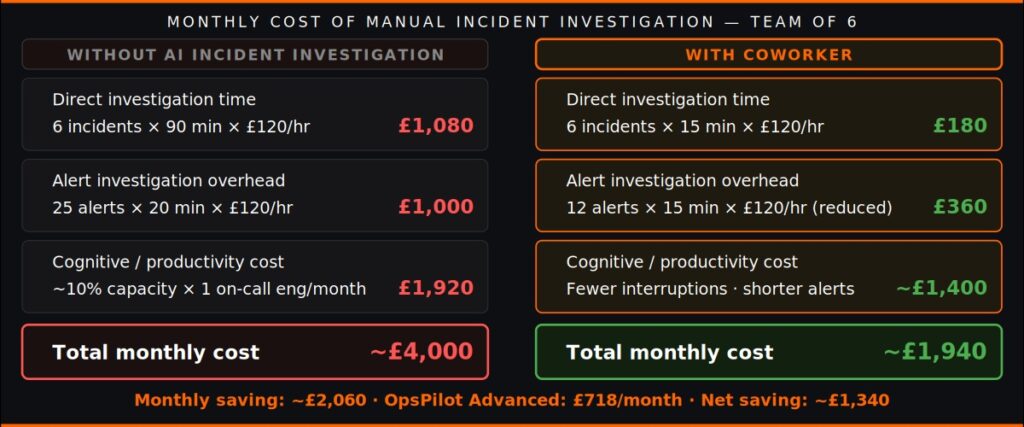
For a team of six engineers sharing an on-call rotation — each on-call for one week in six — the monthly cost of manual incident investigation, fully accounted:
- Direct investigation time: 6 incidents × 90 min × £120/hr = £1,080/month
- Alert investigation overhead: 25 alerts × 20 min × £120/hr = £1,000/month
- Cognitive/productivity cost: 1 engineer/month × 10% × £120/hr × 160hrs = £1,920/month
Total: approximately £4,000/month in engineering cost from manual incident investigation alone.
This is before counting customer impact, SLA exposure, or the compounding effect of incidents that occur during off-hours and impair the next day’s engineering quality.
For a team of 15 engineers, the numbers scale proportionally. For a team with higher incident frequency or longer investigation times, they scale further.
The question this number raises is not whether AI incident investigation is worth the cost. It is whether the cost of continuing without it is visible to the people making platform decisions.
As we covered in How To Defend Your Observability Budget in 2026, invisible costs are the hardest to justify investment against. Making this cost visible is the first step to addressing it.
Ready to calculate what manual incident investigation is costing your team? Book a demo at calendly.com/fusionreactor-sales/opspilot-demo
What AI Incident Investigation Changes
OpsPilot’s Coworker addresses all three cost components of manual incident investigation, though in different ways and to different degrees.
On direct investigation time:
When an alert fires, Coworker has already investigated. It has pulled the relevant metrics, logs, and traces from your OpenTelemetry telemetry, correlated signals across service boundaries, followed the dependency chain, and written up what it found as a situation. The engineer who picks up the alert arrives at a complete investigation, not a blank slate.
Teams running Coworker consistently report the investigation phase — from alert to root cause identification — dropping from 60-90 minutes to 10-15 minutes. For the team profiled above, this reduces direct investigation cost from £1,080 to approximately £180 per month — a saving of £900.
The remaining time is the engineer’s judgment and remediation work. This cannot be automated and should not be. The point of AI incident investigation is not to remove the engineer from the process — it is to remove the analytical orientation work that does not require their expertise.
On alert investigation overhead:
Coworker’s proactive pattern detection catches many of the situations that would otherwise fire alerts before the threshold is crossed. The connection pool situation that would have generated an alert at 90% is surfaced as a warning situation at 72%, resolved proactively, and never generates an alert.
For the team profiled above, reducing alert volume from 40 to 20 per month — a conservative estimate for a team with proactive detection running — reduces alert investigation overhead from £1,000 to £500. But the more significant improvement is in the quality of the alerts that remain: the alerts that fire are the genuinely novel failures, not the predictable threshold crossings that proactive detection should have caught. Investigation time per remaining alert also drops, as Coworker’s context is available for those that do fire.
On cognitive and productivity cost:
This is the most difficult component to quantify precisely, and the one where AI incident investigation makes the most fundamental difference. Fewer alerts that require reactive response means fewer interruptions. Better context when alerts do fire means shorter interruptions. The cumulative effect is an on-call experience that is materially less disruptive to the surrounding engineering work.
As we covered in SRE On-Call 2026, the on-call burden that most teams normalize as inevitable is substantially composed of incidents that proactive detection could have prevented. Removing them does not just save investigation time — it returns the cognitive capacity that was being consumed by the background tax of continuous alert vigilance.
The AI Incident Investigation ROI Calculation
Returning to the team profile above, the monthly cost reduction from AI incident investigation:
- Direct investigation time saved: £900/month
- Alert investigation overhead reduced: £500/month
- Cognitive/productivity improvement: conservatively £500/month
Total monthly saving: approximately £1,900/month
Against OpsPilot’s Advanced tier ($899/month, approximately £718), the saving from manual investigation reduction alone exceeds the platform cost. Even on conservative estimates, the net monthly saving is approximately £1,340.
This is the calculation that engineering leaders can take into a budget conversation. Not “AI incident investigation is interesting technology” — but “we are currently spending £4,000 per month on a cost that AI incident investigation reduces by £1,900, and the platform cost is £718.”
For the full pricing breakdown and cost comparison calculator, see /pricing/ — no form, no sales call.
What AI Incident Investigation Doesn’t Do
It is worth being precise about the limits of what AI incident investigation changes, because overstating the case creates expectations that undermine trust in the capability.
AI incident investigation does not eliminate incidents. Novel failures still occur. Sudden degradations still require human response. Coworker’s proactive pattern detection reduces the incidents that were preventable — which is the majority of incidents — but does not prevent the inherently unpredictable failures that characterize complex production systems.
AI incident investigation does not eliminate investigation time. It reduces the orientation phase — the analytical work of establishing what is affected and why. The judgment phase — deciding what to do, whether the recommended action is appropriate, how to sequence remediation — remains with the engineer. The 10-15 minute figure for AI-assisted investigation represents the orientation phase; total incident handling time includes this plus remediation.
AI incident investigation does not improve immediately to its full capability. Coworker’s proactive detection sharpens as baselines mature over the first month of operation. The alert reduction numbers modelled above reflect a team that has been running Coworker for four to six weeks, not day one.
For more on how Coworker’s investigation capability works technically, see What an AI SRE Teammate Actually Does and From Firefighting to Prevention.
FAQ
How is AI incident investigation different from incident management tools like PagerDuty?
PagerDuty and similar platforms are incident routing and management tools — they receive alert signals and manage the escalation and notification process. AI incident investigation is what happens after the notification fires: the analytical work of identifying root cause. Coworker provides investigation context automatically when alerts fire, reducing the orientation phase from 60-90 minutes to 10-15 minutes. The two complement each other; Coworker does not replace PagerDuty.
Does AI incident investigation work for all types of incidents?
AI incident investigation is most effective for pattern-based incidents — connection pool exhaustion, memory growth, database query degradation, dependency latency trends. For genuinely novel failures with no telemetry precursors, Coworker still reduces investigation time by providing correlation context, but the improvement is less dramatic.
How do you measure the ROI of AI incident investigation?
Direct investigation time (incidents × average MTTR × engineering cost), alert investigation overhead (alert volume × investigation time per alert × engineering cost), and cognitive productivity cost (estimated as a percentage of on-call engineer capacity). After four to six weeks of running Coworker, teams have actual data that makes the ROI calculation concrete.
What does AI incident investigation cost at OpsPilot?
OpsPilot’s pricing starts at $49/month (Starter), Pro at $249/month, and Advanced at $899/month. The pricing page at /pricing/ includes a live cost comparison calculator — no form, no sales call. For most teams, the investigation time saving alone exceeds the platform cost within the first month.
Calculate what manual investigation is costing your team.
Book a demo → calendly.com/fusionreactor-sales/opspilot-demo
Or explore first: Start your free trial → app.opspilot.com/sign-up
OpsPilot is the AI SRE teammate for teams using OpenTelemetry, Prometheus, Grafana, and existing observability stacks — helping engineers investigate incidents, find root cause, and move toward autonomous operations without replacing their tools. OpsPilot, formerly FusionReactor Cloud, is Intergral’s AI-powered observability and AI SRE platform.