
SRE On-Call 2026: Why Your On-Call Rotation Is Broken — And What AI SRE Does About It
SRE on-call 2026 is not a solved problem.
The industry has spent years developing practices around on-call — runbooks, escalation policies, blameless postmortems, rotation scheduling, alert fatigue reduction. These practices help. They do not solve the fundamental problem, which is that on-call engineers are being asked to do reactive work that should not require human judgment at 2am.
The standard fixes to SRE on-call 2026 — better runbooks, tighter thresholds, more people in the rotation — address the symptoms. They do not address the cause. The cause is that most on-call setups are architecturally reactive: they put engineers in the position of responding to production problems rather than preventing them. No amount of process improvement changes what it feels like to be woken at 2 am for an issue that was visible in the telemetry data 48 hours earlier.
This post is about the specific ways that SRE on-call in 2026 is failing engineering teams, why the standard fixes fall short, and what AI site reliability engineering (AI SRE) changes genuinely improve the on-call experience.
Why SRE On-Call 2026 Is Broken
On-call breaks engineering teams in three specific ways.
The volume problem. Alert volume in complex production systems consistently exceeds what humans can productively triage. Engineers on-call receive notifications across multiple channels, for multiple services, at any hour. The cognitive overhead of evaluating each alert — is this real? is it urgent? does it require action now? — is substantial even for a single alert. Sustained across a shift, across a rotation, it produces the alert fatigue we covered in detail in SRE Alert Fatigue 2026. The standard response — tune the alerts — helps at the margins but cannot eliminate the fundamental volume problem in a growing system.
The knowledge concentration problem. On-call value is directly proportional to how well the on-call engineer knows the affected service. The engineer who owns the payment service responds to a payment service incident in 15 minutes. The engineer on rotation who has never worked on it takes 90 minutes to orient themselves before they can even begin to diagnose. Most on-call rotations spread coverage across services that no single engineer knows deeply — which means most on-call incidents are handled by engineers who spend the majority of their time orienting rather than acting.
The 2 am problem. Production systems do not fail during business hours because engineers are kinder in the evenings. They fail at 2 am because that is when the traffic pattern that was trending toward a threshold finally crosses it — and nobody was watching the trend. The trend was visible hours earlier. The alert fires when it is too late for a convenient response. This is not a configuration problem. It is an architectural problem: reactive alerting systems tell you a condition has been met after it has already developed.
Why Standard Fixes Don’t Work
The most common responses to on-call problems are worth examining directly.
Better runbooks reduce investigation time for known failure patterns but require someone to maintain them and assume the failure matches a known pattern. Novel failures — which are often the worst ones — are precisely the failures that runbooks don’t cover.
More people in the rotation reduces individual burden but does not reduce the total burden on the team. It distributes a fixed problem across more engineers rather than reducing the problem. It also introduces the knowledge concentration issue — more engineers covering more services they know less well.
Alert tuning reduces false positives but cannot reduce genuine signals. A growing system generates more genuine alerts over time regardless of how well the thresholds are configured.
Postmortem culture improves the quality of incident learning but is fundamentally retrospective. It makes the team better at responding to the next similar incident — it does not prevent the next similar incident from firing.
None of these address the root cause: the architecture is reactive. Engineers are downstream of problems rather than upstream of them.
Tired of waking up to alerts that should never have fired? Start your free trial at app.opspilot.com/sign-up — no credit card required.
What AI SRE Changes About On-Call
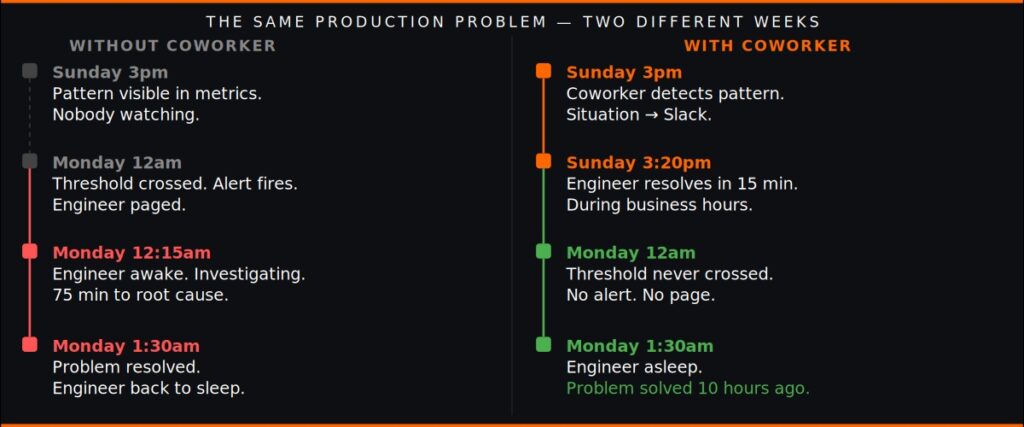
The shift that AI SRE makes to on-call is not incremental — it is architectural. It moves the team from downstream of problems to upstream of them.
Here is what that looks like in practice for a team running OpsPilot’s Coworker.
The pattern that would have caused the 2am page is caught at 3pm.
Coworker watches your telemetry continuously. When it detects the connection pool trending toward saturation — at 72%, rising — it surfaces a situation to your team’s Slack channel during the working day. The situation includes the affected service, the pattern, the recommended action (increase pool size from 20 to 35), and the estimated effort (15 minutes). An engineer acts on it during business hours. The threshold is never crossed. The alert never fires. The 2am page never happens.
This is the primary change. Not faster incident response — fewer incidents that require response.
When incidents do occur, the on-call engineer arrives with context.
For the failures that are genuinely novel — the ones Coworker hasn’t seen before and couldn’t predict — the on-call engineer still receives a page. But they do not arrive at a blank slate. Coworker has already investigated: it has pulled the relevant metrics, logs, and traces, identified which services are affected, followed the dependency chain, and written up what it found as a situation. The engineer opens the situation and sees the investigation already done. The orientation phase — which accounts for the majority of mean time to resolution as we documented in Why Does Root Cause Still Take 3 Hours? — is compressed from 60-90 minutes to 10-15 minutes.
The handoff between on-call shifts is structured and complete.
Without Coworker, shift handoffs rely on the outgoing engineer’s memory and whatever documentation they managed to write during the shift. With Coworker, the incoming engineer opens the situation feed: active situations requiring action at the top, watching situations being monitored below, resolved situations that closed during the shift at the bottom. Every situation includes Coworker’s investigation notes. The context is written down, complete, and current. The handoff takes five minutes.
The knowledge concentration problem is addressed at the source.
Coworker’s investigation work is consistent regardless of which engineer picks up an alert. The on-call engineer who doesn’t own the payment service still receives the same correlation and context that the engineer who does would have assembled manually. The investigation quality no longer depends on the engineer’s familiarity with the service.
As we covered in What an AI SRE Teammate Actually Does, this is the consistent experience reported by teams that have added Coworker. The on-call experience improves measurably — not because the engineers got better, but because the work they’re asked to do during on-call shifts.
SRE On-Call 2026: Before and After Coworker
A concrete SRE on-call 2026 illustration for a team of 30 engineers running eight services on a weekly rotation.
Before Coworker: Six engineers share on-call responsibility. Each carries a week of on-call every six weeks. In a typical week, the on-call engineer handles three to four significant alerts. Average investigation time: 75 minutes per alert. Two of the four alerts fire between 10pm and 6am. The on-call engineer gets seven hours of interrupted sleep. Monday morning they are meaningfully less productive. The pattern that caused Tuesday’s 2am alert was visible in Prometheus metrics since Sunday afternoon.
After Coworker: Coworker surfaces four situations during business hours over the same week. Three are resolved proactively — the problems that would have become 2am alerts are caught and fixed during the day. One genuine novel failure occurs and fires an alert at 11pm. The on-call engineer opens the situation — Coworker has already correlated the signals and identified the affected service. Investigation takes 12 minutes rather than 75. The engineer is back asleep within 20 minutes.
The on-call week involves one interrupted night instead of two, one 12-minute investigation instead of four 75-minute ones, and three production problems that the team resolves proactively rather than reactively.
This is not a hypothetical. It is the operational pattern that teams running proactive AI SRE consistently report.
Getting Started
Coworker connects to your existing OpenTelemetry OTLP endpoint. Your existing alert rules, PagerDuty configuration, and on-call scheduling continue to operate exactly as before — Coworker adds the proactive layer above them, surfacing situations before alerts fire and providing investigation context when they do.
The first situations typically arrive within the first 24-hour analysis cycle. Most teams see a meaningful improvement in on-call experience within the first two weeks as proactive pattern detection begins catching pre-incident situations.
For more on how the AI SRE intelligence layer works, see the AI SRE capability page and the intelligent alerting page. For the Coworker product detail, see Meet Coworker.
FAQ
Does Coworker replace PagerDuty or our existing alerting setup? No. Coworker operates upstream of your alerting layer. Your PagerDuty configuration, escalation policies, and alert routing continue exactly as before. When Coworker catches a pattern early and your team resolves it proactively, the alert that would have fired doesn’t fire. When alerts do fire, Coworker provides investigation context immediately.
How does Coworker handle services that different engineers own? Coworker’s investigation is consistent regardless of who picks up the alert. The on-call engineer receives the same correlation work and context whether or not they own the affected service. The knowledge concentration problem is addressed because the investigation quality no longer depends on the engineer’s familiarity with the specific service.
Will Coworker surface too many situations and create its own noise? Coworker prioritizes situations by severity — critical, warning, and info — and by status — active, watching, and resolved. Active situations requiring immediate attention are clearly separated from watching situations being monitored. On a healthy system, a calm situation list is the expected output. Coworker does not raise situations for the sake of activity.
How quickly does the on-call experience improve? Most teams report a noticeable improvement within the first two weeks as proactive pattern detection begins catching pre-incident situations. The improvement compounds over time as Coworker’s baselines mature and its detection becomes more precisely calibrated to your specific system’s behavior.
Fewer 2am pages. Better context when they do happen. Coworker running from day one.
Start your free trial → app.opspilot.com/sign-up
OpsPilot is the AI SRE teammate for teams using OpenTelemetry, Prometheus, Grafana, and existing observability stacks — helping engineers investigate incidents, find root cause, and move toward autonomous operations without replacing their tools. OpsPilot, formerly FusionReactor Cloud, is Intergral’s AI-powered observability and AI SRE platform.