
SRE Automation: Where the Market Is Heading — And What Teams Should Do Now
SRE automation has been a promise for years. The reality has moved more slowly — and more interestingly — than most predictions suggested.
The original SRE automation story was simple: automate the toil, free the engineers for higher-value work. Runbooks became automated remediation scripts. Alert routing became intelligent escalation. Configuration management became code. These automations were real and valuable. They reduced the most repetitive, lowest-judgment elements of site reliability engineering (SRE) work.
But they did not address the core challenge. The work that consumes the most SRE time — continuous monitoring, pattern detection, incident investigation, root cause analysis — remained stubbornly manual. Not because it could not be automated, but because automating it required a different capability than scripts and configuration management could provide. It required continuous analytical intelligence.
In 2026, that capability exists. And the SRE automation market is moving faster than most engineering leaders have realized. This post is a practical account of where the market is, where it is heading, and what your team should be doing now to be on the right side of that direction.
Where SRE Automation Has Been
The first wave of SRE automation addressed the right target — toil — but with tools that had a limited ceiling.
Script-based automation replaced manual runbook execution. When a known failure pattern occurs, a script runs. The pool restarts. The cache is flushed. The service is recycled. This is valuable. It is also entirely reactive: the script runs after the failure has already occurred, and it only handles the patterns someone thought to write a script for.
Alert-based automation connected monitoring thresholds to automated responses. PagerDuty routes the alert. OpsGenie escalates it. Auto-scaling rules kick in. Again, valuable and limited in the same way — these automations are downstream of the alert, which is downstream of the failure that was already developing.
Infrastructure as code automated environment management, reducing the configuration drift that caused a class of reliability failures. This was genuinely preventative, but preventative at the infrastructure layer, not the observability layer.
What none of these addressed was the gap between having telemetry data and acting on it. As we covered in What Is An Observability Platform?, most teams reached a point of having excellent data collection and visualization — Layers 1 and 2 — without the intelligence layer that converts telemetry into action.
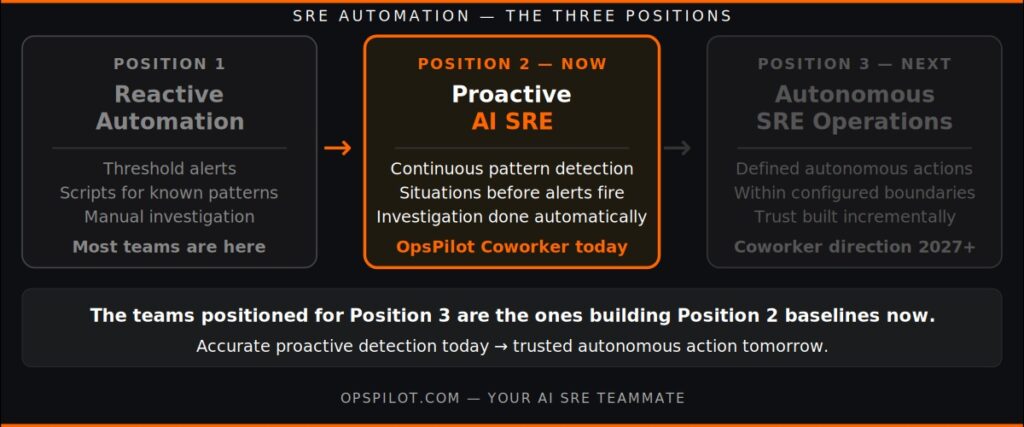
The current state of SRE automation is best understood as a spectrum with three distinct positions, and most teams sitting somewhere in the middle.
Position 1 — Reactive automation: Alerts fire when thresholds are crossed. Scripts run in response to known failure patterns. Engineers investigate manually when alerts don’t map to known patterns. The majority of incident time is still human investigation. This describes most teams that haven’t yet added an AI SRE intelligence layer.
Position 2 — Proactive AI SRE: An AI intelligence layer watches telemetry continuously and surfaces situations — patterns detected before thresholds are crossed, investigation context assembled automatically, health scoring tracking operational quality over time. Engineers still make decisions and execute remediation, but the analytical orientation work is automated. This is where teams running OpsPilot’s Coworker operate today.
The practical difference between positions 1 and 2 is significant. As we covered in From Firefighting to Prevention, the shift from reactive to proactive operations changes the on-call experience fundamentally — fewer 2am pages, faster resolution when incidents do occur, and the cognitive burden of continuous alert vigilance substantially reduced.
Position 3 — Autonomous SRE operations: The AI takes defined autonomous actions within configured boundaries, not just recommendations. When Coworker detects the connection pool approaching exhaustion, it doesn’t only surface a situation — in configured cases, it executes the remediation directly. This is the architectural direction that OpsPilot’s Coworker is moving toward — agentic operations where Coworker acts within boundaries your team has established.
Most teams in 2026 are transitioning from Position 1 to Position 2. The market trajectory is clear: Position 3 is where the leading teams will operate in 2027 and 2028.
Ready to move your team from reactive to proactive SRE automation? Book a demo at calendly.com/fusionreactor-sales/opspilot-demo
Why SRE Automation Is Accelerating Now
Three forces are driving SRE automation faster in 2026 than in any previous period.
OpenTelemetry standardization. The adoption of OpenTelemetry as the standard for telemetry instrumentation has created a common data substrate that AI SRE tools can operate on. Before OTLP, every observability vendor had proprietary data formats that prevented third-party intelligence layers from operating across the stack. With OTLP, adding an AI SRE intelligence layer is a single exporter configuration — not a migration. As we covered in OpenTelemetry Is Now The Standard, this standardization is what makes the intelligence layer practically deployable for most teams.
The maturity of production AI. The AI models capable of continuous pattern detection, cross-signal correlation, and system-specific learning at production scale now exist and are deployable at SaaS cost. In 2023, building this capability required significant ML engineering investment. In 2026, it is a platform subscription. The capability barrier has dropped to the point where teams of five engineers can access the same AI SRE automation that previously required a dedicated ML team.
Engineering team scale pressure. The ratio of services to engineers has grown consistently as cloud-native architectures have expanded production surface area. A team of 10 engineers that managed 20 services in 2022 may be managing 80 services in 2026. The manual monitoring and investigation approach that worked at 20 services does not work at 80. SRE automation is no longer an efficiency improvement — it is a scaling requirement.
What the Market Direction Means for Your Team
The SRE automation market direction has practical implications for decisions teams are making now — particularly around platform architecture and tooling choices.
The intelligence layer is not optional for the long term. Teams operating at Position 1 — reactive automation only — are absorbing a cost in engineer time and on-call burden that compounds as system complexity grows. The investment in moving to Position 2 is available at every tier of OpsPilot’s pricing, starting with a free trial. The question is not whether to add the intelligence layer, but when — and the answer is that the earlier baselines are established, the faster the system-specific learning matures.
OpenTelemetry-native architecture is a prerequisite for what comes next. The movement toward autonomous SRE operations at Position 3 depends entirely on high-quality, complete OTLP telemetry. Teams still running proprietary agents or fragmented instrumentation will find themselves needing to re-instrument before they can participate in the next phase of SRE automation. As we covered in OpenTelemetry Maturity, the instrumentation investment pays for itself in intelligence layer quality — but only if made on the right foundation.
Trust is built incrementally. The path from proactive recommendations (Position 2) to autonomous actions (Position 3) is not a switch that gets flipped — it is a trust relationship that develops as the AI demonstrates accurate judgment over time. Teams that start at Position 2 now, build baselines, refine Coworker’s behavior through corrections, and establish which categories of situation can be acted on autonomously are the teams that will be well-positioned to move to Position 3 as the capability matures.
The Coworker correction mechanism — dismiss with a reason, create a lasting fact — is not just a noise-reduction tool. It is the trust-building mechanism that will eventually support the boundary configuration for autonomous action. The teams investing in it now are building the foundation for what comes next.
As we explored in The Engineer Who Never Sleeps, the autonomous SRE vision is not science fiction — it is the architectural direction that follows naturally from the proactive AI SRE capability that teams are deploying today.
What To Do Now
For engineering leaders thinking about SRE automation positioning, three actions are worth taking in the next quarter.
Assess your current position honestly. Are you at Position 1 — reactive automation with manual investigation? Position 2 — proactive AI SRE with situations surfaced before alerts fire? Understanding where you currently sit determines what the right next step is. The OpenTelemetry maturity self-assessment is a useful starting point.
Close the instrumentation gaps that will limit future automation. If your telemetry coverage is incomplete — some services uninstrumented, distributed trace propagation missing for key service boundaries, logs unstructured — these gaps will limit both your current AI SRE quality and your future autonomous operations capability. Prioritize the services that appear most frequently in incident correlation. See the AI SRE capability page for what complete instrumentation enables.
Start building baselines now. The AI SRE intelligence layer improves with time as it learns your system’s specific behavior. A team that starts running Coworker today will have six months of mature baselines by January 2027 — when the market will have moved substantially further toward autonomous operations. The teams positioned to adopt Position 3 capabilities first are those that have now established accurate Position 2 detection.
The SRE automation market is not waiting for engineering teams to finish their current quarter. The direction is clear, and the pace is accelerating. The practical question is not whether your team participates in this shift — it is whether you are early or late.
FAQ
Is SRE automation the same as NoOps?
No. SRE automation — particularly AI SRE — is augmentation, not elimination. The goal is to automate the analytical orientation work that doesn’t require engineer judgment, freeing engineers for the high-judgment reliability work that does. NoOps implied removing operations entirely. AI SRE implies changing what operations engineers do — less manual triage and investigation, more reliability architecture and system improvement.
Does moving to autonomous SRE operations mean losing control?
Autonomous operations in the AI SRE context means defined autonomous actions within configured boundaries — not unconstrained AI decision-making. The boundaries your team configures determine what Coworker can act on autonomously. The trust relationship develops incrementally, and control is maintained through the boundary configuration.
How long does it take to move from Position 1 to Position 2?
Adding the intelligence layer — connecting OpsPilot’s Coworker to your existing OTLP pipeline — is a configuration change that takes minutes. The first situations surface within 24 hours. Meaningful improvement in on-call experience is typically visible within the first two weeks. Full baseline maturity takes approximately one month.
What does the path from Position 2 to Position 3 look like?
The transition from proactive recommendations to autonomous actions develops as trust is established through accurate recommendations over time. Teams configure boundaries for autonomous action based on their confidence in Coworker’s judgment for specific categories of situations — well-understood, low-risk remediations first, expanding as accuracy is demonstrated. This is the architectural direction OpsPilot is building toward.
Move your team from reactive to proactive SRE automation.
Book a demo → calendly.com/fusionreactor-sales/opspilot-demo
Or start today: Free trial → app.opspilot.com/sign-up
OpsPilot is the AI SRE teammate for teams using OpenTelemetry, Prometheus, Grafana, and existing observability stacks — helping engineers investigate incidents, find root cause, and move toward autonomous operations without replacing their tools. OpsPilot, formerly FusionReactor Cloud, is Intergral’s AI-powered observability and AI SRE platform.