
OpsPilot vs PagerDuty: Upstream AI SRE vs Downstream Incident Management
The most useful thing to say about OpsPilot vs PagerDuty is that for most teams, the answer is not either/or.
PagerDuty is excellent at what it does: coordinating human response to alerts. When an alert fires and a person needs to be paged, routed, escalated, and tracked through resolution — PagerDuty’s scheduling, escalation policy, and stakeholder communication tooling is the category standard. Many teams running OpsPilot continue running PagerDuty. The two sit at different points in the reliability workflow.
The comparison that matters is not “which one should we use.” It is “which problem does each one solve, and do we have both problems?”
The Problem Each One Is Built For
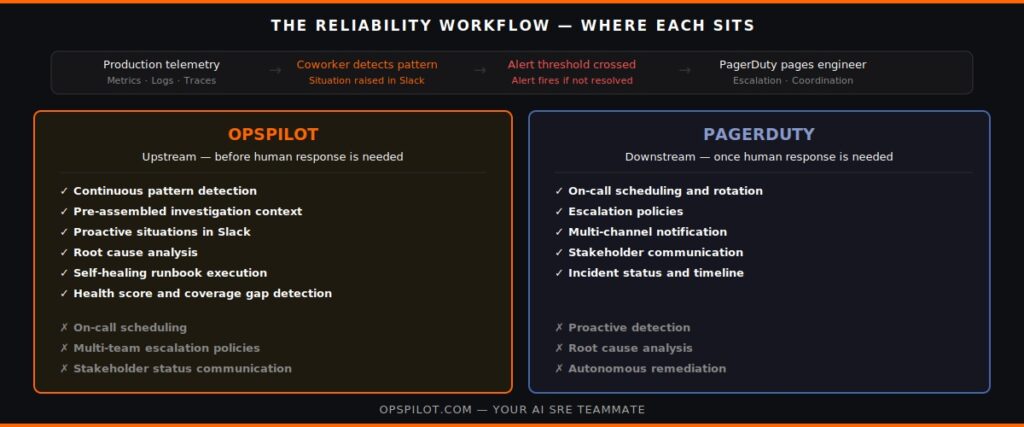
PagerDuty is built for the downstream problem: an alert has fired, a person needs to be reached, and the response needs to be coordinated across a team, an escalation chain, and potentially stakeholders. PagerDuty handles who gets paged, in what order, through what channel, with what escalation if they don’t respond — and provides the workflow for managing the incident through to resolution.
PagerDuty does not change what happens before the alert fires. It does not investigate why the alert fired. It does not reduce the number of alerts that require human response. It makes the human response better coordinated once a response is needed.
OpsPilot is built for the upstream problem: finding and resolving reliability issues before they become alerts that require human response. Coworker watches your production telemetry continuously, identifies patterns trending toward incidents, assembles investigation context automatically, and delivers situations to Slack before alert thresholds are crossed — or with pre-assembled context when they are.
OpsPilot does not replace PagerDuty’s on-call scheduling, escalation policies, or stakeholder communication. For incidents that reach the threshold requiring human coordination, PagerDuty remains the right tool. OpsPilot reduces how many of those incidents occur in the first place, and makes the investigation faster for the ones that do.
Where They Overlap — and Where They Don’t
The overlap zone is incident management. Both platforms have incident management capability. The difference is where that capability sits in the workflow.
PagerDuty’s incident management is downstream of the alert — it provides the workflow for managing a human-coordinated incident response from the point an alert fires. It is optimized for coordination: who is working the incident, what is their status, who are the stakeholders, what is the timeline.
OpsPilot’s incident management is upstream of the alert — it provides the workflow for managing situations Coworker surfaces proactively, many of which never reach the severity level that would trigger a PagerDuty incident. It is optimized for investigation: what is the root cause, what is the recommended action, what is the historical precedent. As we covered in AI SRE Platform and Incident Management, OpsPilot’s incident management integrates directly with its proactive detection layer rather than sitting downstream of alerting.
For incidents that are serious enough to require both — a SEV-1 that triggers PagerDuty’s escalation workflow and also needs OpsPilot’s investigation context — the two work together naturally. OpsPilot’s pre-assembled investigation context accelerates the investigation that PagerDuty’s team is coordinating.
The G2 Comparison
OpsPilot consistently scores higher than PagerDuty across the majority of G2 satisfaction categories — particularly in Product Direction, Setup, and Support. PagerDuty scores higher in Ease of Admin, which reflects the operational sophistication of its on-call management tooling.
The pattern makes sense given what each platform does. Users rate OpsPilot highly on support and setup because connecting to an existing OTLP pipeline and receiving first situations within 24 hours is genuinely fast. Users rate PagerDuty highly on admin ease relative to its complexity because managing multi-team on-call schedules and escalation policies is inherently complex work that PagerDuty has refined over many years.
For the current G2 category comparison, see the OpsPilot vs PagerDuty comparison page.
The Architecture Question
The right question when evaluating OpsPilot vs PagerDuty is not “which one” but “where in our reliability workflow do we have the biggest gap?”
If your biggest gap is coordination — alerts are firing, the right people aren’t being reached quickly enough, escalation is manual, stakeholder communication is inconsistent — PagerDuty addresses that gap.
If your biggest gap is detection and investigation — alerts are firing too late, investigation takes 20-45 minutes of manual work, on-call engineers are being woken for incidents that could have been prevented, and the root cause analysis is reactive — OpsPilot addresses that gap.
Most teams have both gaps. The reliability workflow needs intelligence upstream (OpsPilot) and coordination downstream (PagerDuty). The teams that are furthest along operationally typically run both: Coworker handling proactive detection and investigation, PagerDuty handling on-call coordination for the incidents that do require human escalation.
The specific comparison on which to start with if you only have budget for one: if you are currently losing reliability to incidents that could have been caught earlier, start with OpsPilot — preventing incidents delivers more value than coordinating the response to them. If you are currently losing reliability to poor coordination of incidents that are already happening, start with PagerDuty.
For more on where AI SRE sits in the broader reliability tooling landscape, see AI SRE vs AIOps. For the shift from reactive alert coordination to proactive detection, see Proactive SRE.
The AI SRE page covers OpsPilot’s upstream capability set. For pricing — no form, no sales call.
Frequently Asked Questions
No. OpsPilot's Coworker delivers situations to Slack independently of your existing PagerDuty setup. Your on-call schedules, escalation policies, and PagerDuty routing stay unchanged. For incidents that do escalate to PagerDuty, the investigation context that Coworker has assembled accelerates the response — but the PagerDuty workflow itself is unaffected. The two platforms sit at different layers and don't require integration to coexist effectively.
Not currently. OpsPilot's incident management capability covers the upstream investigation and resolution workflow, not the downstream on-call scheduling and multi-team escalation workflows that PagerDuty specialises in. For teams with complex on-call rotation management across multiple services and teams, PagerDuty's scheduling and escalation tooling is difficult to replace. For teams with simpler on-call structures, OpsPilot's native incident management may cover their needs without requiring a separate on-call platform.
If Coworker resolves a situation autonomously — through an approved self-healing runbook — before the PagerDuty alert threshold is crossed, PagerDuty is not triggered. The incident is logged in OpsPilot's incident timeline and the on-call engineer receives a Slack notification confirming autonomous resolution. If the situation escalates past the PagerDuty threshold before Coworker can resolve it, PagerDuty fires normally alongside Coworker's investigation context.
PagerDuty pricing varies significantly by tier and seat count. OpsPilot's pricing is visible on the pricing page with no form and no sales call. For teams running PagerDuty alongside OpsPilot, the combined cost is evaluated against the incident reduction value that OpsPilot's proactive detection delivers — reduced incident frequency means reduced PagerDuty escalation volume, which can affect PagerDuty usage-based costs.
See what OpsPilot adds upstream of your existing PagerDuty setup.
Book a demo → calendly.com/fusionreactor-sales/opspilot-demo
Or start today: Free trial → app.opspilot.com/sign-up
OpsPilot is the AI SRE teammate for teams using OpenTelemetry, Prometheus, Grafana, and existing observability stacks — helping engineers investigate incidents, find root cause, and move toward autonomous operations without replacing their tools. OpsPilot, formerly FusionReactor Cloud, is Intergral’s AI-powered observability and AI SRE platform.