
AI SRE Next 12 Months: What Engineering Teams Should Be Preparing For Now
The AI SRE next 12 months will define which engineering teams build a durable operational advantage — and which fall further behind. The category did not exist as a distinct market in 2024. Gartner began tracking it separately from AIOps in 2025. By mid-2026, search volume for AI SRE terms is up 376% year-over-year and the major cloud vendors are beginning to build AI SRE capabilities into their platform roadmaps. The next 12 months will see the category move from early adopter to mainstream — and the engineering teams that have been building AI SRE capability into their stacks will have a material operational advantage over those that are still evaluating.
This post is about what the next 12 months look like for AI SRE — the capabilities that are maturing, the architectural shifts that are becoming standard, and what engineering teams should be doing now to position themselves well for where the category is heading.
Where AI SRE Is Right Now
Understanding where AI SRE is heading requires an accurate picture of where it is today. In mid-2026, the AI SRE market has four distinct maturity tiers:
Tier 1 — Reactive monitoring with AI labelling. The largest tier by vendor count. Traditional observability and alerting platforms that have added LLM-based description to their alert output. The underlying architecture is unchanged: threshold-based alerting, reactive investigation, manual remediation. The AI is cosmetic.
Tier 2 — Proactive pattern detection. A smaller tier. Platforms that watch telemetry continuously and surface situations before alert thresholds are crossed. Root cause analysis is pre-assembled rather than requiring manual investigation. OpsPilot’s Coworker operates at this tier — situations in Slack with affected service, correlated signals, recommended action, and estimated effort, delivered before the alert fires.
Tier 3 — Learning and memory. Emerging. Platforms that retain incident knowledge and apply it to future detection — recognizing recurring patterns, calibrating recommendations to what worked previously. OpsPilot’s incident memory capability is in this tier.
Tier 4 — Autonomous remediation. Early stage. Platforms that can not only detect and investigate but execute approved remediation actions without engineer intervention. This tier is where the AI SRE category is heading over the next 12 months.
The engineering teams best positioned for the next 12 months are those currently at Tier 2 — teams that have proactive detection in place, are building incident memory, and are beginning to identify the remediation actions they would be comfortable automating.
The Three Shifts That Define the Next 12 Months
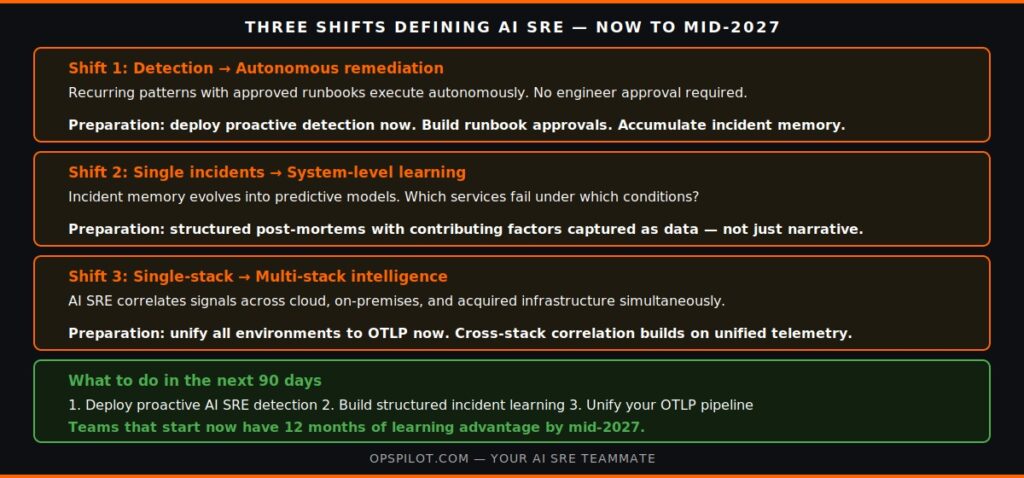
Three shifts will define how the AI SRE category develops between now and mid-2027. Each has implications for how engineering teams should be building their reliability stack today.
Shift 1: From detection to remediation
The most significant shift in the next 12 months is the move from AI-assisted detection to AI-executed remediation. The current dominant model — Coworker detects a situation and recommends an action, an engineer approves and executes — will increasingly become: Coworker detects a situation, identifies it as a recurring pattern with a previously approved runbook, and executes the remediation autonomously.
This shift is not a sudden transition. It is a gradual expansion of the remediation envelope — starting with well-understood recurring situations where the runbook is deterministic and the risk of incorrect remediation is low. Connection pool exhaustion with a known fix. Memory leak patterns with a known restart sequence. Rate limit approaches with a known circuit breaker action.
Second, situations where the remediation has been executed manually several times and the outcomes have been consistently positive. Incident memory allows Coworker to identify these patterns and at that point, autonomous execution is a reduction in response time rather than an increase in risk.
For the current state of autonomous SRE and what it looks like in practice, see Autonomous SRE: The Engineer Who Never Sleeps.
Shift 2: From individual incidents to system learning
The second shift is the maturation of incident memory from a single-incident feature to a system-level learning capability. Current incident memory is primarily reactive — when a pattern recurs, Coworker recognizes it and surfaces the historical context. The next 12 months will see this evolve into proactive pattern learning — Coworker identifying patterns across incidents before they recur, building predictive models of which services are likely to experience specific failure modes under which conditions.
This shift has implications for how teams structure their incident post-mortems. Post-mortems that feed structured data into Coworker’s learning layer produce better predictive models than post-mortems that produce only narrative text.
The practical action today: ensure that OpsPilot’s post-mortem gatekeeper is configured to capture contributing factors in structured fields, not just free text.
Shift 3: From single-stack to multi-stack intelligence
The third shift is the expansion of AI SRE capability across increasingly complex and heterogeneous infrastructure. Current AI SRE deployments are predominantly single-stack. The next 12 months will see more teams deploying AI SRE across multi-cloud environments, across acquired infrastructure, and across hybrid on-premises and cloud systems.
For engineering teams running multiple cloud environments or managing hybrid infrastructure, the preparation is straightforward: ensure that every environment is producing OTLP telemetry and routing to a unified Coworker instance. The cross-stack correlation capability builds on unified telemetry — it cannot be added retrospectively to fragmented monitoring setups.
Ready to start building the AI SRE capability that the next 12 months will reward? Book a demo at calendly.com/fusionreactor-sales/opspilot-demo
What to Do Now to Position for the Next 12 Months
For engineering leaders thinking about where AI SRE is heading, three practical actions today produce the most compounding value over the next 12 months:
1. Get to Tier 2 proactive detection this quarter. Every month of delay is a month of incidents that could have been prevented, a month of baselines not being built, and a month of incident memory not being accumulated. The teams that are best positioned in mid-2027 are the ones that deployed proactive detection in 2026 and have 12 months of learning behind them. The evaluation question to start with is covered in How to Evaluate an AI SRE Platform.
2. Build structured incident learning now. Configure post-mortem requirements to capture structured contributing factors. Categorize situations by service, pattern type, and remediation. Build the data layer that autonomous remediation will run on in 12 months.
3. Unify your telemetry pipeline. Any fragmented monitoring setup — services not yet on OTLP, separate monitoring for different environments, telemetry that doesn’t route to Coworker — is a future limitation. The cost of OTLP unification is lower now than it will be when cross-stack correlation becomes a category standard.
For how to frame the AI SRE investment case, see From Reactive to Proactive SRE. For the current OpsPilot capability set, see the AI SRE page and pricing page — no form, no sales call.
Frequently Asked Questions
Fast enough that the gap between Tier 1 and Tier 2 maturity is visible in operational outcomes today, not just in roadmap comparisons. Teams at Tier 2 with proactive detection are seeing meaningful incident frequency reductions within 90 days. Teams at Tier 1 — reactive monitoring with AI labelling — are seeing the same incident frequency with faster notification delivery. The practical gap in 2026 is already significant. The gap in 2027 as autonomous remediation matures will be larger.
No. Autonomous remediation builds on the baselines, incident memory, and pattern learning that proactive detection accumulates over time. A team that deploys proactive detection now and builds 12 months of learning will be in a materially better position to adopt autonomous remediation when it matures than a team that waits. The preparation for Tier 4 is doing Tier 2 well for an extended period.
Ask to see the current incident memory and learning capability — not the roadmap, the current product. A vendor with genuine incident memory (recognizing recurring patterns, surfacing historical context, calibrating recommendations based on what worked) has the foundation for autonomous remediation. A vendor with only alert notification and LLM description does not. The gap between genuine AI SRE capability and re-labelled reactive monitoring is visible in current product output, not roadmap promises.
On-call rotations don't disappear — they change in character. The incidents that reach on-call engineers are increasingly the novel failures that AI SRE didn't recognize from historical patterns, the high-severity incidents that require human judgment beyond approved runbooks, and the architectural decisions that produce reliability improvements. The high-frequency low-complexity incidents are increasingly handled autonomously. The on-call role shifts from firefighter to reliability architect.
The teams building AI SRE capability now will have the advantage in 2027.
Book a demo → calendly.com/fusionreactor-sales/opspilot-demo
Or start today: Free trial → app.opspilot.com/sign-up
OpsPilot is the AI SRE teammate for teams using OpenTelemetry, Prometheus, Grafana, and existing observability stacks — helping engineers investigate incidents, find root cause, and move toward autonomous operations without replacing their tools. OpsPilot, formerly FusionReactor Cloud, is Intergral’s AI-powered observability and AI SRE platform.
.