
AIOps in 2026: What It Actually Means and Why Your Monitoring Tool Isn't It
Every major monitoring vendor has added “AI” to their marketing in the last two years.
Datadog has AI. New Relic has AI. Dynatrace has AI. Grafana has AI features. The word appears in product pages, conference keynotes, analyst briefings, and sales decks with a frequency that has made it almost meaningless.
AIOps — artificial intelligence for IT operations — has become a label applied to everything from a simple anomaly detection algorithm to a genuine operational intelligence platform. The range is so wide that the term has lost most of its descriptive value.
This matters for engineering teams making platform decisions in 2026, because the question is not whether a tool has AI features. Almost all of them do. The question is what those features actually do, and whether they meet the threshold that makes a tool genuinely useful as an AIOps platform rather than a monitoring tool with an AI badge on it.
The distinction is not academic. It determines whether your team spends less time on incidents or roughly the same amount, with a more expensive subscription.
What AIOps Actually Means
AIOps in 2026 has a clear definition, even if vendors rarely use it clearly.
At its simplest: AIOps is the application of machine learning and data analysis to automate and enhance IT operations workflows. Not observe them. Not visualise them. Enhance and automate them.
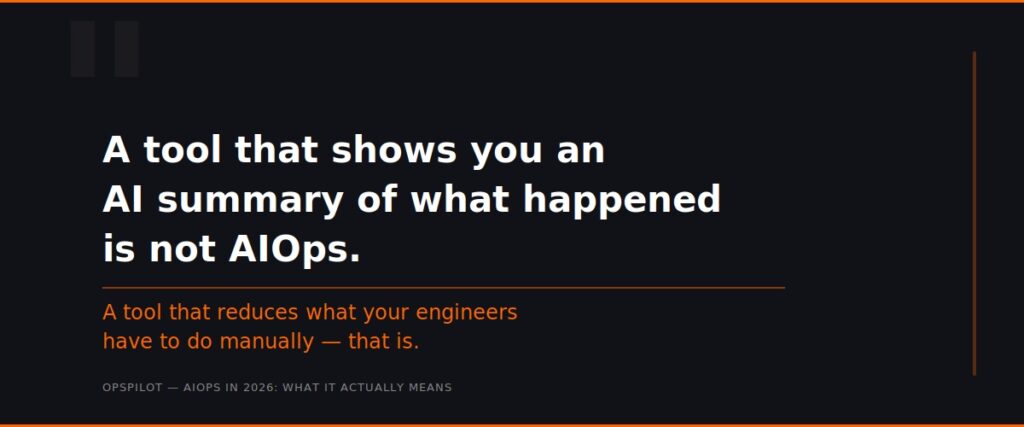
The key word is automate. A tool that shows you an AI-generated summary of what happened is not AIOps. A tool that uses AI to detect patterns, generate recommendations, assist with investigations, and reduce manual work in operations — that is AIOps.
The practical threshold is this: does the AI in this tool reduce what your engineers have to do manually, or does it just change the format in which they receive information to act on manually?
If your team still has to investigate every alert from scratch, the AI isn’t doing AIOps. It is doing AI-assisted visualization, which is a different and more modest thing.
The Four Capabilities That Define Genuine AIOps
When you strip away the marketing language, genuine AIOps in 2026 comes down to four specific capabilities. A tool that has all four is an AIOps platform. A tool that has one or two is a monitoring tool with AI features.
1. Automated anomaly detection with context
Not just “this metric is above its normal range.” Every basic alerting tool does that. Genuine anomaly detection understands the context of the anomaly — is this metric elevated because of a known deployment? Is it correlated with an anomaly in a related service? Is the elevation significant given current traffic patterns or is it within the expected range for this time of day?
Context is what separates an alert from an insight. Alerts tell you a threshold was crossed. Insights tell you whether the threshold crossing matters and why.
2. Automated root cause analysis assistance
When something goes wrong, a genuine AIOps platform does not wait for an engineer to start investigating. It begins correlating signals automatically — matching the pattern of symptoms against known failure signatures, following the dependency chain, identifying the most likely root cause, and surfacing that analysis before the engineer opens a single dashboard.
As we covered in Why Does Root Cause Still Take 3 Hours?, the Phase 1 and Phase 2 work of incident investigation is largely automatable. A genuine AIOps platform automates it. A monitoring tool with AI features generates an AI summary of the alert after it fires.
3. Proactive pattern detection
Genuine AIOps does not wait for incidents to start working. It analyses telemetry continuously and identifies patterns that precede failures before they cause impact. The connection pool trending toward saturation. The memory growth trend that will cause an OOM restart in three days. The slow query that is approaching a critical volume threshold.
These patterns are in the data. The question is whether anything is looking for them systematically and proactively — or whether the team only sees them in retrospect, during the post-mortem, realising the warning was visible for days.
4. Learning and improvement over time
A genuine AIOps platform gets better as it operates. It learns your specific service topology, your normal traffic patterns, your recurring failure modes. Its recommendations become more accurate. Its baselines become more precise. Its false positive rate decreases.
A monitoring tool with AI features runs the same algorithm on your data regardless of how long it has been operating. It does not learn your system. It applies generic rules to your specific context and generates results of variable relevance.
See what genuine AIOps looks like for a mid-sized engineering team. Start your free trial at app.opspilot.com/sign-up — no credit card required.
Why Most Monitoring Tools Don’t Qualify
This is where the conversation gets specific, because it requires saying clearly what most “AI-powered” monitoring tools actually do.
Most major monitoring tools have added AI features that fall into one or more of these categories:
Anomaly detection alerting. Statistical models that flag when a metric deviates from a baseline. Useful. Not AIOps. This is automated threshold management. It reduces the work of configuring static thresholds but does not reduce the work of investigating what the anomaly means.
Natural language querying. The ability to ask questions of your data in plain English rather than a query language. Useful for accessibility. Not AIOps. The investigation is still manual — the interface has changed but the work has not.
AI-generated summaries. After an alert fires, an AI generates a text summary of the relevant metrics and logs. This is AI-assisted reading of information that was already available. It may save a few minutes of dashboard navigation. It does not meaningfully reduce investigation time.
Predictive alerting. Forecasting metric trends and alerting when they’re predicted to cross a threshold. Better than reactive alerting. But still reactive in character — it tells you a problem is coming rather than telling you what to do about it.
None of these is AIOps in the operational sense. They are AI features in monitoring tools. Valuable in their own right. But not the same as a platform that reduces what your team has to do manually.
As we explored in Don’t Buy An AI-Native Black Box, the risk with AI features in monitoring tools is that they can create the impression of intelligence without delivering the operational improvement. Teams pay for the AI features, continue spending the same number of hours on incident investigation, and conclude — correctly — that AIOps didn’t deliver what was promised.
What wasn’t delivered wasn’t AIOps. It was an AI interface on top of reactive monitoring.
What AIOps Looks Like In Practice For A Mid-Sized Team
The enterprise AIOps narrative — autonomous operations, self-healing infrastructure, zero-touch incident response — is real as a direction of travel but misleading as a description of where useful AIOps capability sits today.
The practical AIOps value for a team of 20-100 engineers in 2026 is not autonomy. It is reduction of manual work at the points where manual work is most costly and most replaceable.
Specifically:
Before incidents: Continuous analysis that identifies patterns preceding known failures and delivers prioritised recommendations before anything breaks. The engineer’s job is to act on a clear recommendation rather than find the problem. As described in Your Observability Stack Is Missing Layer 3, this is the intelligence layer that most teams lack.
During incidents: Automated correlation of signals across metrics, logs, and traces that shortens the investigation phase from 90 minutes to 10. The engineer arrives at an incident with the orientation work already done and a hypothesis already formed.
After incidents: Pattern learning that means the same failure is less likely to go undetected next time. Health scoring that tracks whether the team is improving or cycling through the same problems repeatedly.
This is AIOps that is achievable today, from existing OpenTelemetry data, without a multi-year transformation project. It is not the autonomous operations of enterprise vendor keynotes. It is a meaningful reduction in the manual work that consumes engineering capacity and degrades on-call experience.
For the teams running it, the before and after is clear. Before: alerts fire, engineers investigate manually, root cause takes hours. After: patterns are surfaced proactively, incidents fire less frequently, when they do fire the analysis is already done.
The Question To Ask Any AIOps Vendor
The marketing question — “does your tool have AI?” — is not useful in 2026. The answer is always yes.
The useful questions are:
Does the AI reduce manual work or just change its format? If an engineer still has to investigate every alert from scratch, the AI is a presentation layer, not an operational one.
Does the platform analyse proactively or reactively? If analysis only runs when an alert fires, the “AI” is adding a step to the reactive process rather than replacing the reactive process with a proactive one.
Does it get better over time on your specific data? If the platform applies the same generic models regardless of how long it’s been running, it is not learning your system. The value will plateau quickly.
Can you explain to your team what the AI found and why? Black-box outputs are difficult to act on confidently. A platform that can show its reasoning — here is the pattern, here is the evidence, here is the recommended action and why — is one your team will trust and use. As we argued in From Black Box to Big Green Button, explainability is not optional in a production operations context.
Does it work with your existing telemetry? A genuine AIOps platform should connect to your existing OpenTelemetry data without requiring new agents, new instrumentation, or a data migration. If the first step is “migrate your telemetry to our proprietary format,” the platform is optimising for lock-in rather than value delivery.
AIOps Without The Enterprise Price Tag
One reason AIOps has underdelivered for mid-sized teams is that the platforms typically described as AIOps leaders were designed for enterprise IT operations — large organizations with centralized operations teams, significant budgets, and the internal capacity to implement complex platforms over months.
A 30-engineer team does not have an implementation team. It does not have months for a migration project. It does not have an enterprise observability budget.
The AIOps value that matters for mid-sized teams is achievable without enterprise complexity. Connecting to existing OpenTelemetry data takes minutes. Establishing baselines takes a week. Delivering the first actionable recommendation takes 24 hours.
OpsPilot is built specifically for this. Not the enterprise AIOps vision of autonomous operations — the practical AIOps reality of continuous analysis, proactive pattern detection, and prioritized recommendations delivered to your team on your schedule.
The services view gives you the topology context that the intelligence layer needs. The health scoring gives you the improvement metric that your leadership can see. The gap detection finds the instrumentation blind spots before they become incident blind spots.
AIOps in 2026 does not require an enterprise budget or a six-month implementation. It requires an OpenTelemetry endpoint and a Slack or Teams channel.
AIOps without the enterprise complexity. Works with your existing OpenTelemetry data in 24 hours.
OpsPilot is an AI-powered observability intelligence platform that continuously analyses your OpenTelemetry data and delivers prioritised recommendations, health scoring, and gap detection — directly to your team. Built by APM engineers with two decades of experience.