
The Datadog Alternative Checklist: What to Run Before Your Next Observability Renewal
Observability platform renewals — and the Datadog alternative question that often surfaces at renewal — are one of the few moments in the engineering calendar where “is this still the right tool?” gets asked seriously. The rest of the year, the platform is in production, the team is trained on it, and switching costs are abstract. At renewal, the contract is on the table and the cost is concrete.
For teams running Datadog — or any major observability platform — that renewal moment is worth more than a price negotiation. It is an opportunity to evaluate whether the platform is solving the right problem, whether what you’re paying for is producing operational value proportionate to its cost, and whether a Datadog alternative would serve your team better in 2026.
This checklist is designed for that moment. It covers five areas: cost, capability, on-call experience, operational maturity, and fit. Work through it before your renewal conversation. The answers will tell you whether you have a negotiation to run or a platform evaluation to start.
The Five-Area Renewal Checklist
Area 1: Cost — what are you actually paying for?
The cost conversation in observability renewals rarely happens at the right level of detail. Most teams know their total platform bill. Few know the breakdown of what that bill is paying for and what proportion of it is generating operational value.
1a. Query what you pay for. Pull your ingestion and cardinality usage from the last 90 days. What percentage of stored metrics time series were queried? What percentage of logs were accessed during investigation? As we covered in Observability Cost, 15-30% of observability spend is typically on data that nobody queries. Identify this before negotiating — it changes the conversation.
1b. Calculate the investigation cost. How many incidents required engineer response in the last quarter? What was the average investigation time? Multiply by your average engineer hourly cost. This is the invisible cost that sits alongside your platform bill — and for most teams it exceeds the platform cost. As we covered in AI SRE Tools and MTTR, this is the cost a Datadog alternative with proactive AI SRE reduces most significantly.
1c. Compare against what you’re getting. Is the platform bill producing proportionate value? A platform that costs £22k/month and reduces incident investigation cost by £8k/month is producing £8k of value against £22k of cost. A platform that also catches 60-70% of incidents proactively — reducing the incident count itself — changes that equation materially.
1d. Get a like-for-like quote. Before renewing, get a comparison quote from at least one Datadog alternative. OpsPilot’s pricing page shows tier comparison with no form and no sales call. The Datadog alternative page covers the specific capability comparison.
Area 2: Capability — is it doing what you actually need?
2a. The 24-hour autonomous output test. Log in. Do nothing. Come back tomorrow. What did your observability platform surface without being prompted? If the answer is nothing — if the platform waited for you to run a query or for an alert to fire — it is reactive by architecture. In 2026, an observability platform should be watching your production system and telling you what matters, not waiting to be asked.
2b. The investigation completeness test. Take your last three significant incidents. How long did it take from alert to root cause identification? If the answer is 60+ minutes of manual dashboard querying for a typical incident, your platform is providing data but not investigation capability. That’s the gap an AI SRE platform fills.
2c. The proactive detection test. How many of your last quarter’s incidents were caught before the alert fired — during business hours, before customer impact? If the answer is none, your architecture is purely reactive. That’s a category limitation that a Datadog alternative with AI SRE capability addresses differently.
Area 3: On-call experience — what is it costing your engineers?
3a. The on-call survey. Ask your on-call engineers three questions: How many nights were you woken by alerts last quarter? How long did it take to find root cause on your last three incidents? How would you describe the background anxiety of being on-call? As we covered in SRE Burnout, the retention cost of reactive on-call is substantial and rarely counted in the platform cost conversation.
3b. The alert-to-situation ratio. What percentage of alerts that fired last quarter resulted in genuine incidents requiring action? What percentage were noise? High alert noise is a signal that the monitoring architecture is threshold-based and reactive rather than pattern-based and proactive.
Area 4: Operational maturity — is it getting better?
4a. Incident frequency trend. Did incident frequency decline over the last year? If it has remained flat or increased despite increasing observability spend, the platform is not improving your reliability posture — it is documenting your reliability posture. That’s a meaningful distinction.
4b. Health score. Does your current platform give you a composite reliability quality metric that trends over time? If not, you are missing the leadership-visible output that makes reliability investment defensible at budget time.
Area 5: Fit — is it the right tool for your team?
5a. Team profile assessment. What is your team size? Are you primarily cloud-native on Kubernetes with OpenTelemetry instrumentation? Do your operational problems center on alert volume management (AIOps fits), or on analytical depth and proactive detection (AI SRE fits)? As we covered in AI SRE vs AIOps, these are genuinely different architectures solving different problems. Choosing the right category for your profile is as important as choosing the right vendor within a category.
What to Do With the Results
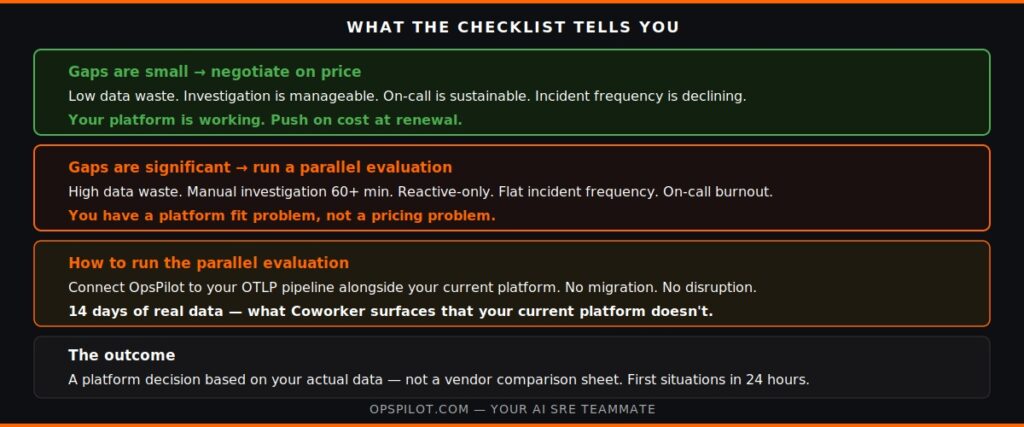
If the checklist surfaces significant gaps — high data waste, manual investigation, reactive-only detection, flat incident frequency, poor on-call experience — you have a platform evaluation to run, not just a negotiation.
The evaluation does not require a migration decision before you have data. OpsPilot’s free trial — no credit card required, first situations in 24 hours — runs alongside your existing Datadog deployment. Your current setup is unchanged. Coworker receives the same OTLP stream as an additional intelligence layer.
After 14 days, you have real comparative data: what Coworker surfaces proactively that your current platform doesn’t, what the investigation time difference looks like on actual incidents, and what the cost comparison is at your usage level.
That data — not a vendor comparison sheet — is what makes a platform decision credible to leadership.
For the specific capability comparison between OpsPilot and Datadog, see the Datadog alternative page and how OpsPilot compares against Datadog. For how to present the business case for switching, see Defending Your Observability Budget in 2026.
To evaluate the AI SRE capability questions from the checklist specifically, the AI SRE evaluation framework covers the six questions that distinguish genuine AI SRE platforms from re-labelled reactive tools.
Book a demo before your renewal to see what OpsPilot finds in 14 days alongside your current platform: calendly.com/fusionreactor-sales/opspilot-demo
Frequently Asked Questions
Yes. OpsPilot connects to your OTLP pipeline as an additional consumer — your Datadog agent and integrations continue unchanged. Coworker receives the same telemetry stream in parallel and analyzes it independently. You can run both in parallel for 14 days to compare what each surfaces before making any platform decision.
Yes. The five areas — cost, capability, on-call experience, operational maturity, and fit — apply to any observability platform renewal. The specific metrics and tests work regardless of which platform you're evaluating. We use Datadog as the reference point because it's the most common incumbent platform our customers move from, but the framework applies equally to Dynatrace, New Relic, Splunk, or any other major platform.
Most of the data needed is available in your existing incident management and observability tooling. The cost analysis (Areas 1a and 1b) typically takes 2-3 hours to pull together properly. The capability tests (Area 2) can be run in a single afternoon. The on-call survey (Area 3a) takes however long it takes to get responses from your on-call rotation — usually 24-48 hours if done asynchronously.
The checklist is most actionable at renewal, but the capability and on-call experience gaps it surfaces are worth knowing at any point. Teams that identify significant gaps mid-contract sometimes negotiate early termination when the gap is large enough — particularly when the data waste calculation (Area 1a) reveals that a significant proportion of their spend is on data nobody queries.
Run the checklist. Book a demo before your renewal.
Book a demo → calendly.com/fusionreactor-sales/opspilot-demo
Or start the parallel evaluation today: Free trial → app.opspilot.com/sign-up
OpsPilot is the AI SRE teammate for teams using OpenTelemetry, Prometheus, Grafana, and existing observability stacks — helping engineers investigate incidents, find root cause, and move toward autonomous operations without replacing their tools. OpsPilot, formerly FusionReactor Cloud, is Intergral’s AI-powered observability and AI SRE platform.