
Datadog Alternative in 2026: Reduce Observability Spend. Add AI SRE
If you are searching for a Datadog alternative in 2026, you are in good company.
The search volume for “datadog alternative” has been consistently high for several years, and the average cost-per-click in that search category — approaching €55 — tells you something important: the teams searching are in active buying mode, and vendors know it. Renewal windows concentrate minds, and Datadog’s enterprise contracts have a way of prompting engineering leaders to ask whether the value matches the cost.
This post is a direct answer to that question — not a marketing comparison designed to make OpsPilot look good regardless of context, but an honest assessment of when switching makes sense, what you gain, and what you should know before you decide.
The short version: OpsPilot is a compelling Datadog alternative for site reliability engineering (SRE) teams whose primary pain points are observability cost and the gap between having telemetry data and getting actionable intelligence from it. If those are your pain points, read on.
Why Teams Look For a Datadog Alternative
The reasons teams search for a Datadog alternative cluster around three themes.
Cost. Datadog’s pricing model — based on hosts, metrics volume, log ingestion, and APM traces — scales with your infrastructure in ways that can surprise teams as they grow. The jump from a stable bill to a significantly larger one after a period of growth or increased instrumentation is a common trigger for renewal-window evaluation. As we covered in How To Defend Your Observability Budget in 2026, the question is not just what the platform costs but what it produces — and the gap between observability spend and demonstrable operational outcomes is what makes teams look for alternatives.
The intelligence gap. Many teams find that even with a mature observability platform in place, they are still doing significant manual investigation work when incidents occur — correlating signals, following dependency chains, and orienting themselves before they can act. This is the intelligence gap described in What Is An Observability Platform? OpsPilot’s Coworker closes it by running continuous proactive analysis on your telemetry — surfacing situations with specific recommended actions before thresholds are crossed, rather than waiting for alerts to fire.
Vendor lock-in concern. Datadog’s proprietary agent and data format create switching costs that increase over time as instrumentation deepens. Teams that have moved to OpenTelemetry — or are planning to — often find that a Datadog alternative built natively on OTLP is architecturally cleaner and less dependent on any single vendor’s continued direction.
What OpsPilot Offers as a Datadog Alternative
OpsPilot works two ways: as an additive AI SRE intelligence layer on top of your existing stack, or as a full replacement for Datadog at 60–70% lower cost. The choice is yours and there is no disruption either way.
For teams that want to evaluate before committing, OpsPilot connects to your existing OTLP endpoint in minutes and runs alongside your current setup — no migration required. For teams approaching renewal and ready to make the switch, OpsPilot replaces Datadog’s collection, visualization, and alerting capabilities while adding the continuous AI SRE intelligence layer that Datadog does not provide.
What OpsPilot’s Coworker does that Datadog does not:
Coworker runs continuously on your OpenTelemetry telemetry — metrics, logs, and traces — and proactively identifies what matters without being asked. When it detects a pattern that precedes a production incident, it surfaces a situation: a grouped, prioritized finding with a specific recommended action, an effort estimate, and a confidence level. It delivers this to Slack or Microsoft Teams before the threshold is crossed and the alert fires.
The operational result is what teams switching from reactive observability platforms consistently report: fewer 2am pages, faster resolution when incidents do occur, and more engineering time available for high-judgment reliability work rather than manual triage and investigation.
As we covered in What an AI SRE Teammate Actually Does, this is the practical difference between a tool that makes data available and one that acts on it.
What you keep from your existing stack:
OpsPilot connects to your OTLP endpoint. Your Grafana dashboards, Prometheus queries, and alerting configuration continue to operate exactly as before. The transition does not require re-instrumentation or a data migration — it requires pointing an additional OTLP exporter at OpsPilot alongside your existing backend.
For teams currently running Datadog agents, migrating to OpenTelemetry instrumentation is a prerequisite for OpsPilot — and a step that removes Datadog’s proprietary instrumentation dependency regardless of what backend you choose. The OpenTelemetry standard post covers what that transition looks like in practice.
Evaluating OpsPilot as a Datadog alternative? Book a demo at calendly.com/fusionreactor-sales/opspilot-demo — we’ll address your specific environment directly.
The Cost Comparison
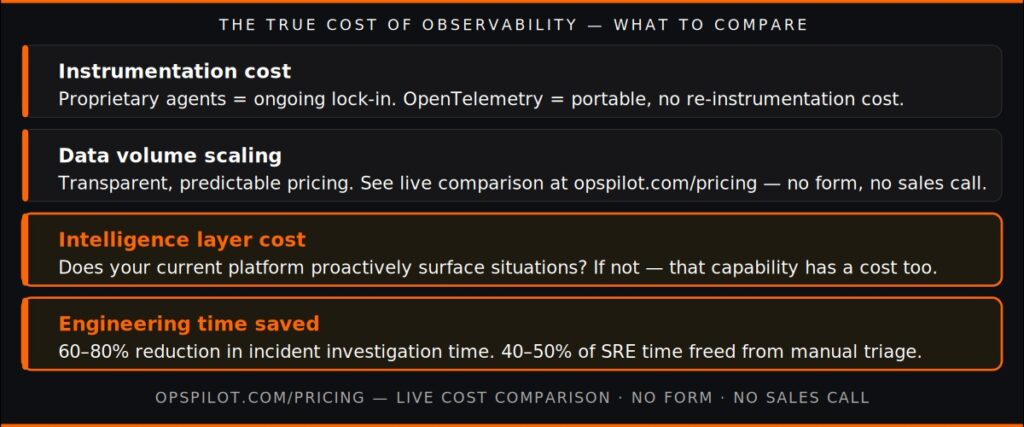
Comparing observability platform costs accurately requires looking at the total cost of the capability, not just the headline licence fee. Several factors affect the true cost of ownership:
Instrumentation cost. Datadog’s proprietary agent creates ongoing dependency on Datadog’s instrumentation format. Migration to a Datadog alternative requires either re-instrumentation or a compatibility layer. OpenTelemetry-native platforms eliminate this cost for teams that have already adopted OTEL instrumentation — the data flows to wherever you point the OTLP exporter.
Data volume scaling. Both Datadog and OpsPilot scale with data volume, but OpsPilot’s pricing model — based on metrics series retained, log and trace volume, and OpsPilot AI Token usage — is designed to be transparent and predictable. The pricing page at /pricing/ includes a live cost comparison calculator across Datadog, Grafana Cloud, New Relic, Splunk, Elastic, Honeycomb, Dash0, and SolarWinds. No form. No sales call.
Intelligence layer cost. If your current Datadog configuration does not include a continuous proactive intelligence layer — and for most teams it does not — the cost of adding that capability needs to be factored into the comparison. OpsPilot’s Coworker is the intelligence layer. Its cost is the incremental cost of moving from reactive to proactive operations.
Engineering time saved. As we documented in Telemetry Volume Goes Up Every Year, the cost of observability is not only the tool licence. Engineering time spent on manual investigation, alert triage, and dashboard review is a significant and often unaccounted cost. Teams that have added OpsPilot’s Coworker consistently report meaningful reductions in this cost — typically 60-80% reduction in incident investigation time.
What the Switch Actually Involves
For teams running Datadog who are evaluating OpsPilot, the practical path is:
Step 1: Evaluate alongside. Run OpsPilot alongside your existing Datadog setup for 30 days. Connect OpsPilot to your OTLP endpoint — if you are already exporting OTLP data alongside Datadog’s agent, this is a configuration change of minutes. Compare what Coworker surfaces proactively against what your Datadog setup catches reactively.
Step 2: Assess the intelligence gap. After 30 days, you have data. What situations did Coworker identify before alerts fired? What cloud cost savings did it surface? How did investigation time compare when Coworker’s correlation work was available versus manual investigation? This data makes the renewal conversation with your team and with leadership straightforward.
Step 3: Decide on instrumentation. If you are running Datadog agents and want to move fully to OpsPilot, migrating to OpenTelemetry instrumentation is the required step. This is a one-time cost that pays for itself in reduced vendor dependency regardless of which backend you choose. See the /opspilot-vs-datadog/ page for the specific migration path.
Step 4: Transition gradually. OpsPilot’s intelligence layer and your existing Datadog setup can run in parallel during the transition. There is no hard cutover requirement.
The full comparison — OpsPilot versus Datadog and other alternatives — is at /opspilot-vs-the-competition/.
When OpsPilot Is the Right Datadog Alternative
OpsPilot is the right Datadog alternative when:
Your primary pain point is cost and the intelligence gap. You are paying for data collection and visualization that your team could replicate with open-source tooling, and you want the budget you free up to go toward genuine AI SRE capability. OpsPilot is purpose-built for this transition.
You have already adopted or are moving to OpenTelemetry. OpsPilot is OpenTelemetry-native. The architectural alignment means no proprietary agents, no re-instrumentation, and no new vendor lock-in.
Your team is experiencing reactive operations fatigue. Your engineers are spending too much time on alert triage, manual investigation, and dashboard review — work that AI SRE handles automatically. As we covered in From Firefighting to Prevention, the shift to proactive operations is the change that frees that time.
You need a platform that learns your system. Coworker builds baselines from your specific telemetry and improves over time as it learns your service topology and failure patterns. The longer it operates, the more precisely it detects what matters for your specific system.
OpsPilot may not be the right Datadog alternative when you need deep APM capabilities with code-level profiling, or when your primary use case is business metrics and custom dashboarding rather than operational reliability.
The /datadog-alternative/ page summarises the comparison directly. The /pricing/ page gives you the cost picture with no form and no sales call required.
FAQ
Does switching to OpsPilot require replacing Datadog’s agent instrumentation? If you are running Datadog’s proprietary agent and want to move fully to OpsPilot, migrating to OpenTelemetry instrumentation is a prerequisite. If you are already exporting OTLP data alongside Datadog, you can connect OpsPilot immediately with no instrumentation change. Many teams run the evaluation phase this way — OpsPilot on the OTLP stream, Datadog on the proprietary agent — before committing to instrumentation migration.
Can OpsPilot fully replace Datadog? Yes — OpsPilot can replace Datadog entirely at 60–70% lower cost, or run alongside it as an additive AI SRE intelligence layer. For teams that want full replacement, OpsPilot handles collection via OTLP, visualization via built-in dashboards, and adds the continuous proactive AI SRE intelligence that Datadog does not provide. Teams that prefer to keep Grafana for dashboards typically pair it with OpsPilot’s Coworker for intelligence — both architectures work without disruption.
How does OpsPilot pricing compare to Datadog? The pricing page at /pricing/ includes a live cost comparison calculator. No form, no sales call. The comparison covers Datadog, Grafana Cloud, New Relic, Splunk, Elastic, Honeycomb, Dash0, and SolarWinds.
Is OpsPilot SOC 2 certified? Yes. OpsPilot is SOC 2 Type 2 accredited. Full documentation is at /soc-2-type-2-accreditation/.
Evaluating OpsPilot as a Datadog alternative? Start here.
Book a demo → calendly.com/fusionreactor-sales/opspilot-demo
Or see the numbers yourself: Pricing and cost comparison → opspilot.com/pricing/ — no form, no sales call
OpsPilot is the AI SRE teammate for teams using OpenTelemetry, Prometheus, Grafana, and existing observability stacks — helping engineers investigate incidents, find root cause, and move toward autonomous operations without replacing their tools. OpsPilot, formerly FusionReactor Cloud, is Intergral’s AI-powered observability and AI SRE platform.