
SRE Alert Fatigue 2026: AI Promises Autonomous Operations. So Why Are SRE Teams Still Drowning in Alerts?
SRE alert fatigue 2026 should not exist.
That is the uncomfortable truth at the center of this conversation. The observability industry has been promising AI-powered intelligence for years. Autonomous operations. Self-healing infrastructure. Alerts that understand context. And yet the engineers on call this weekend will wake to the same wall of notifications their predecessors did in 2022 — a mix of genuine signals, false positives, noisy thresholds, and duplicate notifications that require human triage to separate the urgent from the irrelevant.
SRE alert fatigue in 2026 persists not because the AI promises were dishonest, but because most of the tooling delivering those promises addresses the wrong part of the problem. It makes alerts smarter without making there be fewer of them. It summarizes the noise without removing it. It adds AI to the surface of a reactive system without changing the reactive architecture underneath.
This post is about why SRE alert fatigue persists, what it is actually costing site reliability engineering (SRE) teams, and what genuine AI SRE does that alert management tools do not.
Why SRE Alert Fatigue 2026 Hasn’t Gone Away
The standard account of SRE alert fatigue 2026 treats it as a configuration problem. Too many alerts, too low thresholds, insufficient tuning. The solution, on this account, is better alert hygiene — tighter thresholds, smarter grouping, noise reduction at the alerting layer.
Alert hygiene helps. It does not solve the problem.
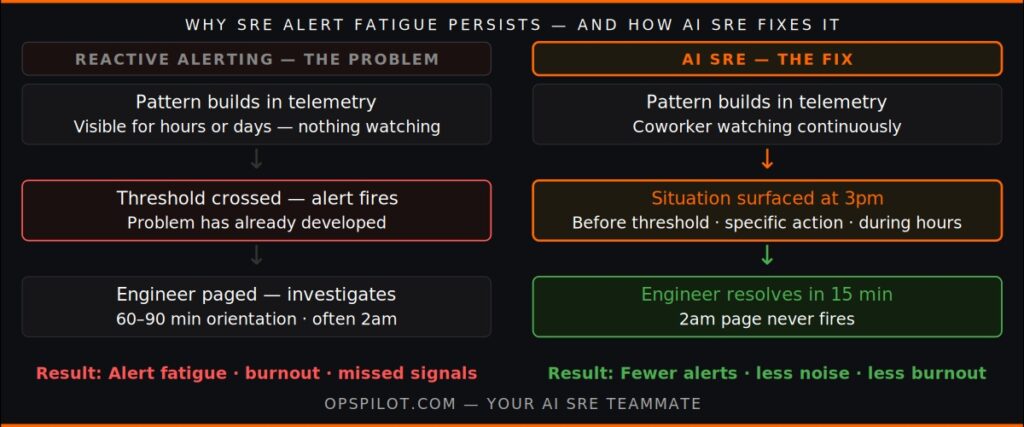
The deeper cause of SRE alert fatigue is architectural, not configurational. Threshold-based alerting is reactive by design. It fires when a condition has already been met — when the metric has already crossed the value that indicates a problem. For every alert that fires, the problem it represents was developing in the telemetry data for some time before the threshold was crossed. The alert is the system’s way of telling you that something has already happened.
In a reactive alerting architecture, the volume of alerts is determined by the volume of production events that cross configured thresholds. Tuning thresholds reduces false positives but cannot reduce the genuine signals. Adding AI summarization changes the format of the alerts but not their frequency. Routing improvements change where the noise lands, not how much of it there is.
SRE alert fatigue 2026 persists because most tooling is still working within the reactive architecture — making the alerts that fire more manageable, rather than preventing the conditions that cause them to fire in the first place.
As we covered in From Firefighting to Prevention, the shift from reactive to proactive operations is the architectural change that alert fatigue requires. It is not a configuration change. It is a different relationship between your team and your production system.
What SRE Alert Fatigue 2026 Actually Costs Your Team
The cost of SRE alert fatigue is usually discussed in terms of missed alerts — the genuine signal that was buried in noise and overlooked. This is real, but it is not the primary cost.
The primary cost is engineer attention. Every alert that fires, whether genuine or not, demands a triage decision. Is this real? Is it urgent? Does it require action now or can it wait? For a team receiving dozens of alerts per day across multiple services, this triage work is constant background noise against which all other engineering work happens.
The cognitive overhead of sustained alerting — the state of continuous partial attention that on-call engineers maintain — is well documented in software engineering research. It degrades decision quality, increases the likelihood of errors in unrelated work, and contributes directly to the burnout and turnover that makes SRE roles among the most difficult to fill and retain.
There is also the more direct cost: investigation time. As we documented in Why Does Root Cause Still Take 3 Hours?, the orientation phase of incident investigation — establishing what is affected, following the dependency chain, identifying the probable cause — accounts for the majority of mean time to resolution. Every alert that fires triggers this process. For alerts that turn out to be false positives or low-priority noise, this investigation time is pure waste.
A team responding to six significant alerts per month at an average of 90 minutes per investigation is consuming nine engineer-hours per month on investigation alone — before any remediation work begins. For alerts that were preventable with proactive pattern detection, this entire cost is avoidable.
Tired of waking up to alerts that should never have fired? Start your free trial at app.opspilot.com/sign-up — no credit card required.
What AI Promises That Most Tools Don’t Deliver
The AI features most commonly added to observability platforms in 2026 address alert fatigue at the surface level:
AI-generated alert summaries condense the metrics and logs related to an alert into a readable paragraph. This reduces the reading time for each alert but does not reduce the number of alerts. The investigation work — determining whether the alert is real, whether it is urgent, what caused it — still falls to the engineer.
Anomaly detection identifies when metrics deviate from expected ranges and generates additional alerts. In high-traffic systems with natural traffic variation, anomaly detection frequently adds to alert volume rather than reducing it. More signals, more triage.
Alert correlation and grouping combines multiple related alerts into a single notification. This is genuinely useful — it reduces the raw count of notifications. It does not prevent the underlying conditions from occurring.
Natural language querying allows engineers to investigate alerts using plain English rather than PromQL or log query syntax. This reduces investigation friction for engineers unfamiliar with the query language. It does not reduce the investigation requirement.
None of these capabilities addresses the root cause of SRE alert fatigue, which is the reactive architecture — the fact that alerts fire after conditions have already developed, requiring triage and investigation that a proactive system would have prevented.
What AI SRE Does Instead
OpsPilot’s Coworker approaches the alert fatigue problem from the other direction — not by making alert management more efficient, but by preventing the conditions that cause alerts to fire.
Coworker runs three continuous background loops against your OpenTelemetry telemetry:
Investigating new signals. When an alert fires, or a scheduled task runs, Coworker investigates immediately — pulling the relevant metrics, logs, and traces, writing up what it finds as insights, and grouping them into a situation. The engineer who picks up the alert arrives with the investigation already complete. The 90-minute orientation phase becomes a 10-minute review and decision.
Pattern detection before threshold crossing. More importantly, Coworker watches for the patterns that precede alerts — not the alerts themselves. Connection pool saturation trending upward. Memory growth on a trajectory toward OOM restart. Slow query emergence under load. These patterns are visible in your OTLP data before the threshold is crossed. Coworker surfaces them as situations — specific, actionable findings with recommended resolutions — during business hours, before the 2am page fires.
Continuous situation management. Coworker continuously reviews open situations, merging related findings, escalating severity when new signals warrant it, and resolving situations when the data shows the problem has cleared. The engineer’s feed shows the current state of operational reality, not a historical record of every alert that has fired.
The result is a different character of on-call experience. Rather than waking to a wall of undifferentiated alerts requiring triage, the on-call engineer sees a prioritized feed of situations — Coworker’s editorial judgment about what matters, what is being watched, and what has resolved. The critical situations requiring immediate action are clearly separated from the watching situations being monitored and the resolved ones that have cleared.
For more on how Coworker’s situations and insights model works in practice, see Meet Coworker.
The On-Call Experience With and Without AI SRE
The contrast is clearest at the moment of an on-call handoff.
Without AI SRE: The incoming on-call engineer receives a summary of alerts from the past 24 hours. They scan through the list, identify which are resolved, which are ongoing, and which are new. This orientation takes 20-30 minutes on a quiet day and longer after a noisy period. The context for each alert — why it fired, what was investigated, what was found — is either documented in a ticket or lives in the outgoing engineer’s memory.
With AI SRE: The incoming on-call engineer opens their Coworker feed. They see the current situation list: two active situations requiring attention, one watching situation being monitored, four resolved since yesterday. Each situation includes Coworker’s investigation notes — what it found when it looked, what evidence it considered, what it recommends. The handoff takes five minutes. The context is complete.
This is the on-call experience that AI SRE enables. Not an absence of alerts, but a fundamentally different relationship with them — one where the AI has already done the triage, the investigation, and the prioritization, and the engineer’s job is judgment and decision rather than orientation and correlation.
As we covered in What an AI SRE Teammate Actually Does, this shift is not theoretical. It is the consistent experience reported by teams that have moved from reactive alerting to proactive AI SRE operations.
Three Questions To Ask About Your Current Alert Setup
If SRE alert fatigue is a current problem for your team, three questions identify where the architecture is failing:
What percentage of alerts require no action? If more than 20-30% of alerts resolve without engineer intervention — either because they clear themselves or because investigation reveals they were false positives — your alerting architecture is generating noise that your engineers are absorbing. This is the clearest signal that threshold tuning alone will not solve the problem.
How much investigation time per alert? If the average time from alert to root cause is more than 30 minutes, the orientation phase is consuming disproportionate engineer time. This is the gap that AI incident investigation closes — not by removing the need for human judgment, but by completing the analytical work before the engineer engages.
What proportion of incidents were preceded by visible patterns? If you trace the telemetry data before your last ten significant incidents, what percentage show clear precursor patterns — trends, growth curves, dependency degradation — that were visible before the alert fired? For most teams this proportion is high. It represents the preventable fraction of your alert volume. It is the fraction that proactive AI SRE addresses directly.
For a deeper look at the intelligence layer that addresses these gaps, see the AI SRE capability page and the proactive AI page.
FAQ
Is alert fatigue inevitable in complex production systems? Alert fatigue is not inevitable — it is the natural consequence of reactive alerting architecture. Teams that have added an AI SRE proactive intelligence layer consistently report meaningful reductions in alert volume and investigation time. The alerts that remain are predominantly genuine signals requiring engineer judgment, rather than noise requiring triage.
Does reducing alert volume risk missing genuine signals? This is the right concern, and it is addressed by the distinction between proactive detection and alert suppression. Coworker does not suppress alerts — it detects the patterns that precede them and surfaces situations before alerts fire. The alert volume reduction comes from prevention, not from hiding signals.
How quickly does SRE alert fatigue improve after adding AI SRE? Most teams report a noticeable improvement in on-call experience within the first two weeks, as Coworker’s proactive pattern detection begins catching pre-incident situations. Meaningful reduction in incident frequency — the metric that reflects genuine alert volume reduction — typically becomes measurable within the first month as baselines mature and pattern detection sharpens.
Can Coworker work alongside our existing PagerDuty or alerting setup? Yes. Coworker connects to your OTLP endpoint and operates independently of your alerting routing. Your existing PagerDuty setup, alert rules, and escalation policies continue to operate exactly as before. Coworker adds the proactive layer above them — surfacing situations before alerts fire, and providing investigation context when they do.
Stop triaging noise. Start preventing the incidents that cause it.
OpsPilot is the AI SRE teammate for teams using OpenTelemetry, Prometheus, Grafana, and existing observability stacks — helping engineers investigate incidents, find root cause, and move toward autonomous operations without replacing their tools. OpsPilot, formerly FusionReactor Cloud, is Intergral’s AI-powered observability and AI SRE platform.